A Ham-Adjacent Portable Radio Repeater

Although ham radio offers a wide array of bands to transmit on, not to mention plenty of modes to communicate with, not everyone wants or needs to use all of this capability. For those needing simple two-way communication services like FRS or GMRS are available (in North America) with much less stringent licensing requirements, and GMRS even allows repeaters to be used to extend their range beyond the typical mile or so. [Dave] aka [N8DAV] has built an off-grid simplex repeater that can travel around with him wherever he goes.

The repeater itself is based on a pre-built simplex repeater module, which means that it has to record an incoming signal and then play it back on the same frequency. Compared to a split frequency repeater which uses different frequencies for transmit and receive this can be a bit cumbersome but simplifies the design and the use. A Baofeng UV-5R is used to perform the actual radio duties paired to a 40 watt amplifier to extend the range as much as possible. It’s all packed into a Pelican-like case and set up with a large battery that could power it for a number of days, making it useful for camping, rescue, or other off-grid activities.

For those wondering why [Dave] is using his ham call sign instead of his GMRS one, all of the equipment in this build will work in either the UHF ham bands or the channels reserved for GMRS with minor adjustments, so it’s perfectly possible to use the setup for one’s preferred license. And, for those in other parts of the world without GMRS there’s a similar class of radio called UHF CB which might be able to support similar builds, but be sure to check your local jurisdiction’s laws before hooking something like this up. For an even longer-range radio repeater using similar equipment we’d recommend looking to the skies.

Continue reading “A Ham-Adjacent Portable Radio Repeater”

Solar-Powered RC Boat Has Unlimited Range

For RC aircraft there are generally legal restrictions that require the craft to stay within line of sight of the operator, but an RC boat or car can in theory go as far as the signal will allow — provided there is ample telemetry to let the operator navigate. [Thingify] took this idea to the extreme with a remote-controlled boat that connects to a satellite internet service and adds solar panels for theoretically unlimited range, in more ways than one.

The platform for this boat is a small catamaran, originally outfitted with an electric powertrain running on a battery. Using a satellite internet connection not only allows [Thingify] to receive telemetry and pilot the craft with effectively unlimited range, but it’s a good enough signal to receive live video from one of a pair of cameras as well. At that point, the main limiting factor of the boat was the battery, so he added a pair of flexible panels on a custom aluminum frame paired with a maximum power point tracking charge controller to make sure the battery is topped off. He also configured it to use as much power as the panels bring in, keeping the battery fully charged and ready for nightfall where the boat will only maintain its position and wait for the sun to rise the next morning.

With this setup [Thingify] hopes to eventually circumnavigate Lake Alexandrina in Australia. Although he has a few boat design issues to work out first; on its maiden voyage the boat capsized due to its high center of gravity and sail-like solar panels. Still, it’s an improvement from the earlier version of the craft we saw at the beginning of the year, and we look forward to his next iteration and the successful voyage around this lake.

Continue reading “Solar-Powered RC Boat Has Unlimited Range”

Restoring A Vintage Computer And Its Plotter

Repairing vintage computers is bread-and-butter for many of us around here. The machines themselves tend to be fairly fixable, assuming spare parts are available and there hasn’t been too much physical damage. Peripherals can be another matter, though. Since they interface with the real world they can have more esoteric problems that aren’t always solvable. [joekutz] was handed just such a device in the form of a CE-150 docking station for a Sharp PC1500 Pocket Computer, which has a plotter built in. Here’s his “tip” for getting plotters like these working again.

The first step here is to disassemble the original, dried out pens to scavenge a few of the parts. The outer case needs to be kept so that it can be put back into the plotter, and a small O-ring is saved as well. To replace the dried-out tips [joekutz] discards the original tips and replaces them with tips from a common ink pen, using shrink wrap tubing to help fit the pen’s tip into the original plotter cylinder. He also takes the ink from the pen to fill the plotter’s cartridge, completing the surgery on the multi-colored plotter and bringing it back to life.

Of course this build goes well beyond the plotter, including bringing the PC1500 back to life as well. There are a few other videos about this project covering that original restoration as well as demonstrating some of the quirks of how this computer is meant to be programmed. But we mostly focused on the plotter here since that is a little bit out of the ordinary, and we’re also sure that refilling ink cartridges of any sort gets under the skin of everyone at HP.

Continue reading “Restoring A Vintage Computer And Its Plotter”

Computer Has One Instruction, Many Transistors

There’s always some debate around what style of architecture is best for certain computing applications, with some on the RISC side citing performance per watt and some on the CISC side citing performance per line of code. But when looking at instruction sets it’s actually possible to eliminate every instruction except one and still have a working, Turing-complete computer. This instruction is called subleq or “subtract and branch if less-than or equal to zero“. [Michael] has built a computer that does this out of discrete components from scratch.

We’ll save a lot of the details of the computer science for [Michael] or others to explain, but at its core this is a computer running with a 1 kHz clock with around 700 transistors total. Since the goal of a single-instruction computer like this is simplicity, the tradeoff is that many more instructions need to be executed for equivalent operations. For this computer it takes six clock cycles to execute one instruction, for a total of about 170 instructions per second. [Michael] also created an assembler for this computer, so with an LCD screen connected and mapped to memory he can write and execute a simple “hello world” program just like any other computer.

[Michael] does note that since he was building this from Logisim directly he doesn’t have a circuit schematic, but due to some intermittent wiring issues might have something in the future if he decides to make PCBs for this instead of using wire on a cardboard substrate. There’s plenty of other information on his GitHub page though. It’s a unique project that gets to the core of what’s truly needed for a working computer. There are a few programming languages out there that are built on a similar idea.

Continue reading “Computer Has One Instruction, Many Transistors”

A Breadboard Computer In Three Chips

Building a computer on a breadboard is a seminal project for many builders, but it can become complicated quite quickly, not to mention that all the parts needed for a computer are being placed on a medium which often lends itself to loose wires and other hardware bugs. [3DSage] has a working breadboard computer that is as simple as it can possibly be, putting it together piece by piece to show exactly what’s needed to get a computer which can count, access memory, and even perform basic mathematical operations.

The first step for any computer is to build a clock, and in this case it’s being provided by a 555 timer which is configured to provide an adjustable time standard and which steps through the clock pulses when a button is pressed. The next piece is a four-bit counter and a memory chip, which lets the computer read and write data. A set of DIP switches allows a user to write data to memory, and by using the last three bits of the data as opcodes, the computer can reset, halt, and jump to various points in a simple program.

Although these three chips make it possible to perform basic programming, [3DSage] takes this a bit further in his video by demonstrating some other simple programs, such as one which can play music or behave as an alarm clock. He also shows how to use a fourth chip in the form of a binary adder to perform some basic math, and then packages it all into a retro-styled computer kit. Of course you can take these principles and build them out as far as they will go, like this full 8-bit computer built on a breadboard or even this breadboard computer that hosts a 486.

Continue reading “A Breadboard Computer In Three Chips”

6502 Puts On An SDR Hat

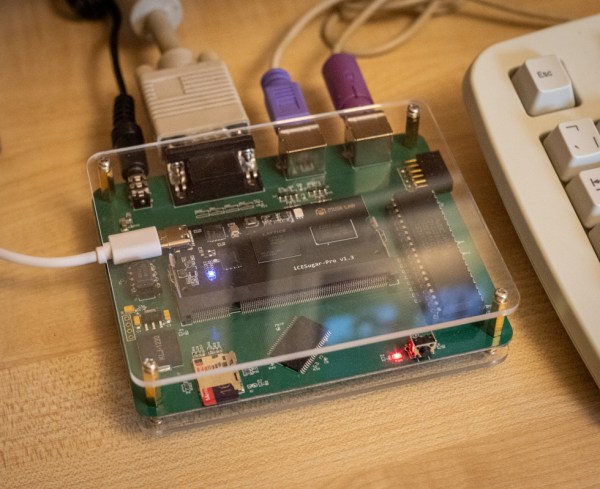
The legendary 6502 microprocessor recently turned 50 years old, and to celebrate this venerable chip which brought affordable computing and video gaming to the masses [AndersBNielsen] decided to put one to work doing something well outside its comfort zone. Called the PhaseLoom, this project uses a few other components to bring the world of software-defined radio (SDR) to this antique platform.

The PhaseLoom is built around an Si5351 clock generator chip, which is configurable over I2C. This chip is what creates the phase-locked loop (PLL) for the radio. The rest of the components, including antenna connectors and various filters, are in an Arduino-compatible form factor that let it work as a shield or hat for the 65uino platform, an Arduino-form-factor 6502 board. The current version [Anders] has been working on is dialed in to the 40-meter ham band, with some buttons on the PCB that allow the user to tune around within that band. He reports that it’s a little bit rough around the edges and somewhat noisy, but the fact that the 6502 is working as an SDR at all is impressive on its own.

For those looking to build their own, all of the schematics and code are available on the project’s GitHub page. [Anders] has some future improvements in the pipe for this project as well, noting that with slightly better filters and improved software even more SDR goodness can be squeezed out of this microprocessor. If you’re looking to experiment with SDR using something a little bit more modern, though, this 10-band multi-mode SDR based on the Teensy microcontroller gets a lot done without breaking the bank.


Multi-Use Roof Eliminates Roof

One of the biggest downsides of installing solar panels on a rooftop is that maintenance of the actual roof structure becomes much more difficult with solar panels in the way. But for many people who don’t have huge tracts of land, a roof is wasted space where something useful could otherwise go. [Mihai] had the idea of simply eliminating traditional roofing materials altogether and made half of this roof out of solar panels directly, with the other half being put to use as a garden.

Normally solar panels are installed on top of a roof, whether it’s metal or asphalt shingles or some other material, allowing the roof to perform its normal job of keeping weather out of the house while the solar panels can focus on energy generation. In this roof [Mihai] skips this step, having the solar panels pull double duty as roof material and energy generation. In a way this simplifies things; there’s less to maintain and presumably any problems with the roof can be solved by swapping out panels. But we would also presume that waterproofing it might be marginally more difficult.

On the antisolar side of the roof, however, [Mihai] foregoes the solar panels in favor of a system that can hold soil for small garden plants. Putting solar panels on this side of the roof wouldn’t generate as much energy but the area can still be useful as a garden. Of course we’d advise caution when working on a garden at height, but at least for the solar panels you can save some trips up a ladder for maintenance by using something like this robotic solar panel scrubber.

Continue reading “Multi-Use Roof Eliminates Roof”