Hackaday Prize And UCPLA Are Driving Assistive Technology Forward

Take a second to imagine all the people in your life. Your family, friends, coworkers. Your buddies down at the hackerspace, and anyone you chat with on IO and over the airwaves. Statistically speaking, one in four of these people has a disability of some kind, and needs help doing everyday things that you might not think twice about — simple things like opening doors or interacting with computers. Or maybe that one in four is you.

For the past 75 years, United Cerebral Palsy of LA (UCPLA) have been helping people with various developmental and intellectual disabilities to live independently with dignity. They work directly with members of the disabled community to develop assistive technology that is both affordable and dependable. UCPLA helps the disabled community with everything from employment to providing a creative outlet, and gives them the tools to do these things and more. Their mission is to help people be as independent as possible so they can feel good about themselves and enjoy a life without limits.

The people behind this non-profit are all about inclusion, access, and opportunity, and this is why we are proud to partner with UCPLA for the 2020 Hackaday Prize. With the world in upheaval, there is no better time to build a better future for everyone. You never know when you might need assistive technology. In addition to the open challenge that calls for everyone to work on a design, this year there is also a Dream Team challenge which offers a $3,000 per month stipend over the next two months to work on a team addressing one specific challenge. Apply for that asap!

What kind of challenges has UCPLA outlined for the Hackaday Prize? Let’s dive in and find out, and we’ll also hear from the UCPLA team in a Q&A video at the end of the article.

Continue reading “Hackaday Prize And UCPLA Are Driving Assistive Technology Forward”

Remotely Navigate The Apocalypse In Mid-Century Style

One of the few positives to come of this pandemic is that the restrictive nature of scarcity can be a boon to creativity. Plus, the doom and gloom of it all is causing people to loosen up and do things they never felt free enough to do before in the demanding world of the before times.

For example, [ossum] makes R/C vehicles on commission to exacting standards, but took a break from perfection to build this remote control hellscape-faring van by the seat of his pants. It’s quite a resourceful build that combines pieces from previous projects with a few standard R/C parts and a handful of clever hacks.

The body is a test print of a 1957 Chevy Suburban van that [ossum] made for someone a few years back. It’s mounted on a scrap metal chassis and moves on printed tank treads designed for a different vehicle.

Since glass is a liability in an apocalypse (and because [ossum] doesn’t have a resin printer yet), the windows have fortified coverings that are printed, patina’d, and detailed with tiny rivet heads.

As far as hacks go, our favorite has to be the clothespin steering. [ossum] only had one electronic speed controller, so he used a servo to actuate a pair of spring-loaded clips, alternating between the two to move the tank-van. There’s a short video after the break that shows the rack and clothes-pinion steering, and it’s loaded up right after a brief demo of the van.

We realize that everyone’s apocalyptic needs are different, but there’s more than enough here to get you started. Don’t have access to enough R/C parts? Gear boxes and drive shafts can be printed, too.

Continue reading “Remotely Navigate The Apocalypse In Mid-Century Style”

Inputs Of Interest: ErgoDox Post-Mortem

In the last installment, I told you I was building an open-source, split, ortholinear keyboard called the ErgoDox. I’m doing this because although I totally love my Kinesis Advantage, it has made me want to crack my knuckles and explore the world of split keyboards. Apparently there are several of you who want to do the same, as evidenced by your interest in the I’m Building an ErgoDox! project on IO. Thank you!

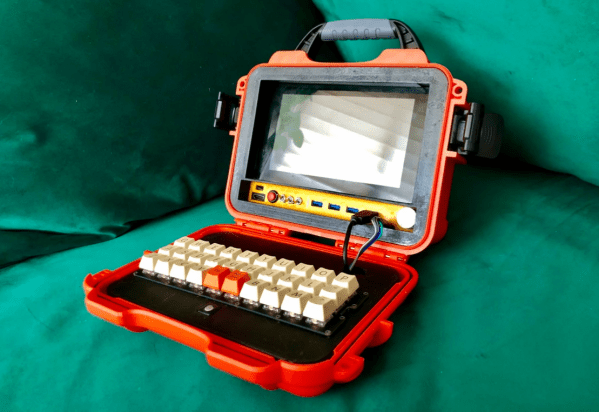
Well boys and girls, the dust has settled, the soldering iron has cooled, and the keycaps are in place. The ErgoDox is built and working. Now that it’s all said and done, let me tell you how it went. Spoiler alert: not great. But I got through it, and it keyboards just like it’s supposed to. I’m gonna lay this journey out as it happened, step by step, so you can live vicariously through my experience.

Continue reading “Inputs Of Interest: ErgoDox Post-Mortem”

Cast Metal From Prints To Solidify Childhood Memories

As far as the hacker’s toolbox goes, the 3D printer is way up there in terms of utility. Sure, it takes time to learn the ins and outs of designing, slicing, and extruding, but after that, the world is pretty much your additive oyster. Follow those design dreams, or use it to replace the things that break. The icing on the cake? You can chase those dreams into other materials, because 3D prints can be used to cast metal.

[RetroTech Journal] wanted to fry up some rosette cookies, a Scandinavian delight from his youth that look a lot like fancy, personal funnel cakes. They’re made with special aluminium irons that shape the dough while it fries, as opposed to the jumbled chaos that is funnel cake.

Rosette irons come in a few traditional shapes, but once you get tired of those, it’s up to you to cast them in aluminium. And how would you go about doing that? By creating a firmly-packed sand mold using a mounted 3D print.

In the endlessly entertaining video after the break, [RetroTech Journal] takes you through the entire process from CAD to cookies. It has everything you could possibly want: LEGO stop-motion, claymation, a little bit of cooking, and a whole lot of knowledge. We can’t wait to see what comes next.

We’ve seen quite a few sand casting projects over the years, but this lathe is among the most useful.

Continue reading “Cast Metal From Prints To Solidify Childhood Memories”

Tarot Machine Flips Through Fate’s Rolodex

Were tarot card readers deemed non-essential in your part of the world (and do you think they saw it coming?) More than ever, we all need diversions that are for entertainment purposes only. And what better basis for entertainment than a mystical fortune-telling robot that can read your tarot cards?

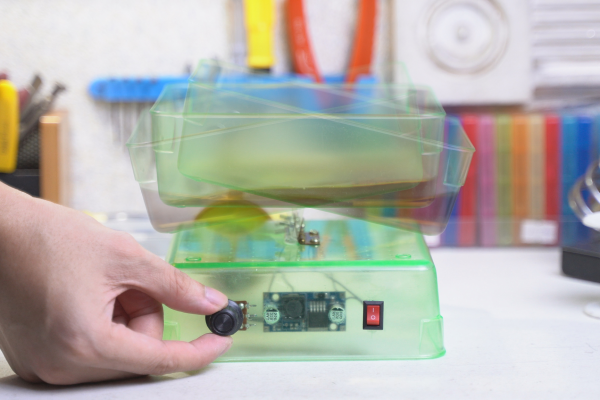
This fantastic-looking ‘bot stands on the shoulders of [Scott Bezak]’s trailblazing method for easy DIY split-flap displays. Push the rather inviting-looking button on the top, and the flaps start flipping around to find your fortune. Once the fates have aligned, a thermal printer on the front spits out an image of your card along with an interpretation.

It’s obvious that [i_mozy] put quite a lot of effort into this slick machine, and we think the stickers look especially great. All the details of physical tarot card readings are accounted for, including a random number to decide the card’s position, and LEDs to represent the card’s element. Suspend your disbelief and check out the demo/promo video after the break.

Split-flap displays are a great choice no matter what you want to show. We’ve seen them used to display everything from the weather to the current Spotify track.

Continue reading “Tarot Machine Flips Through Fate’s Rolodex”

Bluetooth Takes Keyboard From DIY To Super Fly

They say you should never cheap out on anything that comes between you and the ground, like tires, shoes, and mattresses. We would take that a little further into the 21st century and extend it to anything between you and work. In our case, ‘buy nice or buy twice’ includes keyboards and mice.

[Marcus Young] is a fan of ortholinear ergonomic comfort, but not of cables. He gave [adereth]’s dactyl keyboard some wings by using a Bluetooth micro, and the Pterodactyl was born. Of course, the two halves still use a TRRS cable to communicate, and wires are required to charge batteries, but it’s the principle of the thing.

That’s not all [Marcus] did to make the dactyl his own — it also has a modified full-fat base that gives him all the room in the world to wire up the keyswitch matrix compared to the original streamlined design.

Instead of the usual Teensy, Pro Micro, or Proton-C, the pterodactyl has a Feather 32u4 in its belly. [Marcus] is clacking on Holy Panda switches which we’ve been meaning to try, and individual PCBs for each switch, which seems like it might negate gluing the switches in place so they survive through keycap changes. Check out [Marcus]’ write-up to see what he learned during this build.

This isn’t the first modified dactyl we’ve seen flying around here, and it won’t be the last. Here’s one with a dual personality — both halves can work together or alone.

Via r/mk

Aluminium Pucks Fuel Hydrogen Trucks

In the race toward a future free from fossil fuels, hydrogen is rapidly gaining ground. On paper, hydrogen sounds fantastic — it’s clean-burning with zero emissions, the refuel time is much faster than electric, and hydrogen-fueled vehicles can go longer distances between refuels than their outlet-dependent brethren.

The reality is that hydrogen vehicles usually need fuel cells to convert hydrogen and oxygen into electricity. They also need pressurized tanks to store the gases and pumps for refueling, all of which adds weight, takes up space, and increases the explosive potential of the system.

Kurt Koehler has a better idea: make the hydrogen on demand, in the vehicle, using a solid catalyst and a simple chemical reaction. Koehler is the founder of Indiana-based startup AlGalCo — Aluminium Gallium Company. After fourteen years of R&D and five iterations of his system, the idea is really starting to float. Beginning this summer, these pucks are going to power a few trucks in a town just outside of Indianapolis.

Continue reading “Aluminium Pucks Fuel Hydrogen Trucks”