Finishing Your Projects Hack Chat With Zack Freedman

Join us on Wednesday, February 10 at noon Pacific for the Finishing Your Projects Hack Chat with Zack Freedman!

Try as we might, some of us are much better at starting projects than finishing them. Our benches — or all too often, our notebooks — are graveyards of good attempts, littered with the scraps of ideas that really sounded good at the time and clouded by a miasma of good intentions and protestations that “This time, it’ll be different.” Spoiler alert: no, it won’t.

Trying to pin the cause of this painfully common problem on something specific is probably a fool’s errand, especially when given the fact that some people mysteriously don’t suffer from it, it would appear brain chemistry plays a role. Maybe some people just really like the dopamine hit of starting something new, which gives them the rush of excitement while the idea is still fresh, only to have it wane rapidly as the project enters the churn.

Whatever it is, if you suffer from it, chances are good you’ve looked for a way out at least once. If so, you’ll want to hop into this Hack Chat, where “very serious hacker” Zack Freedman, proprietor of the Voidstar Labs channel on YouTube, will share his thoughts on project follow-through. We’ve enjoyed Zack’s projects for a while now, and covered a few, from his in-your-face (on-your-wrist?) smartwatch to his video editing keypad. He gets stuff done, perhaps in part due to his workshop organization, but however he does it, we’re eager to hear about it. Join us as we discuss the art of follow-through and getting stuff done.

join-hack-chatOur Hack Chats are live community events in the Hackaday.io Hack Chat group messaging. This week we’ll be sitting down on Wednesday, February 10 at 12:00 PM Pacific time. If time zones have you tied up, we have a handy time zone converter.

Click that speech bubble to the right, and you’ll be taken directly to the Hack Chat group on Hackaday.io. You don’t have to wait until Wednesday; join whenever you want and you can see what the community is talking about.

Continue reading “Finishing Your Projects Hack Chat With Zack Freedman”

This Classy But Chaotic Gear Clock Keeps You Guessing

There are a lot of ways to tell time, but pretty much all of them involve some sort of sequential scale — the hands sweeping across the face of an analog clock comes to mind, as does the incremental changes of a digital clock. Clocks are predictable by their very nature, and therefore somewhat boring.

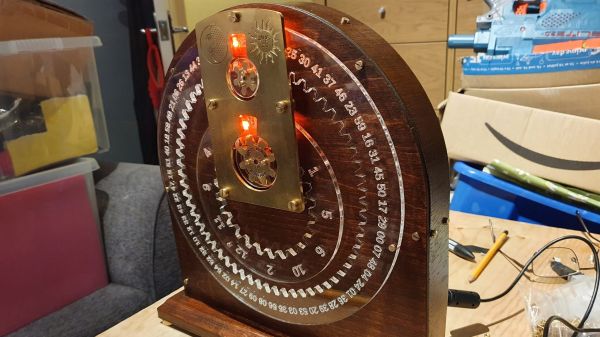
This nonsequential gear clock aims to break that predictability and make for a timepiece that’s just a little bit different. It’s the work of [Tony Goacher], who clearly put a lot of work into it and pulled out nearly every tool in the shop while doing it. He started with a laser-cut plywood prototype to get the basics worked out — a pair of nested rings with internal gear teeth, each hanging on a stepper-driven pinion. The inner ring represents hours and the outer minutes, with the numbers on each randomly distributed — more or less, since no two sequential numbers are positioned more than five seconds of rotation apart.

The finished version of the clock is rendered in brass, acrylic, hardwood, and a smattering of aluminum, with a case reminiscent of the cathedral radios of yore. There are some really nice touches, like custom-made brass screws, a CNC-engraved brass faceplate with traditional clock art, and a Latin inscription on the drive cog for the hours ring that translates roughly to “Time rules all.” When we looked that up we found that “tempus rerum imperator” is the motto of the Worshipful Company of Clockmakers, the very existence of which we find pleasing in the extreme.

The clock runs through its initialization routine in the brief video below. We’re not sure we’d want this on our nightstand, but it’s certainly a unique and enjoyable way to show the passage of time. It sort of reminds us of this three-ringed perpetual calendar, but just a bit more stochastic.

Continue reading “This Classy But Chaotic Gear Clock Keeps You Guessing”

Hackaday Links Column Banner

Hackaday Links: February 7, 2021

What’s that they say about death and taxes? Apparently that maxim doesn’t apply to Flash, at least when it comes to the taxman. As we noted last week, the end of the Adobe Flash era took with it a scheduling and routing app for the railway system in a Chinese city. This time around, it’s the unfortunately acronymed SARS, for South African Revenue Services, having Flash woes. They still have several online tax forms that haven’t been migrated to HTML5, so to keep the revenue flowing they built their own Flash-enabled browser. Taxpayers are free to download and use the browser while SARS works on getting the rest of their forms migrated. It sort of reminds us of those plans the Internal Revenue Service has to ensure tax collection continues after a nuclear apocalypse — death and taxes indeed.

Trouble for Nintendo in the EU? It looks that way, as consumer groups have made the case to EU regulators that Nintendo’s wildly popular Switch consoles are showing unacceptably premature obsolescence with the notorious “Joy-Con drift” issue. The problem, which manifests as players being unable to control a game due to constant movement despite no inputs on the joystick-like controller, requires a repair, one that Nintendo initially only did for free as warranty service for consoles less than a year old. For consoles out of the warranty period, Nintendo was charging €45, which is approximately the same as what a new controller would cost. This didn’t sit well with regulators, and now they’re breathing down Nintendo’s neck. They now offer free repairs for up to two years, but they’re still under the EU microscope. The interesting bit in the linked document is the technical reason for the problem, which is attributed to premature PCB wear — possibly meaning the traces wear away — and inadequate sealing of the Joy-Con mechanism against dust intrusion.

Last year looked as though it was going to be an exciting one with respect to some of our nearest solar and galactic neighbors. For a while there, it looked like the red giant Betelgeuse was going to go supernova, which would have been interesting to watch. And closer to home, there were some signs of life, in the form of phosphine gas, detected in the roiling atmosphere of our sister planet, Venus. Alas, both stories appear not to have panned out. The much-hoped-for (by me) Betelgeuse explosion, which was potentially heralded by a strange off-cycle dimming of the variable star, seems now to be due to its upper atmosphere cooling by several hundred degrees. As for Venus, the phosphine gas that was detected appears actually to have been a false positive triggered by sulfur dioxide. Disappointing results perhaps, but that’s how science is supposed to work.

Amateur radio often gets a bad rap, derided as a hobby for rich old dudes who just like to talk about their medical problems. Some of that is deserved, no doubt, but there’s still a lot of room in the hobby for those interested in advancing the state of the art in radio communications. In this vein, we were pleased to learn about HamSCI, which is short for Ham Radio Science Citizen Investigation. The group takes to heart one of the stated primary missions of amateur radio as the “ontinuation and extension of the amateur’s proven ability to contribute to the advancement of the radio art.” To that end, they’ll be holding HamSCI Workshop 2021, a virtual conference that will be focused on midlatitude ionospheric science. This appears to be a real science conference where both credentialed scientists and amateurs can share ideas. They’ve got a Call for Proposals now, with abstracts due by February 15. The conference itself will be on March 19 and 20, with free admission. The list of invited speakers looks pretty impressive, so if you have any interest in the field, check it out.

And finally, we got a tip this week about a collection of goofy US patents. Everything listed, from the extreme combover to baby bum-print art, is supposedly covered by a patent. We didn’t bother checking Google Patents, but some of these are pretty good for a laugh. We did look at a few, though, and were surprised to learn that the Gerbil Shirt is not a garment for rodents, but a rodent-filled garment for humans.


Simple Sensor Makes Filament Measurements A Snap

Just how tight are the manufacturing tolerances of modern FDM printer filament. Inquiring minds want to know, and when such minds are attached to handy fellows like [Thomas Sanladerer], you end up with something like this home-brew filament measurement rig to gather the data you seek.

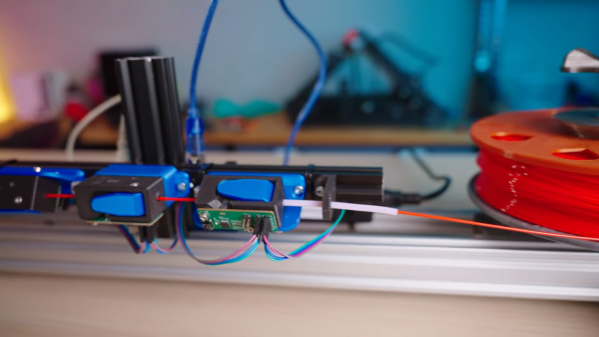
The heart of this build is not, as one might assume, some exotic laser device to measure the diameter of filament optically. Those exist, but they are expensive bits of kit that are best left to the manufacturers, who use them on their production lines to make sure filament meets their specs. Rather, [Thomas] used a very clever homemade device, which relies on a Hall effect sensor and a magnet on a lever to do the job. The lever is attached to a roller bearing that rides on the filament as it spools through the sensor; variations in diameter are amplified by the lever arm, which wiggles a magnet over the Hall sensor, resulting in a signal proportional to filament diameter.

The full test rig has a motor-driven feed and takeup spools, and three sensors measuring across the filament in three different spots around the radius; the measurements are averaged together to account for any small-scale irregularities. [Thomas] ran several different spools representing different manufacturers and materials through the machine; we won’t spoil the results in the video below, but suffice it to say you probably have little to worry about if you buy from a reputable vendor.

When we see a filament sensor, it’s generally more of the “there/not there” variety to prevent a printer from blindly carrying on once the reel is spent. We’ve seen a few of those before, but this is a neat twist on that concept.

Continue reading “Simple Sensor Makes Filament Measurements A Snap”

Proto-TV Tech Lies Behind This POV Clock

If it weren’t for persistence of vision, that quirk of biochemically mediated vision, life would be pretty boring. No movies, no TV — nothing but reality, the beauty of nature, and live performances to keep us entertained. Sounds dreadful.

We jest, of course, but POV is behind many cool hacks, one of which is [Joe]’s neat Nipkow disk clock. If you think you’ve never heard of such a thing, you’re probably wrong; Nipkow disks, named after their 19th-century inventor Paul Gottlieb Nipkow, were the central idea behind the earliest attempts at mechanically scanned television. Nipkow disks have a series of evenly spaced, spirally arranged holes that appear to scan across a fixed area when rotated. When placed between a lens and a photosensor, a rudimentary TV camera can be made.

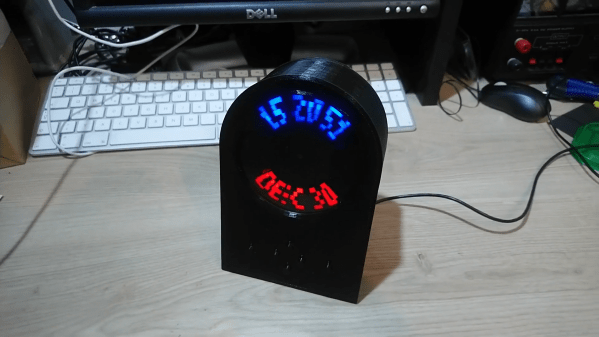
For his Nipkow clock, though, [Joe] turned the idea around and placed a light source behind the rotating disk. Controlling when and what color the LEDs in the array are illuminated relative to the position of the disk determines which pixels are illuminated. [Joe]’s clock uses two LED arrays to double the size of the display area, and a disk with rectangular apertures. The resulting pixels are somewhat keystone-shaped, but it doesn’t really distract from the look of the display. The video below shows the build process and the finished clock in action.

The key to getting the look right in a display like this is the code, and [Joe] put in a considerable effort for his software. If only the early mechanical TV tinkerers had had such help. [Jenny List] did a nice write-up on the early TV pioneers and their Nipkow disk cameras; we’ve also seen other Nipkow displays before, but [Joe]’s clock takes the concept to another level.

Continue reading “Proto-TV Tech Lies Behind This POV Clock”

Reverse-Engineering An Elevator Control Panel Results In Clicky Goodness

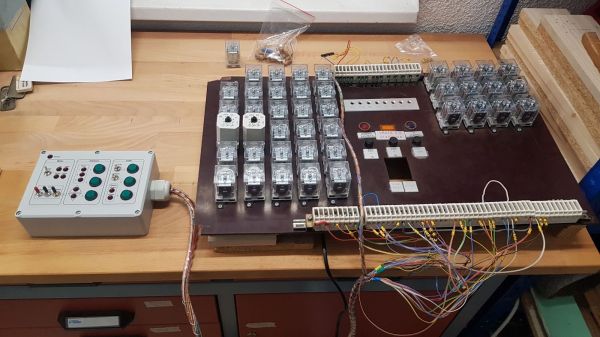
We have to admit that in the hardware hacking universe, there aren’t generally too many chances to hack elevators. Well, at least not opportunities that don’t also include the risk of incarceration. But fortune favors the bold, and when he found the remains of an elevator control panel in an abandoned Croatian resort hotel, [Davor Cihlar] undertook an extensive and instructive reverse-engineering of the panel.

The video below highlights his efforts, which were considerable given the age and state of the panel. This is a relay-only control panel, after all, with most of the relays missing and a rat’s nest of wires connecting the sockets. So [Davor] put his “RevIng” concept to work. This uses a custom PCB with a microcontroller on-board that plugs into each relay socket and probes the connections between it and every other socket. Very clever stuff, and it presented him with the data needed to develop a ladder-logic diagram of the board, with the help of some custom software.

With the original logic in hand, [Davor] set about building a simulator for the panel. It’s a lovely piece of work, with buttons and lights to mimic the control panel inside the elevator car, as well as the call stations that would have graced each lobby of the hotel. Interestingly, he found logic that prevented the elevator from being called to some floors from anywhere but inside the car. The reason remains a mystery, but we suppose that a hotel built by Penthouse publisher [Bob Guccione] would have plenty of secrets.

We love the supremely satisfying clickiness of this build, and the reverse engineering prowess on display, but we can’t find much practical use for something like this. Then again, DIY elevators are a thing.

Continue reading “Reverse-Engineering An Elevator Control Panel Results In Clicky Goodness”

Mechanical Seven-Segment Display, Smaller And Better Than The Original

One thing we love here at Hackaday is when we get to track the evolution of a project over time. Seeing a project grow over time is pretty typical — scope creep is real, after all. But watching a project shrink can be a real treat too, as early versions get refined into sleeker and more elegant solutions.

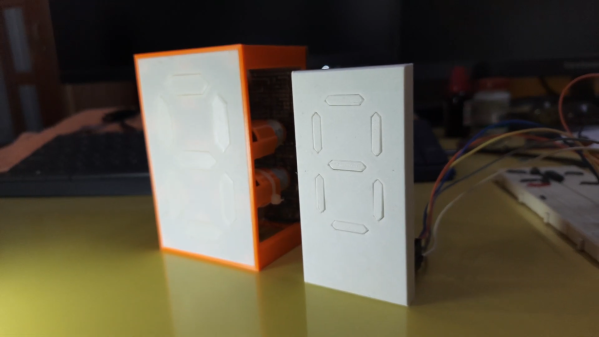
This slimmed-down mechanical seven-segment display is a perfect example of that downsizing trend. When we saw [IndoorGeek]’s first vision of an electromechanical display, it was pretty chunky. Then as now, each segment is a 3D-printed piece with a magnet attached to the rear. The segments hover over solenoid coils, which when energized repel the magnet and protrude the segment, forming the desired digit. The old version used large, hand-wound coils, though, making the display pretty bulky front to back.

Version 2 of the display takes a page from [Carl Bugeja]’s playbook and replaces the wound coils with PCB coils. We’ve seen [Carl]’s coils on both rigid substrates and flex PCBs; [IndoorGeek] used plain old FR4 here. The coils occupy four layers so they have enough oomph to extend and retract each segment, and the PCB includes space for H-bridge drivers for each segment. The PCB forms the rear cover for the display, which is also considerably slimmed down for this version. What’s the same, though, is how good this display looks, especially with strong side-lighting — the shadows cast by the extended segments are striking against the plain white face of the display.

Congratulations to [IndoorGeek] on a great-looking build and a useful improvement over the original.

Continue reading “Mechanical Seven-Segment Display, Smaller And Better Than The Original”