Under Pressure: How Aluminum Extrusions Are Made

At any given time I’m likely to have multiple projects in-flight, by which of course I mean in various stages of neglect. My current big project is one where I finally feel like I have a chance to use some materials with real hacker street cred, like T-slot extruded aluminum profiles. We’ve all seen the stuff, the “Industrial Erector Set” as 80/20 likes to call their version of it. And we’ve all seen the cool projects made with it, from CNC machines to trade show displays, and in these pandemic times, even occasionally as sneeze guards in retail shops.

Aluminum T-slot profiles are wonderful to work with — strong, lightweight, easily connected with a wide range of fasteners, and infinitely configurable and reconfigurable as needs change. It’s not cheap by any means, but when you factor in the fabrication time saved, it may well be a net benefit to spec the stuff for a project. Still, with the projected hit to my wallet, I’ve been looking for more affordable alternatives.

My exploration led me into the bewilderingly rich world of aluminum extrusions. Even excluding mundane items like beer and soda cans, you’re probably surrounded by extruded aluminum products right now. Everything from computer heatsinks to window frames to the parts that make up screen doors are made from extruded aluminum. So how exactly is this ubiquitous stuff made?

Continue reading “Under Pressure: How Aluminum Extrusions Are Made”

Drone Buoy Drifts Along The Gulf Stream For Citizen Science

It may be named after the most famous volleyball in history, but “Wilson” isn’t just a great conversationalist. [Hayden Brophy] built the free-drifting satellite buoy to see if useful science can be done with off-the-shelf hardware and on a shoestring budget. And from the look of the data so far, Wilson is doing pretty well.

Wilson belongs to a class of autonomous vessels known as drifters, designed to float along passively in the currents of the world’s ocean. The hull of [Hayden]’s drifter is a small Pelican watertight case, which contains all the electronics: Arduino Pro Trinket, GPS receiver, a satellite modem, and a charger for the LiPo battery. The lid of the case is dominated by a 9 W solar panel, plus the needed antennas for GPS and the Iridium uplink and a couple of sensors, like a hygrometer and a thermometer. To keep Wilson bobbing along with his solar panel up, there’s a keel mounted to the bottom of the case, weighted with chains and rocks, and containing a temperature sensor for the water.

Wilson is programmed to wake up every 12 hours and uplink position and environmental data as he drifts along. The drifter was launched into the heart of the Gulf Stream on August 8, about 15 nautical miles off Marathon Key in Florida, by [Captain Jim] and the very happy crew of the “Raw Deal”. As of this writing, the tracking data shows that Wilson is just off the coast of Miami, 113 nautical miles from launch, and drifting along at a stately pace of 2.5 knots. Where the buoy ends up is anyone’s guess, but we’ve seen similar buoys make it all the way across the Atlantic, so here’s hoping that hurricane season is kind to Wilson.

We think this is great, and congratulations to [Hayden] for organizing a useful and interesting project.

Continue reading “Drone Buoy Drifts Along The Gulf Stream For Citizen Science”

Recreating Retrocomputers Hack Chat

Join us on Wednesday, August 12 at noon Pacific for the Recreating Retrocomputers Hack Chat with Mike Gardi!

Building the first commercial computers in the late 1950s and early 1960s was certainly a complex a task, but building the computer industry was even harder. Sure, engineers were already getting on board with designing in silicon and germanium instead of glass and tungsten, and all digital circuits are really just abstractions of analog designs most of them were already familiar with. But what about all the other people who would need to get up to speed on the workings of digital computers? What good is a tool if the only people who know how to use it art the ones who built it?

To make computers make money, companies needed legions of installers, operators, programmers, marketers, and salespeople, and all of them needed training. And so early computer companies put a lot of effort into building training devices to get people up to speed. These trainers helped teach everything from basic logic circuits and Boolean relationships to simple programming concepts, and each of them contributed in their own way to developing the computer industry that we know today.

Mike Gardi has a unique hobby: among other things, he builds faithful replicas of some of the nicer examples of these lost bits of computing history. His reproduction of Claude Shannon’s Minivac 601 trainer is a great example of the art, as is the DEC H-500 Computer Lab build he’s currently working on. Along the way, he’s explored some side alleys on the road to our computerized world, like Dr. Nim and the paperclip computer. All his builds are lovingly created from 3D-prints and really capture the essence of the toys and tools of the time.

Join us as we take a trip inside this niche realm of retrocomputing and find out why Mike finds it fascinating enough to devote the time it obviously takes to build such exacting replicas. We’ll talk about what projects he’s got going on right now, what he has planned for the future, and maybe even dive into some of his secrets for such great looking 3D prints.

join-hack-chatOur Hack Chats are live community events in the Hackaday.io Hack Chat group messaging. This week we’ll be sitting down on Wednesday, August 12 at 12:00 PM Pacific time. If time zones baffle you as much as us, we have a handy time zone converter.

Click that speech bubble to the right, and you’ll be taken directly to the Hack Chat group on Hackaday.io. You don’t have to wait until Wednesday; join whenever you want and you can see what the community is talking about.

Continue reading “Recreating Retrocomputers Hack Chat”

The Weather Station At The Top Of The World

The crown jewels of the Earth’s mountain ranges, the Himalayas, are unsurpassed in their beauty, their height, and their deadly attraction to adventurers, both professional and amateur. The gem of the Himalayas is, of course, Mount Everest, known as Sagarmatha to the Nepalis and Chomolungma to the Tibetans. At 8,848 meters (29,029 ft) — or more; it’s a geologically young mountain that’s still being thrust upward by tectonic activity — it’s a place so forbidding that as far as we know the summit was never visited until 1953, despite at least 30 years of previous attempts, many of which resulted in death.

The conquest of Everest remains a bucket list challenge for many adventurers, and despite advances in technology that have made the peak accessible to more people — or perhaps because of that — more than 300 corpses litter the mountain, testament to what can happen when you take the power of Mother Nature for granted.

To get better data on the goings-on at the Roof of the World, an expedition recently sought to install five weather stations across various points on the route up Mount Everest, including one at its very peak. The plan was challenging, both from a mountaineering perspective and in terms of the engineering required to build something that would be able to withstand some of the worst conditions on the planet, and to send valuable data back reliably. It didn’t all go exactly to plan, but it’s still a great story about the intersection of science and engineering.

Continue reading “The Weather Station At The Top Of The World”

Unique Instrument Plucks Out Notes On A Ruler

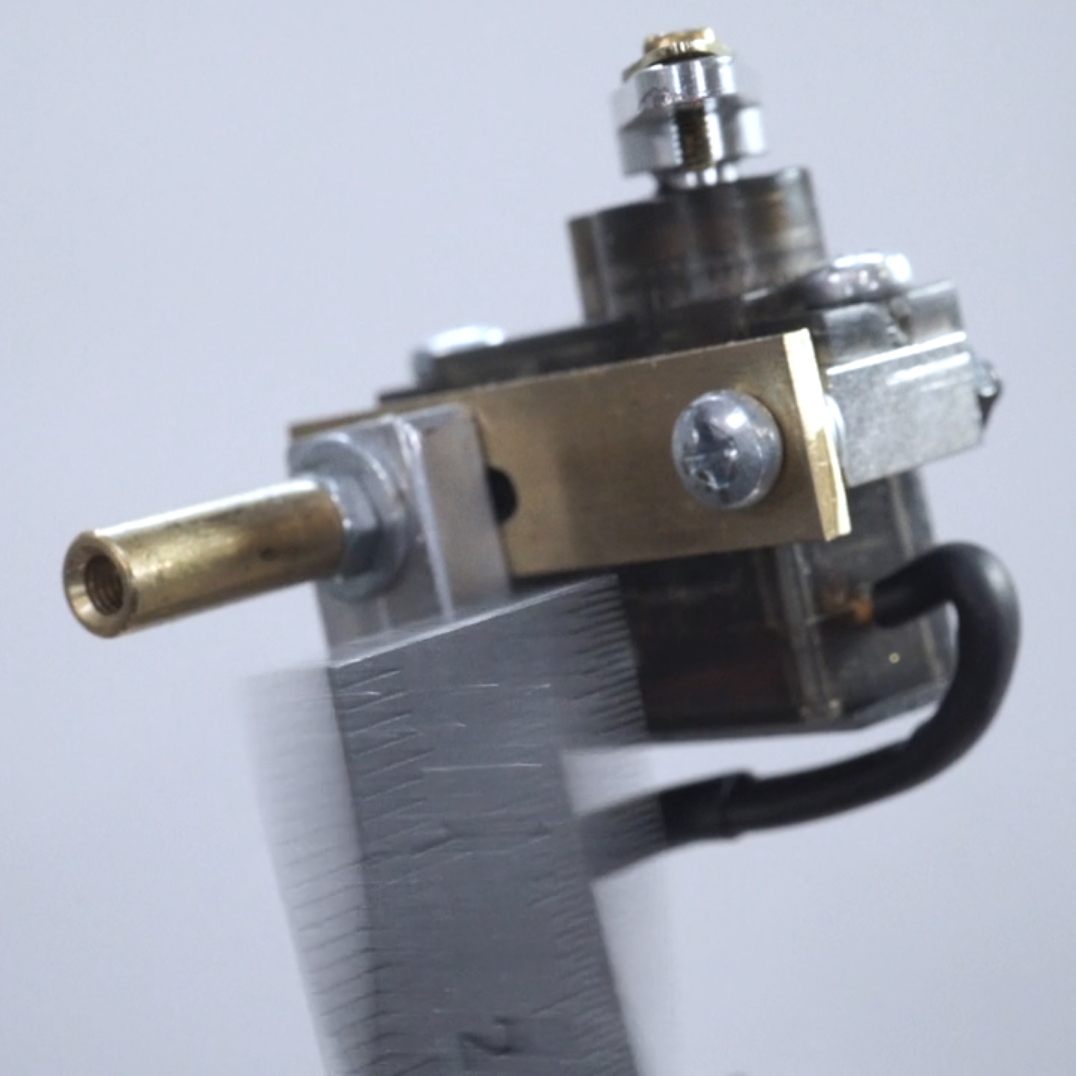
How does one describe the notes that come from a ruler that is anchored on one end and then plucked? The best word we can come up with is “wubulation”. So would that make this ruler-plucking synthesizer a “wubulator”? Or perhaps a “wubatron”?

Whatever we decide to call it, [Dmitry Morozov] dubbed it the RBS-20, or “ruler bass synth, 20-cm”, for the 20-cm stainless steel ruler that forms the heart of the instrument. The ruler is attached to a linear slide which varies the length of the sprung section. A pair of servos can pluck the free section of the ruler in two different places, providing notes in different registers, while another pair of servos control metal fingers that can damp the vibration, change the sustain, and alter the notes. There’s no resonator; the sounds are instead picked up by a piezo mic. Twelve keys on the base of the instrument can be programmed for various lengths, and an OLED display gives the musician feedback. The video below shows the instrument wubulating, and brings us back to those desktop jam sessions in our grade school days — at least until the rulers were confiscated.

We’ve covered a ton of similarly unique musical instruments before, like this hybrid synthesizer-violin, a symphony of soda bottles, and inexplicably, a leg guitar.

Continue reading “Unique Instrument Plucks Out Notes On A Ruler”

Hackaday Links Column Banner

Hackaday Links: August 9, 2020

We regret to admit this, but we completely missed the fact that Windows 10 turned five years old back in March. Granted, things were a little weird back then — at least it seemed weird at the time; from the current perspective, things were downright normal then. Regardless, our belated congratulations to Microsoft, who, like anyone looking after a five-year-old, spends most of their time trying to keep their charge from accidentally killing itself. Microsoft has done such a good job at keeping Windows 10 alive that it has been installed on “one billion monthly active devices”. Of course, back in April of 2015 they predicted that the gigainstall mark would be reached in 2018. But what’s a couple of years between friends?

Of all the things that proved to be in short supply during the pandemic lockdowns, what surprised us most was not the toilet paper crunch. No, what really surprised us was the ongoing webcam supply pinch. Sure, it makes sense, with everyone suddenly working from home and in need of a decent camera for video conferencing. But we had no idea that the market was so dominated by one manufacturer — Logitech — that their cameras could suddenly become unobtainium. Whatever it is that’s driving the shortage, we’d take Logitech’s statement that “demand will be met in the next 4-6 weeks” with a huge grain of salt. After all, back-to-school shopping is likely to look vastly different this year than in previous years.

Speaking of education, check out the CrowPi2 STEM laptop. On the one hand, it looks like just another Raspberry Pi-based laptop, albeit one with a better level of fit and finish than most homebrew Pi-tops. With a Raspberry Pi 4b on board, it can do all the usual stuff — email, browse the web, watch videos. The secret sauce is under the removable wireless keyboard, though: a pretty comprehensive electronics learning lab. It reminds us of the Radio Shack “150-in-One” kits that so many of us cut our teeth on, but on steroids. Having a complete suite of modules and a breadboarding area built right into the laptop needed to program it is brilliant, and we look forward to seeing how the Kickstarter for this does.

Exciting news from Hackaday Superfriend Chris Gammell — he has launched a new podcast to go along with his Contextual Electronics training courses. Unsurprisingly dubbed the Contextual Electronics Podcast, he already has three episodes in the can. They’re available as both video and straight audio, and from the few minutes we’ve had to spend on them so far, Chris has done a great job in terms of production values and guests with Sophy Wong, Stephen Hawes, and Erik Larson leading off the series. We wish him luck with this new venture, and we’re looking forward to future episodes.

One of the best things about GoPro and similar sports cameras is their ability to go just about anywhere and show things we normally don’t get to see. We’re thinking of those gorgeous slo-mo selfies of surfers inside a curling wave, or those cool shots of a skier powder blasting down a mountain slope. But this is the first time we’ve seen a GoPro mounted inside a car’s tire. The video by the aptly named YouTuber [Warped Perception] shows how he removed the tire from the wheel and mounted the camera, a battery pack, and an LED light in the rim, then remounted the tire. The footage of the tire deforming as it contacts the ground is fascinating but oddly creepy. It sort of reminds us a little of the footage from cameras inside the Saturn V fuel tanks — valuable engineering information to be sure, but forbidden in some way.


How About A Nice Cuppa TEA Laser?

If lasers are your hobby, you face a conundrum. There are so many off-the-shelf lasers that use so many different ways of amplifying and stimulating light that the whole thing can be downright — unstimulating. Keeping things fresh therefore requires rolling your own lasers, and these DIY nitrogen TEA and dye lasers seem like a fun way to go.

These devices are the work of [Les Wright], who takes us on a somewhat lengthy but really informative tour of transversely excited atmospheric (TEA) lasers. The idea with TEA lasers is that a gas, often carbon dioxide in commercial lasers but either air or pure nitrogen in this case, is excited by a high-voltage discharge across long parallel electrodes. TEA lasers are dead easy to make — we’ve covered them a few times — but as [Les] points out, that ease of construction leads to designs that are more ad hoc than engineered.

In the video below, [Les] presents three designs that are far more robust than the typical TEA laser. His lasers use capacitors made from aluminum foil with polyethylene sheets for dielectric, sometimes with the addition of beautiful “doorknob” ceramic caps too. A spark gap serves as a very fast switch to discharge high voltage across the laser channel, formed by two closely spaced aluminum hex bars. Both the spark gap and the laser channel can be filled with low-pressure nitrogen. [Les] demonstrates the power and the speed of his lasers, which can even excite laser emissions in a plain cuvette of rhodamine dye — no mirrors needed! Although eye protection is, of course.

These TEA lasers honestly look like a ton of fun to build and play with. You might not be laser welding or levitating stuff with them, but that’s hardly the point.

Continue reading “How About A Nice Cuppa TEA Laser?”