Burning Propane Beautifully Illustrates How A Tesla Valve Works

When you hear the name “Tesla”, chances are good that thoughts turn instantly to the company that’s trying to reinvent the motor vehicle and every industry that makes it possible. While we applaud the effort, it’s a shame that they chose to appropriate the surname of a Serbian polymath as their corporate brand, because old [Nikola] did so many interesting things in his time, and deserves to be remembered in his own right.

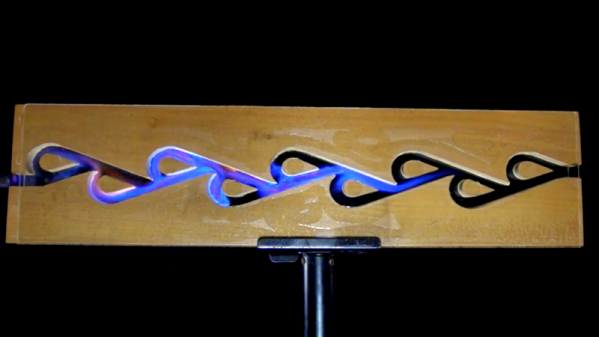
Take the Tesla valve. In essence a diode for fluids, the Tesla valve uses a tortuous path to allow flow in one direction but severely restrict it in the other. Understanding how it works isn’t necessarily intuitive, though, which is why [NightHawkInLight] chose to demonstrate the Tesla valve principle with exploding propane. It’s not new territory to him; we’ve covered his propane-powered rifle in the past.

The swirling blue and green flame front in those experiments make burning propane the perfect working fluid to demonstrate how the Tesla valve works. The video below tells the tale, with high-speed footage showing the turbulence that restricts the reverse flow. The surprise discovery is that in the forward direction, the burning gas actually seems to accelerate as it moves down the valve; hypersonic Tesla plasma cannon, anyone?

We’ve seen Tesla valves before, including one made from a “Shrinky Dink”. That did a pretty good job of visualizing the flow patterns that make the valve work, but there’s a huge showmanship gap between tiny channels filled with colored water and the explosive decomposition of a fuel-air mix. It’s a bit riskier, and standard “don’t try this at home” disclaimers apply, but luckily [NightHawkInLight] still has his eyebrows, so he must be doing something right.

Continue reading “Burning Propane Beautifully Illustrates How A Tesla Valve Works”
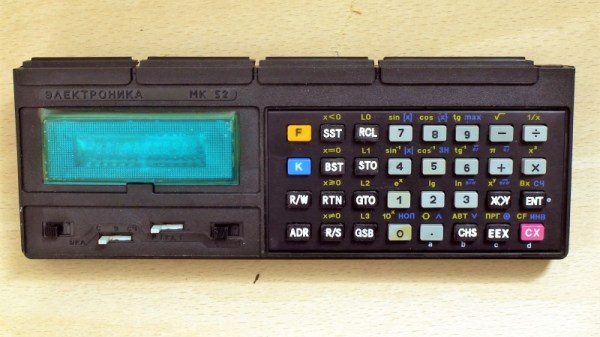
3D-Printer And CNC Make This Russian Calculator Bilingual

Let’s be clear right up front: there are probably more obvious solutions to the problem of using a Russian calculator when you don’t speak Russian than printing new keys and engraving translated markings on them. But easy solutions are boring and generally considered beyond the scope of Hackaday articles, so let’s dive in.

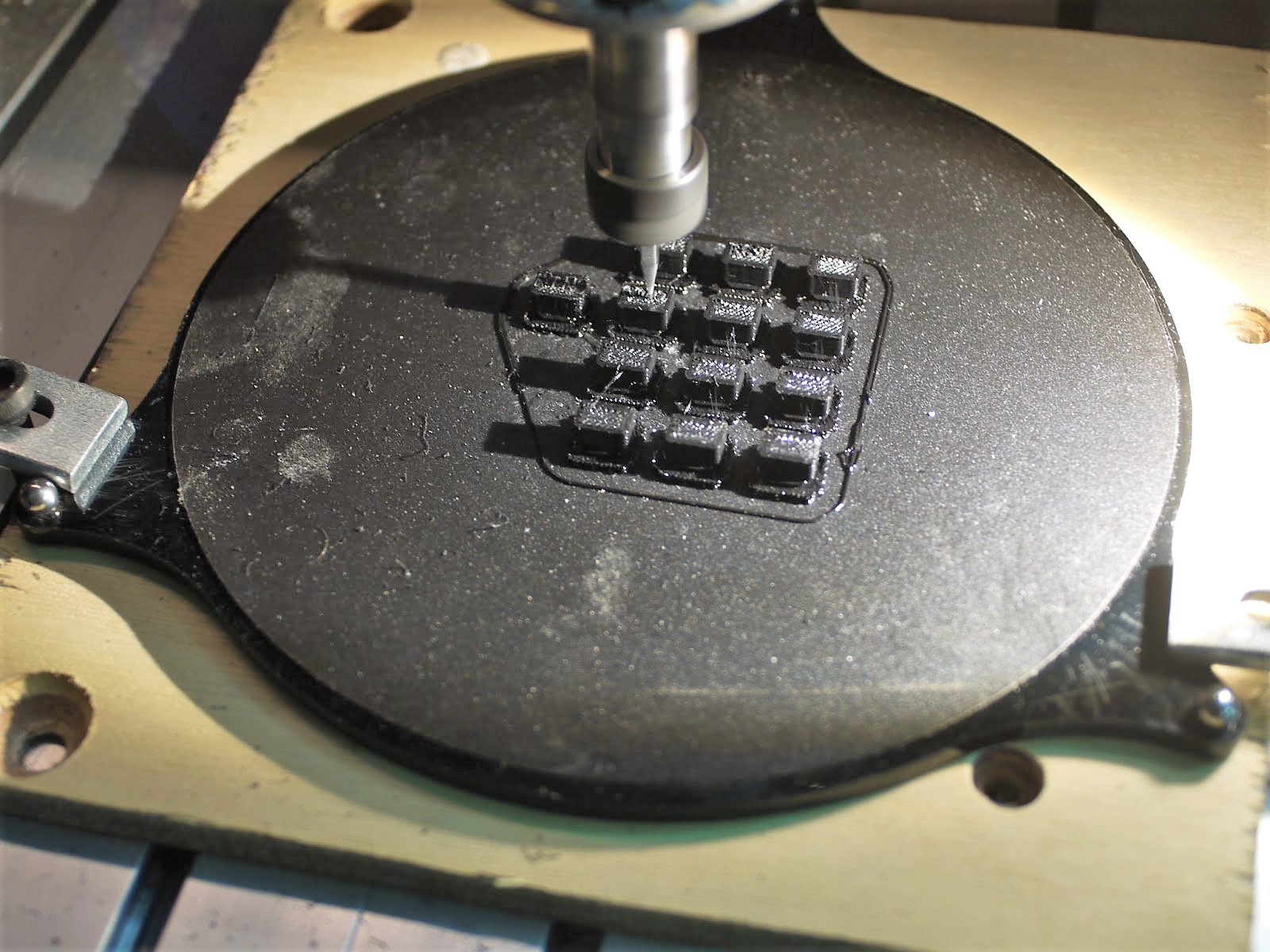
They say that mathematics is the universal language, but that’s only true to an extent. Still, even with our limited non-existent Cyrillic skills, the Russian keyboard on this RPN calculator isn’t that hard to figure out. But as [Amen] points out, in the midst of fevered calculations, one prefers not to mentally translate Χ→П to STO or remember that В↑ is the Enter key. So he printed a set of replacements for the confusing keys from PLA. While pondering how to safely fixture such small parts for the later engraving step, [Amen] hit on a genius solution: move the print bed to the CNC router and fixture everything in one go. The resulting characters are large enough to be legible and deep enough to be filled with air-drying polymer clay for contrast. After sanding and polishing, the calculator looks like it came from the Министерство электронной промышленности that way.

Honestly, we’d love to get a look inside this calculator. The insides of Russian electronics can be fascinating, and we’ve even seen entire forums dedicated to decapping Russian parts. But we understand the desire to keep it intact.

Continue reading “3D-Printer And CNC Make This Russian Calculator Bilingual”

Custom Nixies Perform When Cranked Up To 100,000 Hertz

With the popularity of Nixie clocks, we’d be forgiven for thinking that the glowing tubes are only good for applications with a stately pace of change. But we forget that before they became the must-have hobbyist accessory, Nixies were used in all kinds of scientific instruments, from frequency counters to precision multimeters. In such applications, update rates in the hundreds or thousands of Hertz aren’t uncommon, and the humble Nixie handled display refreshes with ease.

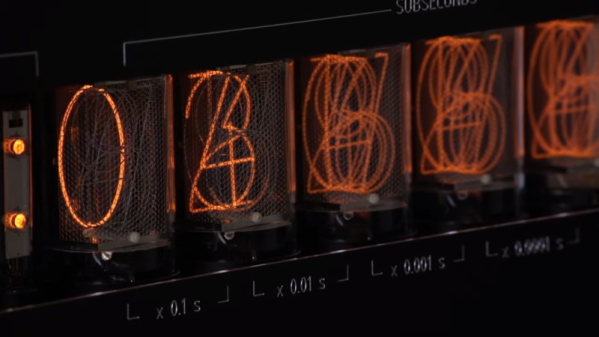
But what about refreshing a Nixie at 100 kHz? That was the question put to artisanal Nixie maker [Dalibor Farný] by a client who wanted a timer to calibrate high-speed cameras. It was a feat that [Dalibor] wasn’t sure his custom-made tubes could handle. The video below shows his efforts to find out.

If you ever wanted to know about the physics of gas-discharge displays like the Nixie, the fifteen minutes starting at about 5:13 will give you everything you need. That basic problem boils down to the half-life of excited neon, or how long it takes for half the population of excited molecules to return to the ground state. That, in turn, dictates how long a given cathode will continue to visibly glow after it’s turned off, which determines how many digits will appear illuminated at once.

To answer that, they engaged a company in Prague with a camera capable of a mind-blowing 900,000 frames per second. Even though they found a significant afterglow period for each cathode, even at 100 kHz it’s clear which digit is the one that’s currently illuminated. They also looked at the startup of digits in a cold Nixie versus one that’s warmed up, leading to some fascinating footage at around 26:30.

We appreciate [Dalibor]’s attention to detail, not only in the craftsmanship of his custom tubes but in making sure they’re going to do their job. He recently did a failure analysis on some of his high-end clocks that showed the same care for his product and his brand.

Continue reading “Custom Nixies Perform When Cranked Up To 100,000 Hertz”

Are You Getting Your Money’s Worth From Threaded Inserts?

Have you ever wondered whether it’s worth the time and expense to install threaded inserts into your 3D-printed projects? [Stefan] from CNC Kitchen did, and decided to answer the question once and for all, with science.

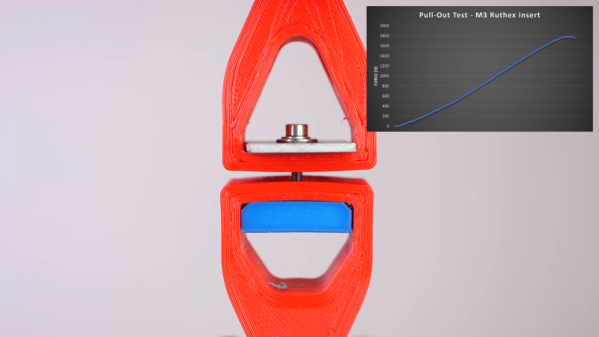
If this sounds familiar, it’s with good reason: we covered [Stefan]’s last stab at assessing threaded inserts back in March. Then, he was primarily interested in determining if threaded inserts are better than threads cut or printed directly into parts. The current work is concerned with the relative value of different designs of threaded inserts. He looked at three different styles of press-in inserts, ranging in price from pennies apiece to a princely 25 cents. The complexity of the outside knurling seems not to be correlated with the price; the inserts with opposed helical knurls seem like they’d be harder to manufacture than the ones with simple barbs on the outside of the barrel, but cost less. And in fact, the mid-price insert outperformed the expensive one in pull-out tests. Surprisingly, the cheapest inserts were actually far worse at pull-out resistance than printing undersized holes and threading an M3 screw directly into the plastic.

[Stefan] also looked at torque resistance, and found no substantial difference between the three insert types. Indeed, none of the inserts proved to be the weak point, as the failure mode of all the torque tests was the M3 bolt itself. This didn’t hold with the bolt threaded directly into the plastic, of course; any insert is better than none for torque resistance.

We enjoyed seeing [Stefan]’s tests, and appreciate the data that can help us be informed consumers. [John] over at Project Farm does similar head-to-head tests, like this test of different epoxy adhesives.

Continue reading “Are You Getting Your Money’s Worth From Threaded Inserts?”

Tracking Wasted Time With A Ferrofluid Clock

We know this project is supposed to be about developing a fine-looking ferrofluid clock, and not about the value of procrastination. But after watching the video below, see if you don’t think that procrastination has taken these two students further than expected.

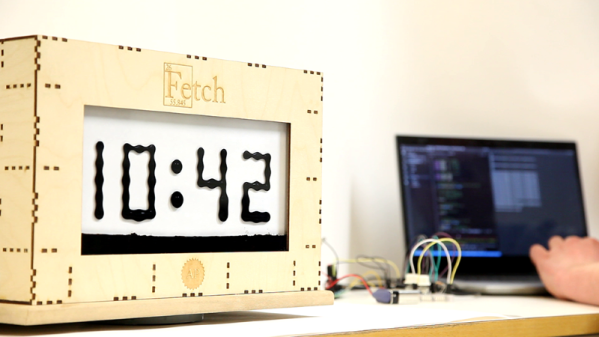
We first ran into [Simen] and [Amund] several months ago when they launched their ferrofluid project in a fit of “There’s got to be more to life than studying.” It seemed then that building a good-looking, functional ferrofluid display would be a temporary distraction, but the problems posed proved to be far deeper and thornier than either of the electrical engineering students expected. The idea is simple: contain a magnetic fluid between two transparent panels and create pixels using an array of electromagnets to move dots of the fluid around. The implementation, however, was another matter, with the ferrofluid itself proved to be the biggest obstacle. All the formulas they tried seemed to coagulate or degrade over time and tended to stain the glass. While the degradation was never fully sorted, they managed to work around the staining by careful cleaning of the glass and using a saturated brine solution to fill the container.

Backed by 252 electromagnets and drivers on ten custom PCBs, the video below shows the (mostly) finished panel in action as a clock. We’re impressed by the smoothness of the movements of each pixel, even if there’s a bit of drooping at the bottom thanks to gravity. As for the future of the project, that’s unclear since [Simen] is headed off for a NASA internship. We’re not sure if that was despite or because of this procrastination-driven project, but we congratulate him either way and look forward to hearing more from both of them in the future.

Continue reading “Tracking Wasted Time With A Ferrofluid Clock”

Laptop Like It’s 1979 With A 16-Core Z80 On An FPGA

When life hands you a ridiculously expensive and massively powerful FPGA dev board, your first reaction may not be to build a 16-core Z80 laptop with it. If it’s not, perhaps you should examine your priorities, because that’s what [Chris Fenton] did, with the result being the wonderfully impractical “ZedRipper.”

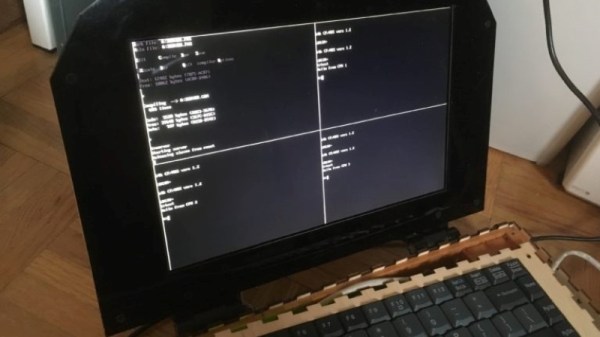
Our first impression is that we’ve got to start hanging around a better class of lab, because [Chris] came by this $6000 FPGA board as the result of a lab cleanout; the best we ever scored was a few old Cat-5 cables and some power strips. The Stratix FPGA formed the heart of the design, surrounded by a few breakout boards for the 10.1″ VGA display and the keyboard, which was salvaged from an old PS/2. The 16 Z80 cores running in the FPGA are connected by a ring-topology network, which [Chris] dubs the “Z-Ring”. One of the Z80 cores, the server core, runs CP/M 2.2 and a file server called CP/NET, while the other fifteen machines are clients that run CP/NOS. A simple window manager shows 80 x 25 character terminal sessions for the server and any three of the clients at once, and the whole thing, including a LiPo battery pack, fits into a laser-cut plywood case. It’s retro, it’s modern, it’s overkill, and we absolutely love it.

Reading over [Chris]’s build log puts us in the mood to break out our 2019 Superconference badge and try spinning up a Z80 of our own. If you decide to hack the FPGA-est of conference badges, you might want to check out what [Sprite_TM] has to say about it. After all, he designed it. And you’ll certainly want to look at some of the awesome badge hacks we saw at Supercon.

Thanks to [yNos] for the tip.

Open-Source Satellite Propulsion Hack Chat

Join us on Wednesday, December 11 at noon Pacific for the Open-Source Satellite Propulsion Hack Chat with Michael Bretti!

When you look back on the development history of any technology, it’s clear that the successful products eventually reach an inflection point, the boundary between when it was a niche product and when it seems everyone has one. Take 3D-printers, for instance; for years you needed to build one if you wanted one, but now you can buy them in the grocery store.

It seems like we might be getting closer to the day when satellites reach a similar inflection point. What was once the province of nations with deep pockets and military muscles to flex has become far more approachable to those of more modest means. While launching satellites is still prohibitive and will probably remain so for years to come,  building them has come way, way down the curve lately, such that amateur radio operators have constellations of satellites at their disposal, small companies are looking seriously at what satellites can offer, and even STEM programs are starting to get students involved in satellite engineering.

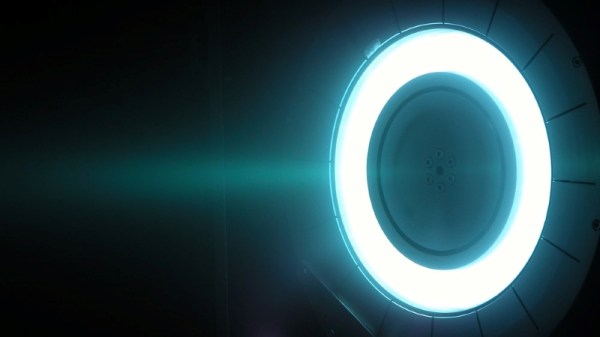
Michael Bretti is on the leading edge of the trend toward making satellites more DIY friendly. He formed Applied Ion Systems to address one of the main problems nano-satellites face: propulsion. He is currently working on a range of open-source plasma thrusters for PocketQube satellites, a format that’s an eighth the size of the popular CubeSat format. His solid-fuel electric thrusters are intended to help these diminutive satellites keep station and stay in orbit longer than their propulsion-less cousins. And if all goes well, someday you’ll be able to buy them off-the-shelf.

Join us for the Hack Chat as Michael discusses the design of plasma thrusters, the details of his latest testing, and the challenges of creating something that needs to work in space.

join-hack-chatOur Hack Chats are live community events in the Hackaday.io Hack Chat group messaging. This week we’ll be sitting down on Wednesday, December 11 at 12:00 PM Pacific time. If time zones have got you down, we have a handy time zone converter.

Click that speech bubble to the right, and you’ll be taken directly to the Hack Chat group on Hackaday.io. You don’t have to wait until Wednesday; join whenever you want and you can see what the community is talking about.