Finely Machined Valve Controls Miniature RC Hydraulics

Hydraulic components are the industrial power transmission version of LEGO. Pumps, cylinders, valves – pretty much everything is standardized, and fitting out a working system is a matter of picking the right parts and just plumbing everything together. That’s fine if you want to build an excavator or a dump truck, but what if you want to scale things down?

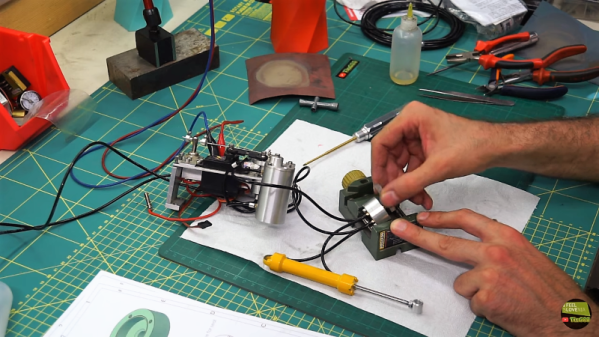
Miniature hydraulic systems need miniature components, of which this homebrew hydraulic valve made by [TinC33] is a great example. (Video embedded below.) If you’re curious about why anyone would need these, check out the tiny hydraulic cylinders he built a while back, wherein you’ll learn that miniature RC snowplows are a thing. The video below starts with a brief but clear explanation about how hydraulic circuits work, as well as an explanation of the rotary dual-action proportional valve he designed. All the parts are machined by hand in the lathe from aluminum and brass stock. The machining operations are worth watching, but if you’re not into such things, skip to final assembly and testing at 13:44. The valve works well, providing very fine control of the cylinder and excellent load holding, and there’s not a leak to be seen. Impressive.

[TinC33] finishes the video with a tease of a design for multiple valves in a single body. That one looks like it might be an interesting machining challenge, and one we’d love to see.

Thanks to [mgsouth] for the tip.

Parallax Update Hack Chat

Join us on Wednesday, August 28th at noon Pacific for the Parallax Update Hack Chat with Chip and Ken Gracey!

For a lot of us, our first exposure to the world of microcontrollers was through the offerings of Parallax, Inc. Perhaps you were interested in doing something small and light, and hoping to leverage your programming skills from an IBM-PC or an Apple ][, you chanced upon the magic of the BASIC Stamp. Or maybe you had a teacher who built a robotics class around a Boe-Bot, or you joined a FIRST Robotics team that used some Parallax sensors.

Whatever your relationship with Parallax products is, there’s no doubting that they were at the forefront of the hobbyist microcontroller revolution. Nor can you doubt that Parallax is about a lot more than BASIC Stamps these days. Its popular multicore Propeller chip has been gaining a passionate following since its 2006 introduction and has found its way into tons of projects, many of which we’ve featured on Hackaday. And now, its long-awaited successor, the Propeller 2, is almost ready to hit the market.

The Gracey brothers have been the men behind Parallax from the beginning, with Chip designing all the products and Ken running the business. They’ll be joining us on the Hack Chat to catch us up on everything new at Parallax, and to give us the lowdown on the P2. Be sure to stop be with your Parallax questions, or just to say hi.

join-hack-chatOur Hack Chats are live community events in the Hackaday.io Hack Chat group messaging. This week we’ll be sitting down on Wednesday, August 28 at 12:00 PM Pacific time. If time zones have got you down, we have a handy time zone converter.

Click that speech bubble to the right, and you’ll be taken directly to the Hack Chat group on Hackaday.io. You don’t have to wait until Wednesday; join whenever you want and you can see what the community is talking about.

The Satellite Phone You Already Own: From Orbit, UbiquitiLink Will Look Like A Cell Tower

For anyone that’s ever been broken down along a remote stretch of highway and desperately searched for a cell signal, knowing that a constellation of communications satellites is zipping by overhead is cold comfort indeed. One needs specialized gear to tap into the satphone network, few of us can justify the expense of satellite phone service, and fewer still care to carry around a brick with a chunky antenna on it as our main phone.

But what if a regular phone could somehow leverage those satellites to make a call or send a text from a dead zone? As it turns out, it just might be possible to do exactly that, and a Virginia-based startup called UbiquitiLink is in the process of filling in all the gaps in cell phone coverage by orbiting a constellation of satellites that will act as cell towers of last resort. And the best part is that it’ll work with a regular cell phone — no brick needed.

Continue reading “The Satellite Phone You Already Own: From Orbit, UbiquitiLink Will Look Like A Cell Tower”

Vintage Console Becomes The Calculator It Appears To Be

What’s sitting on [Bob Alexander]’s desk in the video below did not start out life as the desktop calculator it appears to be. Turning it into a standalone calculator with features the original designers couldn’t imagine turned out to be an interesting project, and a trip down the retrocomputing rabbit hole.

A little explanation is in order. Sure, with its Nixie display, calculator keypad, and chunky mid-century design, the Wang 360 desktop console looks like a retro calculator. But it’s actually only a dumb terminal for a much, MUCH bigger box, called the Electronic Package, that would fit under a desk. The foot-warming part that was once connected to [Bob]’s console by a thick cable that had been unceremoniously lopped off by a previous owner. [Bob] decided to remedy the situation with modern electronics. The console turned out to have enough room for a custom PCB carrying a PIC32, some level-shifting components, power supply modules that include the high-voltage supply for the Nixies, and a GPS module because Nixies and clocks just go together. The interesting bit is the programming; [Bob] chose to emulate the original Wang methods of doing math, which include multiplication by logarithmic addition. Doing so replicates the original look and feel of the calculator down to the rapid progression of numbers across the Nixies as the logarithms are calculated using the display registers.

We normally frown on vintage gear being given modern guts, but in this case [Bob] hit just the right balance of new and old, And given that the Electronic Packages these consoles were connected to go for $1500 or more on eBay, it was a better choice than letting the console go to scrap. A similarly respectful approach was taken with this TRS80 Model 100 revival.

Continue reading “Vintage Console Becomes The Calculator It Appears To Be”

Hackaday Links Column Banner

Hackaday Links: August 25, 2019

Doesn’t the Z-axis on 3D-printers seem a little – underused? I mean, all it does is creep up a fraction of a millimeter as the printer works through each slice. It would be nice if it could work with the other two axes and actually do something interesting. Which is exactly what’s happening in the nonplanar 3D-printing methods being explored at the University of Hamburg. Printing proceeds normally up until the end, when some modifications to Slic3r allow smooth toolpaths to fill in the stairsteps and produce a smooth(er) finish. It obviously won’t work for all prints or printers, but it’s nice to see the Z-axis finally pulling its weight.

If you want to know how something breaks, best to talk to someone who looks inside broken stuff for a living. [Roger Cicala] from LensRentals.com spends a lot of time doing just that, and he has come to some interesting conclusions about how electronics gear breaks. For his money, the prime culprit in camera and lens breakdowns is side-mounted buttons and jacks. The reason why is obvious once you think about it: components mounted perpendicular to the force needed to operate them are subject to a torque. That’s a problem when the only thing holding the component to the board is a few SMD solder pads. He covers some other interesting failure modes, too, and the whole article is worth a read to learn how not to design a robust product.

In the seemingly neverending quest to build the world’s worst Bitcoin mining rig, behold the 8BitCoin. It uses the 6502 processor in an Apple ][ to perform the necessary hashes, and it took a bit of doing to port the 32-bit SHA256 routines to an 8-bit platform. But therein lies the hack. But what about performance? Something something heat death of the universe…

Contributing Editor [Tom Nardi] dropped a tip about a new online magazine for people like us. Dubbed Paged Out!, the online quarterly ‘zine is a collection of contributed stories from hackers, programmers, retrocomputing buffs, and pretty much anyone with something to say. Each article is one page and is formatted however the author wants to, which leads to some interesting layouts. You can check out the current issue here; they’re still looking for a bunch of articles for the next issue, so maybe consider writing up something for them – after you put it on Hackaday.io, of course.

Tipline stalwart [Qes] let us know about an interesting development in semiconductor manufacturing. Rather than concentrating on making transistors smaller, a team at Tufts University is making transistors from threads. Not threads of silicon, or quantum threads, or threads as a metaphor for something small and high-tech. Actual threads, like for sewing. Of course, there’s plenty more involved, like carbon nanotubes — hey, it was either that or graphene, right? — gold wires, and something called an ionogel that holds the whole thing together in a blob of electrolyte. The idea is to remove all rigid components and make truly flexible circuits. The possibilities for wearable sensors could be endless.

And finally, here’s a neat design for an ergonomic utility knife. It’s from our friend [Eric Strebel], an industrial designer who has been teaching us all a lot about his field through his YouTube channel. This knife is a minimalist affair, designed for those times when you need more than an X-Acto but a full utility knife is prohibitively bulky. [Eric’s] design is a simple 3D-printed clamshell that holds a standard utility knife blade firmly while providing good grip thanks to thoughtfully positioned finger depressions. We always get a kick out of watching [Eric] design little widgets like these; there’s a lot to learn from watching his design process.

Thanks to [JRD] and [mgsouth] for tips.

Lead Former Makes LED Cubes A Little Easier To Build

There’s no doubting the allure of a nicely crafted LED cube; likewise, there’s no doubting that they can be a tremendous pain to build. After all, the amount of work scales as the cube of the number of LEDs you want each side to have, and let’s face it – with LED cubes, the bigger, the better. What to do about all that tedious lead forming?

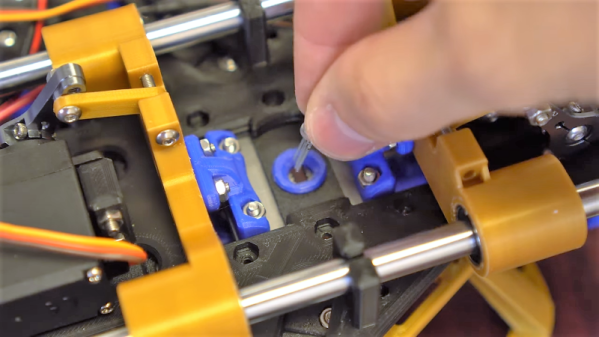
[TylerTimoJ]’s solution is a custom-designed lead-forming tool, and we have to say we’re mighty impressed by it. His LED cubes use discrete RGB LEDs, the kind with four leads, each suspended in space by soldering them to wires. For the neat appearance needed to make such a circuit sculpture work, the leads must be trimmed and bent at just the right angles, a tedious job indeed when done by hand. His tool has servo-controlled jaws that grip the leads, with solenoid-actuated lead formers coming in from below to bend each lead just the right amount. The lead former, along with its companion trimmer, obviously went through a lot of iterations before [TylerTimoJ] got everything right, but we’d say being able to process thousands of LEDs without all the tedium is probably worth the effort.

We’re looking forward to the huge LED cubes this tool will enable. Perhaps this CNC wire bender and an automated wire cutter would come in handy for the supporting wires?

Continue reading “Lead Former Makes LED Cubes A Little Easier To Build”

Feeding Chickens, With Style

Ah, the joys of domestic animals. Often adorable, occasionally useful, they’re universally unable to care for themselves in the slightest. That’s part of the bargain though; we take over responsibility for their upkeep and they repay us with whatever it is they do best. Unless the animal in question is a cat, of course – they have their own terms and conditions.

Chickens, though, are very useful indeed. Give them food and water and they give you delicious, nutritious, high-quality protein. Feeding them every day can be a chore, though, unless you automate the task. This Twitch-enabled robotic chicken feeder may be overkill for that simple use case, but as [Sean Hodgins] tell it, there’s a method to all the hardware he threw at this build. That would include a custom-welded steel frame holding a solar panel and batteries, a huge LED matrix display, a Raspberry Pi and camera, and of course, food dispensers. Those are of the kind once used to dispense candy or gum for a coin or two in the grocery; retooled with 3D-printed parts, the dispensers now eject a small scoop of feed whenever someone watching a Twitch stream decides to donate to the farm that’s hosting the system. You can see the build below in detail, or just pop over to Sweet Farm to check out the live feed and gawk at some chickens.

It’s an impressive bit of work on [Sean]’s part for sure, and we did notice how he used his HCC rapid prototyping module to speed up development. Still, we’re not convinced there will be many donations at $10 a pop. Then again, dropping donations to the micropayment level may lead to overfed chickens, and that’s not a good thing.

Continue reading “Feeding Chickens, With Style”