Robotic Dishwashers And Dishwashing As A Service

There’s a story that goes back to the 1980s or so about an engineering professor who laid down a challenge to the students of his automation class: design a robot to perform the most mundane of household tasks — washing the dishes. The students divided up into groups, batted ideas around, and presented their designs. Every group came up with something impressive, all variations on a theme with cameras and sensors and articulated arms to move the plates around. The professor watched the presentations respectfully, and when they were done he got up and said, “Nice work. But didn’t any of you idiots realize you can buy a robot that does dishes for $300 from any Sears in the country?”

The story may be apocryphal, but it’s certainly plausible, and it’s definitely instructive. The cultural impression of robotics as a field has a lot of ballast on it, thanks to decades of training that leads us to believe that robots will always be at least partially anthropomorphic. At first it was science fiction giving us Robbie the Robot and C3PO; now that we’re living in the future, Boston Dynamics and the like are doing their best to give us an updated view of what robots must be.

But all this training to expect bots built in the image of humans or animals only covers a narrow range of use cases, and leaves behind the hundreds or thousands of other applications that could prove just as interesting. One use case that appears to be coming to market hearkens back to that professor’s dishwashing throwdown, and if manufacturers have their way, robotic dishwashers might well be a thing in the near future.

Continue reading “Robotic Dishwashers And Dishwashing As A Service”

Ask Hackaday: What Are Your Apollo Memories?

This month will mark the 50th anniversary of the Apollo 11 mission that brought to a successful conclusion the challenge laid down by President Kennedy only eight years earlier. Three men went to the Moon, two walked on it, and they all came back safely, in a dramatic eight-day display of engineering and scientific prowess that was televised live to the world.

If you’ve made more than 50 trips around the sun, chances are good that you have some kind of memories of the first Moon landing. An anniversary like this is a good time to take stock of those memories, especially for something like Apollo, which very likely struck a chord in many of those that witnessed it and launched them on careers in science and engineering. We suspect that a fair number of Hackaday readers are in that group, and so we want to ask you: What are your memories of Apollo?

A Real American Hero

My memory of the Moon landing is admittedly vague. I had just turned five the month before, hadn’t even started kindergarten yet, but I had already caught the space bug in a big way. I lived and breathed the space program, and I knew everything about the Mercury missions that were over by the time I was born, and the Gemini missions that had just wrapped up. Apollo was incredibly exciting to me, and I was pumped to witness the landing in the way that only a five-year-old can be.
Continue reading “Ask Hackaday: What Are Your Apollo Memories?”

Unique Clock Keeps Time The Fibonacci Way

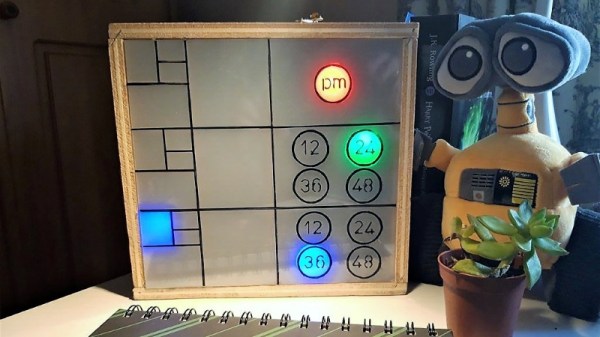
You say your binary clock no longer has the obfuscation level needed to earn the proper nerd street cred? Feel like you need something a little more mathematically challenging to make sure only the cool kids can tell the time? Then this Fibonacci clock might be just the thing to build.

Granted, [TecnoProfesor]’s clock is a somewhat simplified version of an earlier version that was nigh impossible to decode. But with its color coding and [Piet Mondrian]-esque grids, it’s still satisfyingly difficult to get the time from a quick glance. The area of the blocks represents the Fibonacci sequence 1, 1, 2, 3, 5, and adding up which blocks are illuminated by the RGB LEDs behind the frosted front panel. That lets you tally up to 12 intervals; for the minutes and seconds, there are indicators for the powers multiples of 12 up to 48. Put it all together and you’ve got a unique and attractive graphical time display that’s sure to start interesting conversations when the mathematically disinclined try to use it. Check out the video below as the clock goes from 12:28:01 to 12:28:46. We think.

If this doesn’t scratch your itch for obfuscated clocks, we’ve got plenty of them. From random four-letter words to an analog digital clock to an epic epoch clock, we’ve got them all.

Continue reading “Unique Clock Keeps Time The Fibonacci Way”

Space Age Bitcoin Mining On An Apollo AGC

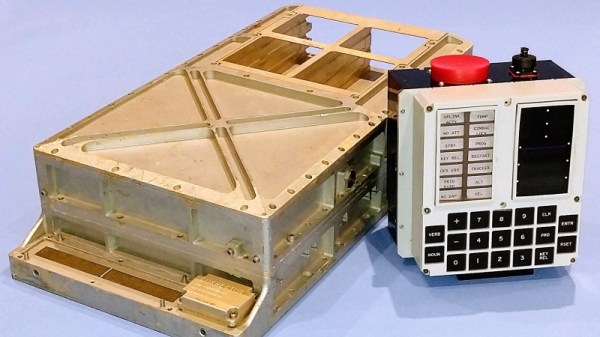
Imagine you’ve got an Apollo Guidance Computer, the machine that took men to the Moon 50 years ago. You’ve spent ages restoring it, and now it’s the only working AGC on the planet. It’s not as though you’re going to fly to the Moon with it, so what do you do with it? Easy – turn it into a perfectly awful Bitcoin mining rig.

The AGC that [Ken Shirriff] and others have been restoring barely resembles a modern computer. The AGC could only do about 40,000 operations per second, but raw speed was far less important than overall reliability and the abundant IO needed to run a crewed spacecraft. It was a spectacular success on the Apollo missions, but [Ken] wanted to know if turning it into a Bitcoin mining rig was possible.

[Ken] gives a great overview of how Bitcoin mining works, with one of the best explanations of the hashing algorithm we’ve seen. Getting that to run on the AGC was no mean feat, especially with limits imposed by the memory addressing scheme and the lack of machine instructions for manipulating words. He eventually got it working, though, clocking in at a screaming 10.3 seconds per Bitcoin hash. [Ken] estimates that the first coin will be successfully mined in a mere 400 zettaseconds, which is about a billion times older than the universe. With about 13 quadrillion years to the first ka-ching, you have plenty of time to watch a block mined in the video below; alas, it was an old block, so no coins were awarded to compensate the team for their efforts.

This isn’t the first time [Ken] has implemented a useless Bitcoin mine. The Xerox Alto mine was actually fast compared to the AGC, but it sure beats the IBM mainframe and punchcards.

Continue reading “Space Age Bitcoin Mining On An Apollo AGC”

It’s NICER In Orbit

Given the sheer volume of science going on as the International Space Station circles above our heads every 90 minutes or so, it would be hard for any one experiment to stand out. ISS expeditions conduct experiments on everything from space medicine to astrophysics and beyond, and the instruments needed to do the science have been slowly accreting over the years. There’s so much stuff up there that almost everywhere you turn there’s a box or pallet stuck down with hook-and-loop fasteners or bolted to some bulkhead, each one of them doing something interesting.

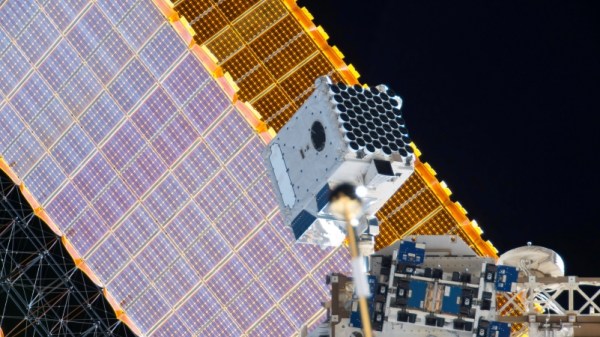
The science on the ISS isn’t contained completely within the hull, of course. The outside of the station fairly bristles with science, with packages nestled in among the solar panels and other infrastructure needed to run the spacecraft. Peering off into space and swiveling around to track targets is an instrument with the friendly name NICER, for “Neutron Star Interior Composition Explorer.” What it does and how it does it is interesting stuff, and what it’s learning about the mysteries of neutron stars could end up having practical uses as humanity pushes out into the solar system and beyond.

Continue reading “It’s NICER In Orbit”

Manufacturing In China Hack Chat

Join us on Wednesday 10 July 2019 at noon Pacific for the Manufacturing in China Hack Chat with Jesse Vincent!

It started out where many great stories start: as a procrastination project. Open source developer Jesse Vincent decided that messing around with a new keyboard design was a better thing to spend time on than whatever he was supposed to be doing, and thus Keyboardio was born.

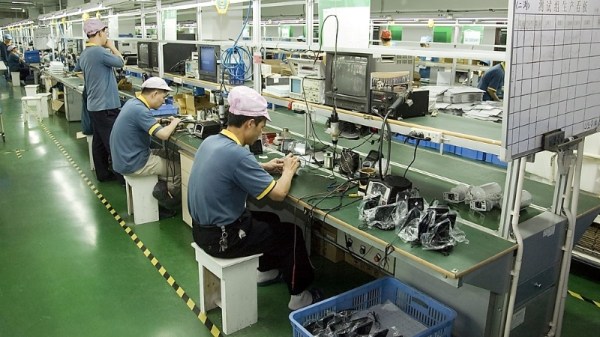
Their heirloom-grade keyboards of solid maple and with sculpted keycaps are unique to the eye and to the touch, but that’s only part of the Keyboardio story. Jesse has moved further down the road of turning a project into a product and a product into a company than most of us have, and he’s got some insights about what it takes. Particularly in climbing the learning curve of off-shore manufacturing, which will be the focus of this Hack Chat. Join us to learn all about the perils, pitfalls, and potential rewards of getting your Next Big Idea manufactured in China.

join-hack-chatOur Hack Chats are live community events in the Hackaday.io Hack Chat group messaging. This week we’ll be sitting down on Wednesday July 10 at 12:00 PM Pacific time. If time zones have got you down, we have a handy time zone converter.

Click that speech bubble to the right, and you’ll be taken directly to the Hack Chat group on Hackaday.io. You don’t have to wait until Wednesday; join whenever you want and you can see what the community is talking about.

No Filament Needed In This Direct Extrusion 3D-Printer

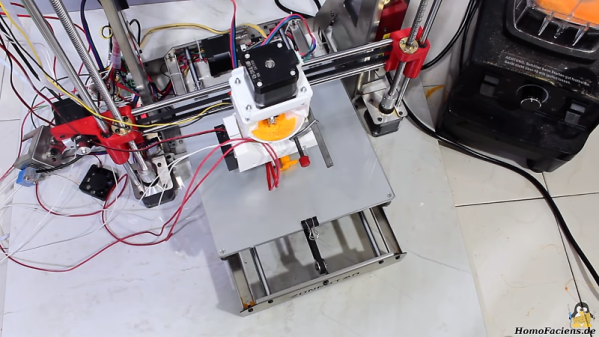
Ground plastic bits go in one end, finished 3D-prints come out the other. That’s the idea behind [HomoFaciens]’ latest build: a direct-extrusion 3D-printer. And like all of his builds, it’s made from scraps and bits most of us would throw out.

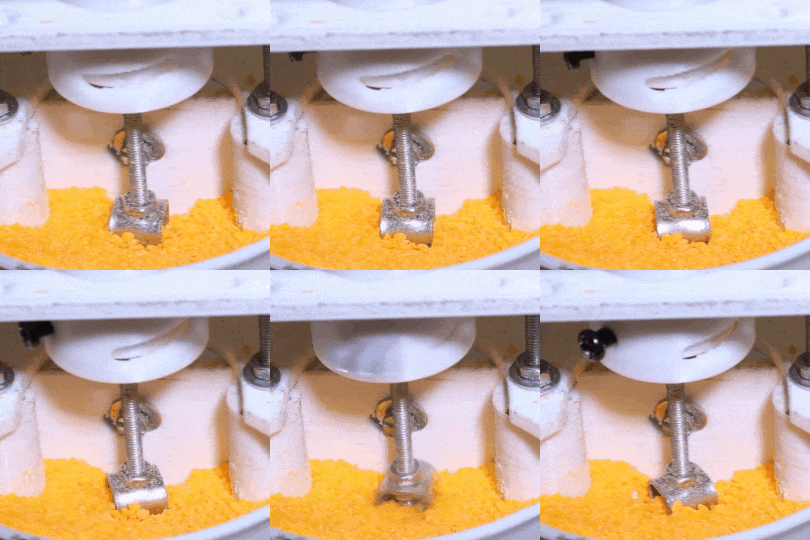
Pellet agitator is part of the extruder. All of this travels along with the print head.

Take the extrusion screw. Like the homemade rotary encoders [HomoFaciens] is known for, it appears at first glance that there’s no way it could work. An early version was just copper wire wrapped around a threaded rod inside a Teflon tube; turned by a stepper motor, the screw did a decent job of forcing finely ground PLA from a hopper into the hot end, itself just a simple aluminum block with holes drilled into it. That worked, albeit only with basically powdered PLA. Later versions of the extruder used a plain galvanized woodscrew soldered to the end of a threaded rod, which worked with chunkier plastic bits. Paddles stir up the granules in the hopper for an even flow into the extruder, and the video below shows impressive results. We also picked up a few tips, like using engine gasket paper and exhaust sealant to insulate a hot end. And the slip coupling, intended to retract the extruder screw slightly to reduce stringing, seems brilliant but needs more work to make it practical.

It’s far from perfect, but given the inputs it’s pretty amazing, and there’s something attractive about reusing all those failed prints. It reminds us a bit of the trash printer we featured recently, which is another way to stick it to the filament man. Continue reading “No Filament Needed In This Direct Extrusion 3D-Printer”