High-Style Ball Balancing Platform

If IKEA made ball-balancing PID robots, they’d probably look like this one.

This [Johan Link] build isn’t just about style. A look under the hood reveals not the standard, off-the-shelf microcontroller development board you might expect. Instead, [Johan] designed and built his own board with an ATmega32 to run the three servos that control the platform. The entire apparatus is made from a dozen or so 3D-printed parts that interlock to form the base, the platform, and the housing for the USB webcam that’s perched on an aluminum tube. From that vantage point, the camera’s images are analyzed with OpenCV and the center of the ball is located. A PID loop controls the three servos to center the ball on the platform, or razzle-dazzle it a little by moving the ball in a controlled circle. It’s quite a build, and the video below shows it in action.

We’ve seen a few balancing platforms before, but few with such style. This Stewart platform comes close, and this juggling platform gets extra points for closing the control loop with audio feedback. And for juggling, of course.

Continue reading “High-Style Ball Balancing Platform”

Custom Jig Makes Short Work Of Product Testing

When you build one-off projects for yourself, if it doesn’t work right the first time, it’s a nuisance. You go back to the bench, rework it, and move on with life. The equation changes considerably when you’re building things to sell to someone. Once you take money for your thing, you have to support it, and anything that goes out the door busted is money out of your pocket.

[Brian Lough] ran into this fact of life recently when the widget he sells on Tindie became popular enough that he landed an order for 100 units. Not willing to cut corners on testing but also not interested in spending days on the task, he built this automated test jig to handle the job for him. The widget in question is the “Power BLough-R”, a USB pass-through device that strips the 5-volt from the line while letting the data come through; it’s useful for preventing 3D-printers from being backfed when connected to Octoprint. The tester is very much a tactical build, with a Nano in a breakout board wired to a couple of USB connectors. When the widget is connected to the tester, a complete series of checks make sure that there are no wiring errors, and the results are logged to the serial console. [Brian] now has complete confidence that each unit works before going out the door, and what’s more, the tester shaved almost a minute off each manual test. Check in out in action in the video below.

We’ve featured quite a few of [Brian]’s projects before. You may remember his Tetris-themed YouTube subscriber counter, or his seven-segment shoelace display.

Continue reading “Custom Jig Makes Short Work Of Product Testing”

Geared Cable Winder Keeps Vive Sync Cable Neatly Wound

Long cables are only neat once – before they’re first unwrapped. Once that little cable tie is taken off, a cable is more likely to end up rats-nested than neatly coiled.

Preventing that is the idea behind this 3D-printed cable reel. The cable that [Kevin Balke] wants to make easier to deal with is a 50 foot (15 meters) long Vive lighthouse sync cable. That seems a bit much to us, but it makes sense to separate the lighthouses as much as possible and mount them up high enough for the VR system to work properly.

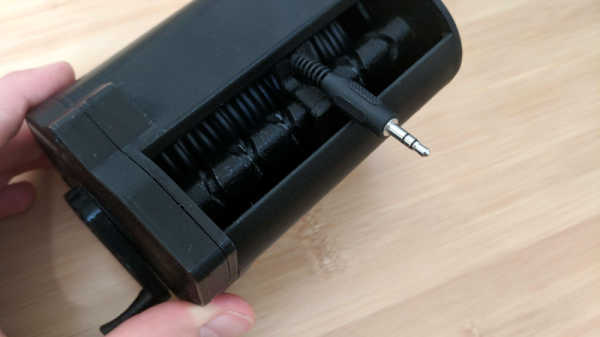
[Kevin] put a good deal of effort into making this cable reel, which looks a little like an oversize baitcasting-style fishing reel. The cable spool turns on a crank that also runs a 5:1 reduction geartrain powering a shaft with a deep, shallow-pitch crossback thread. An idler runs in the thread and works back and forth across the spool, laying up the incoming cable neatly. [Kevin] reports that the reciprocating mechanism was the hardest bit to print, as surface finish affected the mechanism’s operation as much as the geometry of the mating parts. The video below shows it working smoothly; we wonder how much this could be scaled up for tidying up larger cables and hoses.

This is another great entry in our 3D Printed Gears, Pulleys, and Cams Contest. The contest runs through February 19th, so there’s still plenty of time to get your entries in. Check out [Kevin]’s entry along with all the others, and see what you can come up with.

Continue reading “Geared Cable Winder Keeps Vive Sync Cable Neatly Wound”

AI Patent Trolls Now On The Job For Drug Companies

Love it or loathe it, the pharmaceutical industry is really good at protecting its intellectual property. Drug companies pour billions into discovering new drugs and bringing them to market, and they do whatever it takes to make sure they have exclusive positions to profit from their innovations for as long a possible. Patent applications are meticulously crafted to keep the competition at bay for as long as possible, which is why it often takes ages for cheaper generic versions of blockbuster medications to hit the market, to the chagrin of patients, insurers, and policymakers alike.

Drug companies now appear poised to benefit from the artificial intelligence revolution to solidify their patent positions even further. New computational methods are being employed to not only plan the synthesis of new drugs, but to also find alternative pathways to the same end product that might present a patent loophole. AI just might change the face of drug development in the near future, and not necessarily for the better.

Continue reading “AI Patent Trolls Now On The Job For Drug Companies”

Follow The Bouncing Needles Of This Analog Meter Clock

Our community never seems to tire of clock builds. There are seemingly infinite ways to mark the passage of time, and finding unique ways to display it is endlessly fascinating.

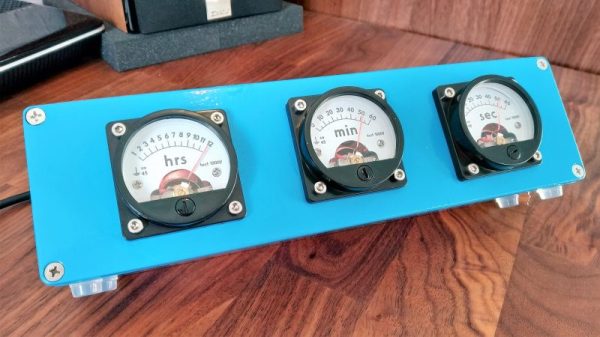
There’s something about this analog voltmeter clock that really seems to have caught on with the Redditors who commented on the r/DIY thread where we first spotted this. [ElegantAlchemist]’s design is very simple – just a trio of moving coil meters with nice industrial-looking bezels. The meters were wired for 300 volts AC, so the rectifier and smoothing cap were removed and the series resistance was substituted for one more appropriate for the 0-5VDC range needed for the project. New dial faces showing hours, minutes and seconds were whipped up in Corel Draw, and everything was put into a sturdy and colorful aluminum “stomp box” normally used for effects pedals. An Arduino Nano and an RTC drive the meters with a nice, bouncy action. Simple, cheap to build, and a real crowd pleaser.

The observant reader will note a similarity to a clock we covered a while back. That one chose 3D-printed cases for an airplane instrument cluster look. We like the spare case design in [ElegantAlchemist]’s build, but wonder how this clock would look in a fine wood case.

Plastics: PETG

You’d be hard-pressed to walk down nearly any aisle of a modern food store without coming across something made of plastic. From jars of peanut butter to bottles of soda, along with the trays that hold cookies firmly in place to prevent breakage or let a meal go directly from freezer to microwave, food is often in very close contact with a plastic that is specifically engineered for the job: polyethylene terephthalate, or PET.

For makers of non-food objects, PET and more importantly its derivative, PETG, also happen to have excellent properties that make them the superior choice for 3D-printing filament for some applications. Here’s a look at the chemistry of polyester resins, and how just one slight change can turn a synthetic fiber into a rather useful 3D-printing filament.

Continue reading “Plastics: PETG”

Adventures In Power Outage Hacking

The best type of power outage is no power outage, but they will inevitably happen. When they do, a hacker with a house full of stuff and a head full of ideas is often the person of the hour. Or the day, or perhaps the week, should the outage last long past the fun little adventure phase and become a nuisance or even an outright emergency.

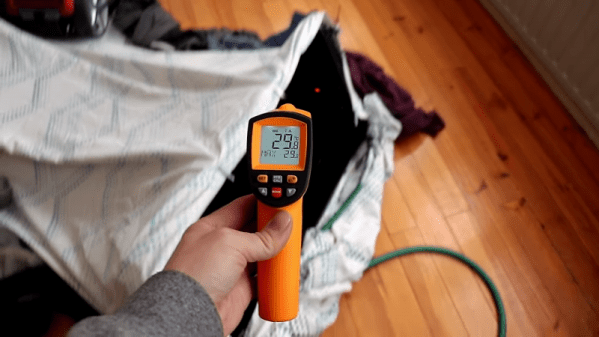
Such was the position that [FFcossag] found himself in at the beginning of January, when a freak storm knocked out power to his community on a remote island in the middle of the Baltic Sea. [FFcossag] documented his attempts to survive the eight-day outage in vlog form, and although each entry is fairly long, there’s a lot to be learned from his ordeal. His main asset was a wood cook stove in the basement of the house, which served as his heat source. He used a car radiator and a small water pump to get some heat upstairs – a battery bank provided the power for that, at least for a while. The system evolved over the outage and became surprisingly good at keeping the upstairs warm.

The power eventually came back on, but to add insult to injury, almost as soon as it did, the ground-source heat pump in the house went on the fritz. A little sleuthing revealed an open power resistor in the heat pump control panel, but without a replacement on hand, [FFcossag] improvised. Parts from a 30-year-old TV transmitter were close at hand, including a nice handful of power resistors. A small parallel network gave the correct value and the heat pump came back online.

All in all, it was a long, cold week for [FFcossag], but he probably fared better than his neighbors. Want to be as prepared for your next outage? Check out [Jenny]’s comprehensive guide.

Continue reading “Adventures In Power Outage Hacking”