The Cyborgs Among Us: Exoskeletons Go Mainstream

Every technological advancement seems to have a sharp inflection point, a time before which it seems like any early adopters are considered kooks, but beyond which the device or service quickly becomes so mainstream that non-adopters become the kooky ones. Take cell phones, for example – I clearly remember a news report back in the 1990s about some manufacturers crazy idea to put a digital camera in a phone. Seemingly minutes later, you couldn’t buy a phone without a camera.

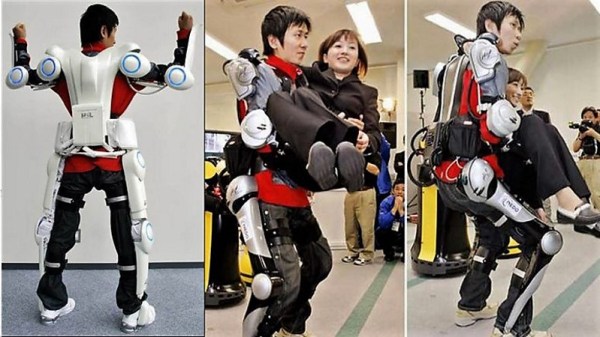
It seems like we may be nearing a similar inflection point with a technology far more complex and potentially far more life-altering than cameras in cell phones: powered exoskeletons. With increasing numbers of news stories covering advancements in exoskeletal assistants for the elderly, therapeutic applications for those suffering from spinal cord injuries and neurodegenerative diseases, and penetration into the workplace – including the battlefield – as amplifiers of human effort, it’s worth taking a look at where we are with exoskeletons before seeing someone using one in public becomes so commonplace as to go unnoticed.

Continue reading “The Cyborgs Among Us: Exoskeletons Go Mainstream”
Automate Your Comfort Food Prep With An IoT Grilled Cheese Robot

What exactly qualifies as comfort food is very much in the palate of the comfortee. Grilled cheese may not work for everyone under every circumstance, but we’ll risk a bet that the gooey delicacy is pretty close to universal, especially when you’re under the weather.

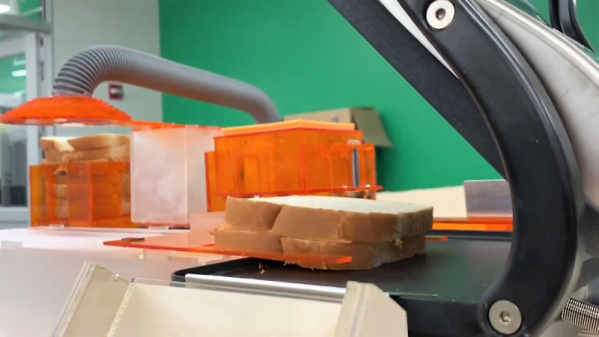
But if you’re too sick to grill up your own and don’t have anyone to do it for you, this grilled cheese sandwich-making robot might be the perfect kitchen accessory. Dubbed “The Cheeseborg” and built as a semester project by [Taylor Tabb], [Mitchell Riek], and [Evan Hill] at Carnegie-Mellon University, the bot takes a few shortcuts that might rankle the grilled cheese purist. Chief among these is the use of a sandwich press rather than a plain griddle. We understand that this greatly simplifies the flipping problem, but to us the flipping, especially the final high arcing double backflip onto the sandwich plate, is all part of the experience. Yes, a fair number of sandwiches end up going to the dog that way, but that’s beside the point.

As realized, Cheeseborg feeds bread and cheese from stacks using a vacuum arm, sprays the grill with butter, and uses a motorized arm to push the uncooked sandwich into the press. At the peak of grilled perfection, the press opens and ejects the sandwich to a waiting plate. As an added bonus, the whole thing is Google Assistant enabled so you can beseech Cheeseborg to fix you a sandwich from your sick bed. See it in action below.

This is far from the first culinary robot to grace our pages. There was the recent CNC sausage bot, we’ve seen plenty of pancake bots, and even [Ben Krasnow] once automated cookie making.

Continue reading “Automate Your Comfort Food Prep With An IoT Grilled Cheese Robot”

Quartet Of SMD Resistors Used To Sense Z-Axis Height

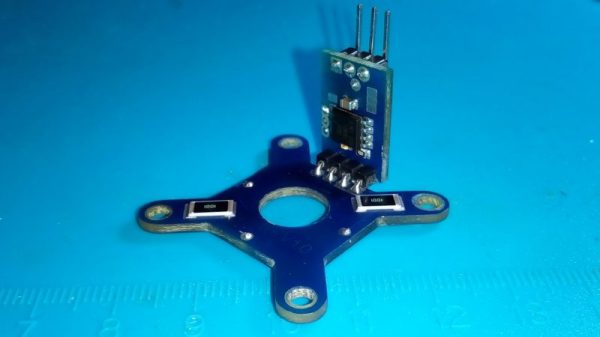
Here’s a neat trick for your next 3D-printer build or retrofit: a Z-axis sensor using a DIY strain gauge made from SMD resistors. We’re betting it could have plenty of other applications, too.

Conventional load cells, at least the ones you can pick up cheaply from the usual sources or harvest from old kitchen or bathroom scales, are usually way too big to be used on the extruder of a 3D-printer. [IvDm] wanted to build a touch sensor for his Hybercube printer, so he built his own load cell to do it. It consists of four 1000 ohm SMD resistors in the big 2512 device size. He mounted them to an X-shaped PCB and wired them in the classic Wheatstone bridge configuration, with two resistors on one side of the board and two on the other.

The extruder mounts into a hole in the center of the board and floats on it. Through an HX711 load cell driver chip, the bridge senses the slight flex of the board when the extruder bottoms out on the bed, and an ATtiny85 pulls a limit switch input to ground. [IvDm] even did some repeatability testing with this sensor and it turned out to be surprisingly consistent. The first minute or so of the video below shows it in action on the Hypercube.

We found the use of SMD resistors as strain gauges pretty clever here, but there’s plenty to do with off-the-shelf load cells: measuring how much filament is left on a roll, checking the thrust of a model rocket engine, or even figuring out if you’re peeing correctly.

Continue reading “Quartet Of SMD Resistors Used To Sense Z-Axis Height”

Rebuilding The First Vocal Encryption System

Back in the early days of radio, it was quickly apparent that the technology would revolutionize warfare, but only if some way could be found to prevent enemies from hearing what was said. During World War II, the Allies put a considerable amount of effort into securing vocal transmissions, resulting in a system called SIGSALY – 50 tons of gear developed by Bell Laboratories with the help of Alan Turing that successfully secured communications between the likes of Churchill and Roosevelt during the war.

Now, a small piece of the SIGSALY system lives again, in the form of a period-faithful reproduction of the vocal quantizer used in the system. It’s the work of [Jon D. Paul], who undertook the build to better understand how the SIGSALY system worked. [Jon] also wanted to honor the original builders, who developed a surprisingly sophisticated system given the technology of the day.

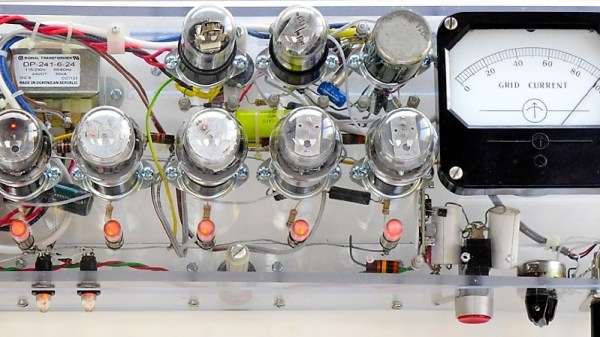
SIGSALY was seriously Top Secret in the day, and most of the documentation was destroyed when the system was decommissioned. Working from scant information, [Jon] was able to recreate the quantizer from period parts, including five vintage VT-109/2051 thyratrons scrounged from eBay. The vacuum tubes are similar in operation to silicon-controlled rectifiers (SCRs) and form the core of the ADC, along with a resistor divider ladder network. Almost every component is period correct, and everything is housed in a nice acrylic case. It’s a beautiful piece of work and a great homage to a nearly forgotten piece of cryptographic history.

Interestingly, Bell Labs had a bit of a head start on the technology that went into SIGSALY, by virtue of their work on the first voice synthesizer in the 1930s.

Continue reading “Rebuilding The First Vocal Encryption System”

Billiard Ball Finds A New Home In Custom Trackball Mouse

They walk among us, unseen by polite society. They seem ordinary enough on the outside but they hide a dark secret – sitting beside their keyboards are trackballs instead of mice. We know, it’s hard to believe, but that’s the wacky world we live in these days.

But we here at Hackaday don’t judge based on alternate input lifestyles, and we quite like this billiard ball trackball mouse. A trackball aficionado, [Adam Haile] spotted a billiard ball trackball in a movie and couldn’t resist the urge to make one of his own, but better. He was hoping for a drop-in solution using an off-the-shelf trackball, but alas, finding one with the needed features that fit a standard American 2-1/4″ (57.3 mm) billiard ball. Besides, he’s in the thumb control camp, and most trackballs that even come close to fitting a billiard ball are designed to be fiddled with the fingers.

So he started from the ground up – almost. A 1980s arcade-style trackball – think Centipede or Missile Command – made reinventing the trackball mechanism unnecessary, and was already billiard ball compatible. [Adam] 3D-printed a case that perfectly fit his hand, with the ball right under his thumb and arcade buttons poised directly below his fingers. A palm swell rises up to position the hand naturally and give it support. The case, which contains a Teensy to translate the encoder signals into USB commands, is a bit on the large side, but that’s to be expected for a trackball.

Still curious about how the other half lives? We’ve got plenty of trackball hacks for you, from the military to the game controller embedded to the strangely organic looking.

Reaction Wheels Almost Control This Unusual Drone

When you think about all the forces that have to be balanced to keep a drone stable, it’s a wonder that the contraptions stay in the air at all. And when the only option for producing those forces is blowing around more or less air it’s natural to start looking for other, perhaps better ways to achieve flight control.

Taking a cue from the spacecraft industry, [Tom Stanton] decided to explore reaction wheels for controlling drones. The idea is simple – put a pair of relatively massive motorized wheels at right angles to each other on a drone, and use the forces they produce when they accelerate to control the drone’s pitch and roll. [Tom]’s video below gives a long and clear explanation of the physics involved before getting to the build, which results in an ungainly craft a little reminiscent of a lunar lander. The drone actually manages a few short, somewhat stable flights, but in general the reaction wheels don’t seem to be up to the task. [Tom] chalks this up to the fact that he’s using the current draw of each reaction wheel motor as a measure of its torque, which is not exactly correct for all situations. He suggests that motors with encoders might do a better job, but by the end of the video the little drone isn’t exactly in shape for continued experimentation.

Of course, dodgy reaction wheels don’t only cause problems with drones. They can also be a problem for spacecraft when the Sun gets fussy too.

Continue reading “Reaction Wheels Almost Control This Unusual Drone”

Rifle-Mounted Sensor Shows What Happens During Shot

People unfamiliar with shooting sports sometimes fail to realize the physicality of getting a bullet to go where you want it to. In the brief but finite amount of time that the bullet is accelerating down the barrel, the tiniest movement of the gun can produce enormous changes in its trajectory, and the farther away your target is, the bigger the potential error introduced by anticipating recoil or jerking the trigger.

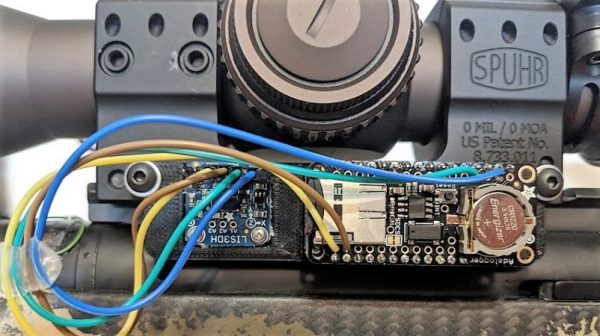
Like many problems this one is much easier to fix with what you can quantify, which is where this DIY rifle accelerometer can come in handy. There are commercial units designed to do the same thing that [Eric Higgins]’ device does but most are priced pretty dearly, so with 3-axis accelerometer boards going for $3, rolling his own was a good investment. Version 1, using an Arduino Uno and an accelerometer board for data capture with a Raspberry Pi for analysis, proved too unwieldy to be practical. The next version had a much-reduced footprint, with a Feather and the sensor mounted in a 3D-printed tray for mounting solidly on the rifle. The sensor captures data at about 140 Hz, which is enough to visualize any unintended movements imparted on the rifle while taking a shot. [Eric] was able to use the data to find at least one instance where he appeared to flinch.

We like real-world data logging applications like this, whether it’s grabbing ODB-II data from an autocross car or logging what happens to a football. We’ll be watching [Eric]’s planned improvements to this build, which should make it even more useful.