Little Laser Light Show Is Cleverly Packaged, Cheap To Build

We’re suckers for any project that’s nicely packaged, but an added bonus is when most of the components can be sourced cheaply and locally. Such is the case for this little laser light show, housed in electrical boxes from the local home center and built with stuff you probably have in your junk bin.

When we first came across [replayreb]’s write-up and saw that he used hard drives in its construction, we assumed he used head galvanometers to drive the mirrors. As it turns out, he used that approach in an earlier project, but this time around, the hard drive only donated its platters for use as low mass, first surface mirrors. And rather than driving the mirrors with galvos, he chose plain old brushed DC motors. These have the significant advantage of being cheap and a perfect fit for 3/4″ EMT set-screw connectors, designed to connect thin-wall conduit, also known as electromechanical tubing, to electrical boxes and panels. The motors are mounted to the back and side of the box so their axes are 90° from each other, and the mirrors are constrained by small cable ties and set at 45°. The motors are driven directly by the left and right channels of a small audio amp, wiggling enough to create a decent light show from the laser module.

We especially like the fact that these boxes are cheap enough that you can build three with different color lasers. In that case, an obvious next step would be bandpass filters to split the signal into bass, midrange, and treble for that retro-modern light organ effect. Or maybe figuring out what audio signals you’d need to make this box into a laser sky display would be a good idea too.

Continue reading “Little Laser Light Show Is Cleverly Packaged, Cheap To Build”

Building A Metalworking Vise, Layer By Layer

Machine shop wisdom says the lathe is the king of machine tools. We ascribe to that belief, although the common aphorism that the lathe is the only tool that can make copies of itself seems a bit of a stretch. But in the shadow of the almighty lathe is a tool without which even the simplest projects would be vastly more difficult: the lowly vise. Trouble is, finding a good vise can be a tall order. So why not take matters into your own hands and build this very sturdy vise from scratch?

Most commercially available vises are made from a couple of large castings, but as complete as [MakeItExtreme]’s metalworking shop has become, casting molten iron is not a tool in their kit — yet. So they turned back to what they know and welded up the body and jaw of the vise from mild steel. The video below shows the long sessions of welding and grinding that bring the body and the jaw into being, in the process consuming miles of MIG wire. The main screw is cut from stainless steel and threaded with the correct Acme form for such a high load application, especially given the mechanical advantage the long handle provides. The jaws have dovetails for replaceable inserts, too, which is a nice touch that’s hard to find on commercial units.

Vises on Hackaday tend to the lighter duty varieties, such as a 3D-printed vise, the Stickvise for PCBs, or even a fancied-up woodworking vise. It’s nice to see a heavy metal build for a change.

Continue reading “Building A Metalworking Vise, Layer By Layer”

Smart Child Seat Aims To Prevent Tragedy

For most of us, a memory lapse is as harmless as forgetting to bring the garbage to the curb, or maybe as expensive as leaving a cell phone and cup of coffee on the roof of the car before driving off. But when the toddler sleeping peacefully in the car seat slips your mind in the parking lot, the results can be deadly.

We have no doubt that child detection systems will soon be standard equipment on cars, like backup cameras and trunk-escape levers are now. Not willing to wait, [ayavilevich] came up with his own car occupancy sensor for child seats (Update: We originally linked to the Instructable but [ayavilevich] wrote in and mentioned this is actual Hackaday Prize entry and he’s looking for more people to get involved in the project).

Dubbed Fochica, for “Forgotten Child in Car Alert,” the system is clearly a proof of concept right now, but it has potential. The Arduino Uno senses Junior’s presence in the car seat with a homebrew capacitive sensor under the padding of the seat and a magnetic reed switch in the chest harness buckle. An Android app on a smartphone pairs with a BLE module to get the sensors’ status, and when the phone goes out of Bluetooth range while the seat is occupied, the app sounds an alarm. Simple, but effective.

We like how well [ayavilevich] thought this through. Systems like this are best left uncomplicated, so any improvements he makes should probably concentrate on engineering a reliable, fieldable device. Another hack we’ve presented in the kid-safety space is fast stairwell lights for a visually impaired girl, which might provide some ideas.

Continue reading “Smart Child Seat Aims To Prevent Tragedy”

Automated Parts Counter Helps Build A Small Business

We love to see projects undertaken for the pure joy of building something new, but to be honest those builds are a dime a dozen around here. So when we see a great build that also aims to enhance productivity and push an entrepreneurial effort along, like this automated small parts counter, we sit up and take notice.

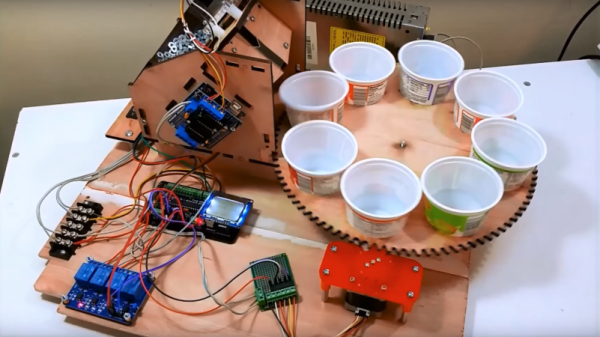
The necessity that birthed this invention is [Ryan Bates’] business of building DIY arcade game kits. The mini consoles seen in the video below are pretty slick, but kitting the nuts, bolts, spacers, and other bits together to ship out orders was an exercise in tedium. Sure, parts counting scales are a thing, but that’s hardly a walk-away solution. So with the help of some laser-cut gears and a couple of steppers, [Ryan] built a pretty capable little parts counter.

The interchangeable feed gears have holes sized to move specific parts up from a hopper to a chute. A photointerrupter counts the parts as they fall into plastic cups on an 8-position carousel, ready for bagging. [Ryan] also has a manual counter for wire crimp connectors that’s just begging to be automated, and we can see plenty of ways to leverage both solutions as he builds out his kitting system.

While we’ve seen more than a few candy sorting machines lately, it’s great to see someone building hardware to streamline the move from hobby to business like this. We’re looking forward to seeing where [Ryan] takes this from here.

Continue reading “Automated Parts Counter Helps Build A Small Business”

Simple Scanner Finds The Best WiFi Signal

Want to know which way to point your WiFi antenna to get the best signal? It’s a guessing game for most of us, but a quick build of a scanning WiFi antenna using mostly off-the-shelf components could point you in the right direction.

With saturation WiFi coverage in most places these days, optimizing your signal might seem like a pointless exercise. And indeed it seems [shawnhymel] built this more for fun than for practical reasons. Still, we can see applications where a scanning Yagi-Uda antenna would come in handy. The build started with a “WiFi divining rod” [shawnhymel] created from a simple homebrew Yagi-Uda and an ESP8266 to display the received signal strength indication (RSSI) from a specific access point. Tired of manually moving the popsicle stick and paperclip antenna, he built a two-axis scanner to swing the antenna through a complete hemisphere.

The RSSI for each point is recorded, and when the scan is complete, the antenna swings back to the strongest point. Given the antenna’s less-than-perfect directionality — [shawnhymel] traded narrow beam width for gain — we imagine the “strongest point” is somewhat subjective, but with a better antenna this could be a handy tool for site surveys, automated radio direction finding, or just mapping the RF environment of your neighborhood.

Yagi-Uda antennas and WiFi are no strangers to each other, whether it be a WiFi sniper rifle or another recycling bin Yagi.  Of course this scanner isn’t limited to WiFi. Maybe scanning a lightweight Yagi for the 2-meter band would be a great way to lock onto the local Ham repeater.

Continue reading “Simple Scanner Finds The Best WiFi Signal”

Put Plasma To Work With This Basic Toolkit

Fair warning: [Justin Atkin]’s video on how to make plasma, fusors, and magnetrons is a bit long. But it’s worth watching because he’s laying a foundation for a series of experiments with plasma, which looks like it will be a lot of fun.

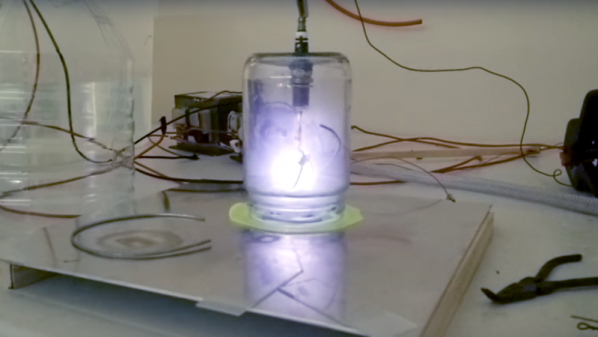
After a nice primer on the physics of plasma, [Justin] goes into some detail about the basic tools of the trade: high voltage and high vacuum. A couple of scrap microwave oven transformers, a bridge rectifier, and a capacitor provide the 2000 volts DC output needed. It’s a workable setup, but we’ll take issue with the incredibly dangerous “scariac” autotransformer, popularized by [The King of Random]. It seems foolish to risk a painful death mixing water and line current when a 20-amp variac can be had for $100.

A decent vacuum pump will be needed too, of course; perhaps the money you can save by building your own Sprengel vacuum pump can be put toward the electrical budget. Vacuum chambers are cheap too — Mason jars with ground rims and holes drilled for accessories like spark plugs. Magnets mounted below one chamber formed a rudimentary magnetron, thankfully without the resonating cavities needed for producing microwaves. Another experiment attempted vapor deposition of titanium nitride.

It’s all pretty cool stuff, and we’re looking forward to more details and results. While we wait, feel free to check out the tons of plasma projects we’ve featured, from tiny plasma speakers to giant plasma tubes.

Continue reading “Put Plasma To Work With This Basic Toolkit”

Automate The Freight: Drones Across The Sea

When you think about which of the many technological advances of the 20th century had the most impact on the global economy, which one would you rank as the most important? Would it be the space program, which gave rise to advances in everything from communications satellites to advanced composite materials? Or would it be the related aerospace industry, which stitched the world together so tightly that you can be almost anywhere on the planet within 24 hours? Or perhaps it’s the Internet, the global platform for buying almost anything from almost anyone.

Those are all important, but for the most economically impactful technology of the 20th century, I’d posit that the lowly shipping container and the containerized cargo industry that grew around it win, hands down.

Continue reading “Automate The Freight: Drones Across The Sea”