A Xilinx Zynq Linux FPGA Board For Under $20? The Windfall Of Decommissioned Crypto Mining

One of the exciting trends in hardware availability is the inexorable move of FPGA boards and modules towards affordability. What was once an eye-watering price is now merely an expensive one, and no doubt in years to come will become a commodity. There’s still an affordability gap at the bottom of the market though, so spotting sub-$20 Xilinx Zynq boards on AliExpress that combine a Linux-capable ARM core and an FPGA on the same silicon is definitely something of great interest. A hackerspace community friend of mine ordered one, and yesterday it arrived in the usual anonymous package from China.

There’s a Catch, But It’s Only A Small One
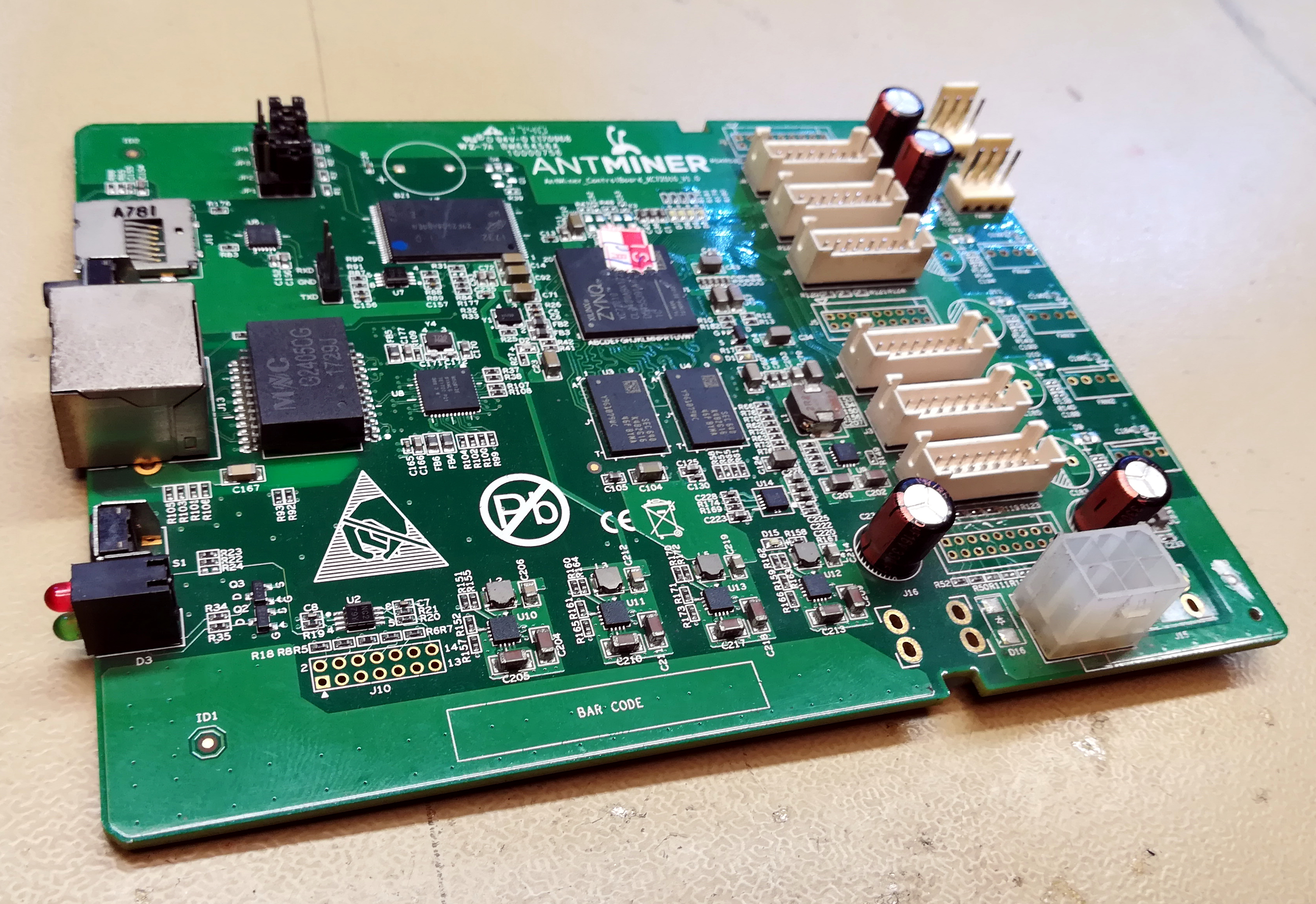
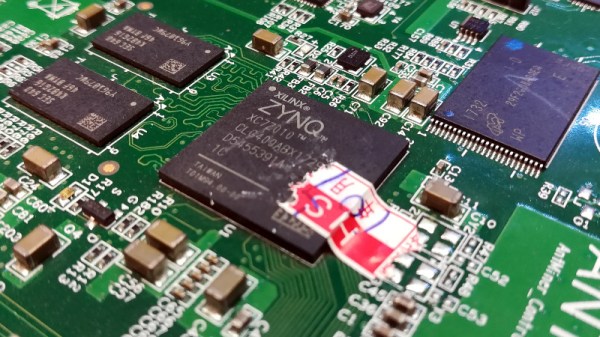
The heftier of the two boards, in all its glory.

There are two boards to be found for sale, one featuring the Zynq 7000 and the other the 7010, which the Xilinx product selector tells us both have the same ARM Cortex A9 cores and Artix-7 FPGA tech on board. The 7000 includes a single core with 23k logic cells, and there’s a dual-core with 28k on the 7010. It was the latter that my friend had ordered.

So there’s the good news, but there has to be a catch, right? True, but it’s not an insurmountable one. These aren’t new products, instead they’re the controller boards for an older generation of AntMiner cryptocurrency mining rigs. The components have 2017 date codes, so they’ve spent the last three years hooked up to a brace of ASIC or GPU boards in a mining data centre somewhere. The ever-changing pace of cryptocurrency tech means that they’re now redundant, and we’re the lucky beneficiaries via the surplus market.

Continue reading “A Xilinx Zynq Linux FPGA Board For Under $20? The Windfall Of Decommissioned Crypto Mining”

Who Says Solder Paste Stencils Have To Be CNC Cut?

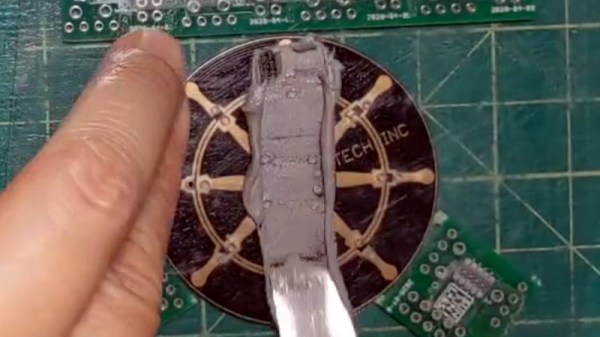
Imagine having a surface mount kit that you’d like to stencil with solder paste and reflow solder, but which doesn’t come with a solder stencil. That was what faced [Honghong Lu], and she rose to the challenge by taking a piece of PET sheet cut from discarded packaging and hand-cutting her own stencil. It’s not a huge kit, the Technologia Incognita 2020 kit, but her home-made stencil still does an effective job.

So how does one create a solder stencil from household waste? In the video we’ve put below the break, she starts with her packaging, and cuts from it a square of PET sheet. It’s 0.24mm thick, which is ideal for the purpose. She then lays it over the PCB and marks all the pads with a marker pen, before cutting or drilling the holes for the pads. The underside is then sanded to remove protruding swarf, and the stencil can then be used in the normal way. She proves it by stenciling the solder paste, hand placing the parts, and reflowing the solder on a hotplate.

It’s clear that this is best suited to smaller numbers of larger components, and we’ll never use it to replace a laser-cut stencil for a thousand tiny 0201 discretes. But that’s not the point here, it’s an interesting technique for those less complex boards, and it’s something that can be tried by anyone who is curious to give stenciling and reflowing a go and who doesn’t have a project with a ready-cut stencil. And for that we like it.

Making your own stencils doesn’t have to include this rather basic method. They can be etched, or even 3D printed.

Continue reading “Who Says Solder Paste Stencils Have To Be CNC Cut?”

A Portable Serial Terminal That Should Be From The 1970s

The humble standalone serial terminal might be long gone from the collective computing experience, but in the ghostly form of a software virtual terminal and a serial converter it remains the most basic fall-back and essential tool of the computer hardware hacker. [Mitsuru Yamada] has created the product that should have been made in the serial terminal’s heyday, a standalone handheld terminal using a 6809 microprocessor and vintage HP dot matrix LEDs. In a die-cast box with full push-button keyboard it’s entirely ready to roll up to a DB-25 wall socket and log into the PDP/11 in the basement.

Using today’s parts we might achieve the same feat with a single-chip microcontroller and a small LCD or OLED panel, but with an older microcomputer there is more system-building required. The 6809 is a wise choice from the 1970s arsenal because it has some on-board RAM, thus there’s no need for a RAM chip. Thus the whole thing is achieved with only a 2716 EPROM for the software, a 6850 UART with MAX232 driverĀ  for the serial port, and a few 74 chips for glue logic, chip selects, and I/O ports to handle keyboard and display. There’s no battery in the case, but no doubt that could be easily accommodated. Also there’s not much information on the keyboard itself, but in the video below we catch a glimpse of its wiring as the box is opened.

The value in a terminal using vintage parts lies not only in because you can, but also in something that can’t easily be had with a modern microcontroller. These parts come from a time when a computer system had to be assembled as a series of peripherals round the microprocessor because it had few onboard, leading to a far more in-depth understanding of a computer system. It’s not that a 6809 is a sensible choice in 2020, more that it’s an interesting one.

By comparison, here’s a terminal using technology from today.

Continue reading “A Portable Serial Terminal That Should Be From The 1970s”

The Gatwick Drone: Finally Someone Who Isn’t Us Asks Whether It Ever Really Existed

It’s taken two years, but finally it’s happened. Finally a respected national mass-media outlet has asked the question Hackaday were posing shortly after the event: what evidence was there that a drone was actually present in restricted airspace?

The Guardian newspaper in the UK is the outlet looking into the mystery of the Gatwick drone. It was the worldwide story of the moment around this time back in 2018 when the London airport closed down for several days in response to a series of drone reports. The assumption being put forward was that bad actors in the drone community were to blame, but there was significant disquiet in those ranks as the police and media story simply lacked credibility to anyone with knowledge of drones. At no point could they point to evidence that held water, the couple they arrested turned out to be innocent, and eventually a police officer admitted that there might not have been a drone after all. The damage had by then been done, as Received Opinion had it that irresponsible drone enthusiasts had put lives in danger and caused huge economic damage by closing an airport for several days.

The Guardian piece paints a fascinating and detailed picture of the events surrounding the investigation, by bringing the investigative journalism resources of a national newspaper into tracing and interviewing people involved from all sides. They talk to former Gatwick employees, off-the-record police officers with knowledge of the case, a drone specialist journalist, and the drone community including some of its members with significant professional experience in the world of aviation. It talks about the slow drip-feed of freedom of information requests revealing the machinations behind the scenes and furthermore the continuing lack of tangible proof of a drone. It’s very much worth a read, and we hope it will prompt further investigation of the events without the focus being on a non-existent drone.

We’d like to invite you to read Hackaday’s coverage from a few days after the event, and for an overview of the subject including the later Heathrow event, watch the CCCamp talk I presented on the topic in 2019. Then as now, our wish is for competent police investigations, responsible media reporting of drone stories, and credible official investigations of air proximity reports surrounding drones.

Header: Lucy Ingham, CC BY-SA 4.0.

A Brain Transplant For An Uncommon Smart Bulb

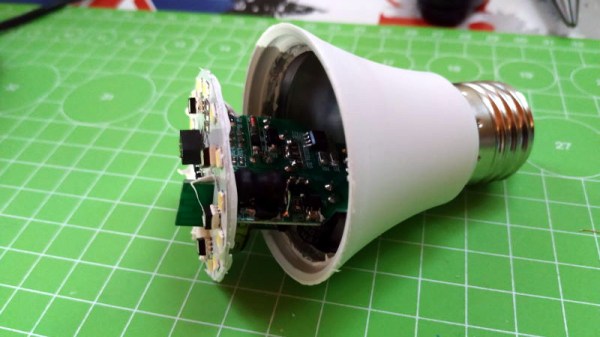
By now it’s a hardware hack that’s become common enough to be unremarkable, taking a smart light bulb or other mains switchable appliance and replacing its firmware with an open-source equivalent such as Tasmota. But what can be done when a new device is found to have a microcontroller unsupported by any open-source equivalents? If you are [Luca Dentella], you don’t throw in the towel and buy another one with a known processor, instead you reverse engineer it enough to give it a brain transplant of an ESP8266 module.

The Fcmila branded smart bulb in question was found to have a relatively unknown Chinese SoC, the Opulinks OPL1000. Since this couldn’t even raise a serial port it was more trouble than it was worth to write software for it, so instead he spent a while reverse engineering its schematic and electrical protocols, before grafting in a Wemos D1 ESP8266 board. He’s made a video about the project which you can see below the break.

Thankfully the majority of smart bulbs on the market seem to use more familiar hardware that can be flashed with relative ease.

Continue reading “A Brain Transplant For An Uncommon Smart Bulb”

Ground Off Part Number Leads To Chip Detective Work

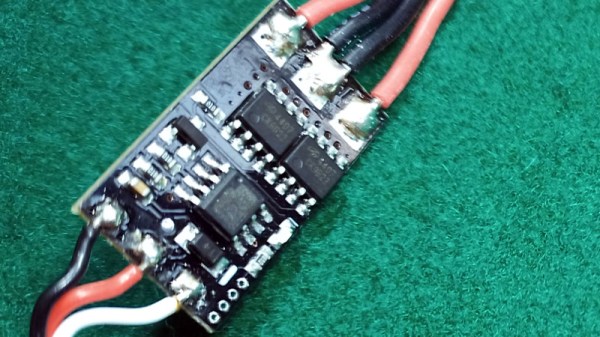
Sometimes when a piece of electronics lands on the bench, you find that its chips have their markings sanded off. The manufacturer is trying to make the task of the reverse engineer less easy, thus protecting their market. [Maurizio Butti] found an unexpected one in an electronic switch designed for remote control systems, it had the simple job of listening to the PWM signal from a receiver in a model aircraft or similar and opening or closing a FET.

From previous experience he suspected it might be a microcontroller from STC based on the location of power, ground, Rx, and Tx pins. This 8051-compatible device could be readily reprogrammed, so he has able to create his own firmware for it. He’s published the code and it’s pretty simple, as it simply replicates the original. He acknowledges that this might seem odd, but makes the point that it is left open for future upgrades such as for example repeatedly cycling the output as in a flashing light.

We don’t see so much of the STC chips here aside from one of their earlier offerings, but the 8051 core features here more regularly as it’s found in Nordic’s NRF24 series of wireless-capable chips.

A Retro Camcorder Upgraded As A Raspberry Pi HQ Camera

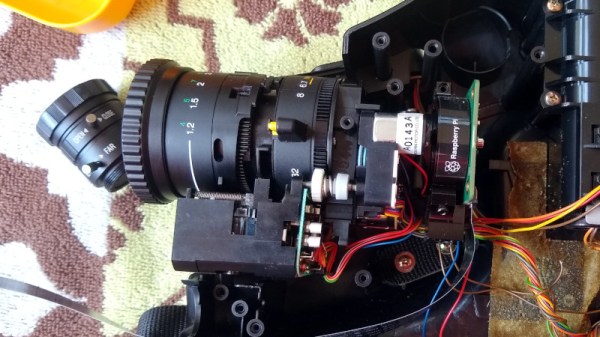
In 2020 when we carry an all-purpose computer and data terminal able to store our every thought and deed on a global computer network, it’s easy to forget that once upon a time we were excited by the simpler things. Take the camcorder for example, back in the 1990s the idea of a complete video recording solution that captured moving images on tape cartridges and fit in the palm of your hand was a very big deal indeed, and camcorders as we called them in those innocent times were a prized posession. Now they’re a $0.50 find a Goodwill, which is how [Dustin] picked up the RCA camcoder he’s converting into something altogether more modern. He’s gutted it and upgraded it by removing the analogue innards and retaining only the case and lens assembly to put around a Raspberry Pi and associated HQ camera module.

Opening the camcorder up reveals a ton of miniaturised analogue circuitry, but once the original assemblies are removed it’s relatively straightforward to put the Pi camera on the rear of the lens unit. There’s plenty of space for the Pi in the box, and he’s putting a touchscreen on the outside.

Sadly the camcorder’s original tiny CRT is no longer working, else that would have been the ultimate retro viewfinder. Still we hope to see some tinkering on that part of the project since those little CRTS make for delightful hacks. The project is very much a work in progress, but should serve that these once ubiquitous devices are now in the realm of the throwaway.

This isn’t the first such conversion we’ve seen with a Raspberry Pi, the original camera module is a handy fit to an 8mm movie camera.