The Smallest Large Display Is Projected Straight Onto Your Retina

For most of human history, the way to get custom shapes and colors onto one’s retinas was to draw it on a cave wall, or a piece of parchment, or on paper. Later on, we invented electronic displays and used them for everything from televisions to computers, even toying with displays that gave the illusion of a 3D shape existing in front of us. Yet what if one could just skip this surface and draw directly onto our retinas?

Admittedly, the thought of aiming lasers directly at the layer of cells at the back of our eyeballs — the delicate organs which allow us to see — likely does not give one the same response as you’d have when thinking of sitting in front of a 4K, 27″ gaming display to look at the same content. Yet effectively we’d have the same photons painting the same image on our retinas. And what if it could be an 8K display, cinema-sized. Or maybe have a HUD overlay instead, like in video games?

In many ways, this concept of virtual retinal displays as they are called is almost too much like science-fiction, and yet it’s been the subject of decades of research, with increasingly more sophisticated technologies making it closer to an every day reality. Will we be ditching our displays and TVs for this technology any time soon?

Continue reading “The Smallest Large Display Is Projected Straight Onto Your Retina”

On 5G And The Fear Of Radiation

The world around us is a scary place, with a lot of visible and invisible dangers. Some of those invisible dangers are pretty obvious, such as that of an electrical shock from exposed wiring. Some are less obvious, for example the dangers of UV radiation to one’s skin and eyes commonly known, but also heavily underestimated by many until it’s too late. In the US alone, skin cancer ends up affecting about one in every five people.

Perhaps ironically, while the danger from something like UV radiation is often underestimated, other types of electromagnetic radiation are heavily overestimated. All too often, the distinction between what is and isn’t considered to be harmful appears to be made purely on basis of whether it is ‘natural’ radiation or not. The Sun is ‘natural’, ergo UV radiation cannot be harmful, but the EM radiation from a microwave or 5G wireless transceiver is human-made, and therefore harmful. This is, of course, backwards.

Rather than dismissing such irrational fears of radiation, let’s have a look at both the science behind radiation and the way humans classify ‘danger’, such as in the case of 5G cell towers. Continue reading “On 5G And The Fear Of Radiation”

Navigating Self-Driving Cars By Looking At What’s Underneath The Road

When you put a human driver behind the wheel, they will use primarily their eyes to navigate. Both to stay on the road and to use any navigation aids, such as maps and digital navigation assistants. For self-driving cars, tackling the latter is relatively easy, as the system would use the same information in a similar way: when to to change lanes, and when to take a left or right. The former task is a lot harder, with situational awareness even a challenge for human drivers.

In order to maintain this awareness, self-driving and driver-assistance systems use a combination of cameras, LIDAR, and other sensors. These can track stationary and moving objects and keep track of the lines and edges of the road. This allows the car to precisely follow the road and, at least in theory, not run into obstacles or other vehicles. But if the weather gets bad enough, such as when the road is covered with snow, these systems can have trouble coping.

Looking for ways to improve the performance of autonomous driving systems in poor visibility, engineers are currently experimenting with ground-penetrating radar. While it’s likely to be awhile before we start to see this hardware on production vehicles, the concept already shows promise. It turns out that if you can’t see whats on the road ahead of you, looking underneath it might be the next best thing. Continue reading “Navigating Self-Driving Cars By Looking At What’s Underneath The Road”

Star Trackers: Telling Up From Down In Any Space

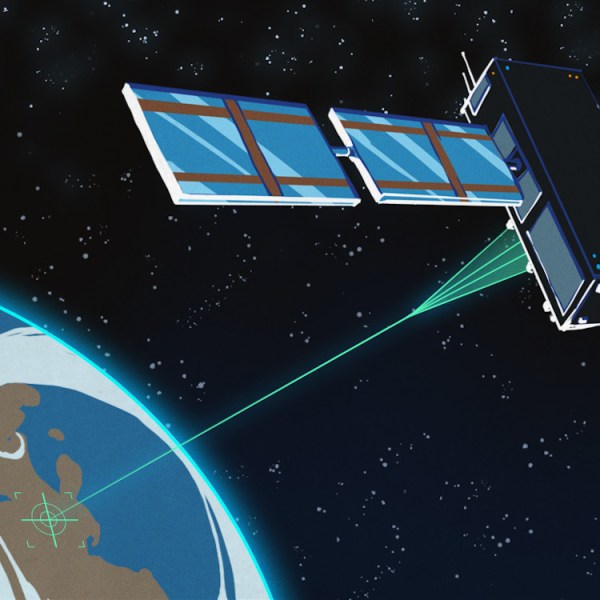
Keeping track of position is crucial in a lot of situations. On Earth, it’s usually relatively straight-forward, with systems having been developed over the centuries that would allow one to get at least a rough fix on one’s position on this planet. But for a satellite out in space, however, it’s harder. How do they keep their communications dishes pointed towards Earth?

The stars are an obvious orientation point. The Attitude and Articulation Control Subsystem (AACS) on the Voyager 1 and 2 space probes has the non-enviable task of keeping the spacecraft’s communication dish aligned precisely with a communications dish back on Earth, which from deep space is an incomprehensibly tiny target.

Back on Earth, the star tracker concept has become quite popular among photographers who try to image the night skies. Even in your living room,  VR systems also rely on knowing the position of the user’s body and any peripherals in space. In this article we’ll take a look at the history and current applications of this type of position tracking. Continue reading “Star Trackers: Telling Up From Down In Any Space”

Teaching Robots Workplace Etiquette

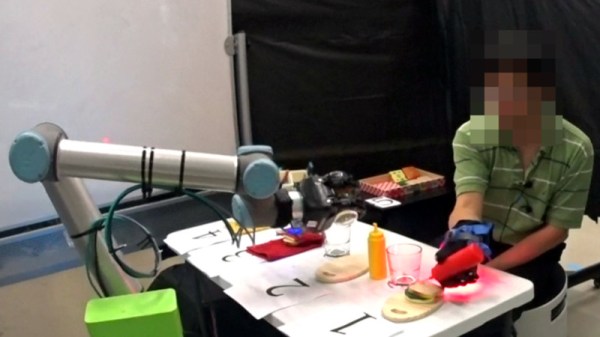
Most often, humans and robots do not have to work directly together, instead working on different parts in a production pipeline or with the robot performing tasks instead of a human. In such cases any human-robot interaction (HRI) will be superficial. Yet what if humans and robots have to work alongside each other? This is a question which a group of students at MIT’s Computer Science and Artificial Intelligence Lab (CSAIL) have recently studied some answers to.

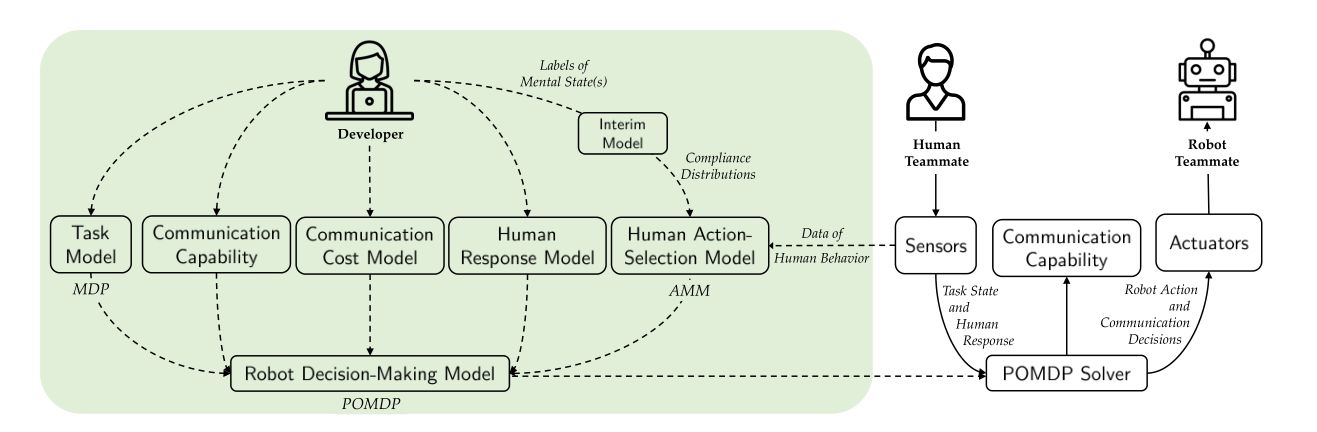
In their paper on human-robot collaborative tasks (PDF), they cover the three possible models one can use for this kind of interaction: there can be no communication (‘silent’), the communication can be pre-programmed (state machine), or in this case a Markov model-based system. This framework which they demonstrate is called CommPlan and it uses observation data from human subjects to construct a Markov model that can integrate sensor data in order to decide on its next action.

In the experiment they performed (the preparation of a meal; see the embedded video after the break), human subjects had to work alongside a robot. Between the three different approaches, the CommPlan one was the fastest, using voice interaction only when it deemed it to be necessary. The experiment’s subjects expressed hereby a preference for bidirectional communication, much as would occur between human workers.

Continue reading “Teaching Robots Workplace Etiquette”

Dissecting China-Sourced Vintage HP 1970s ICs: Genuine Or Not?

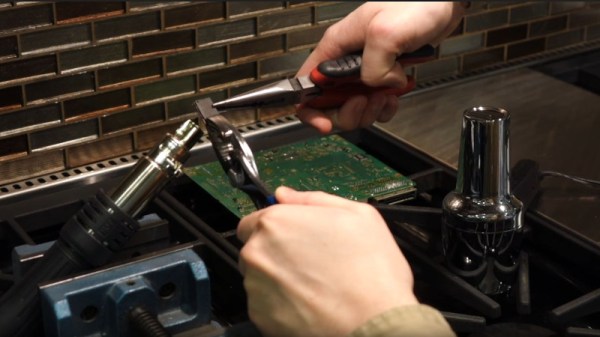
While repairing a real-time clock module for a 1970s HP computer that had been damaged by its leaky internal battery, [CuriousMarc] began to suspect that maybe the replacement clock chips which he had sourced from a seller in China were the reason why the module still wasn’t working after the repairs. This led him down the only obvious path: to decap and inspect both the failed original Ti chip and the replacement chip.

The IC in question is the Texas Instruments AC5948N (along with the AC5954N on other boards), which originally saw use in LED watches in the 1970s. HP used this IC in its RTC module, despite it never having been sold publicly. This makes it even more remarkable that a Chinese seller had the parts in stock. As some comments on the YouTube video mention, back then there wasn’t as much secrecy around designs, and it’s possible someone walked out of the factory with one of the masks for this chip.

Whether true or not, as the video (also included after the break) shows, both the original 1970s chip and the China-sourced one look identical. Are they original stock, or later produced from masks that made their way to Asia? We’ll probably never know for sure, but it does provide an exciting opportunity for folk who try to repair vintage equipment.

Continue reading “Dissecting China-Sourced Vintage HP 1970s ICs: Genuine Or Not?”

Where Do You Get Your Neutrons? Neutron Sources For Nuclear Fusion, Science, Medicine, And Industry

All of us probably know what neutrons are, or have at least heard of them back in physics class. Yet these little bundles of quarks are much more than just filler inside an atom’s nucleus. In addition to being an essential part of making matter as stable as it (usually) is, free neutrons can be used in a variety of manners.

From breaking atoms apart (nuclear fission), to changing the composition of atoms by adding neutrons (transmutation), to the use of neutrons in detecting water and inspecting materials, neutrons are an essential tool in the sciences, as well as in medicine and industrial applications. This has meant a lot of development toward the goal of better neutron sources. While nuclear fission is an efficient way to get lots of neutrons, for most applications a more compact and less complicated approach is used, some of which use nuclear fusion instead.

In this article we’ll be taking a look at the many applications of neutron sources, and these neutron sources themselves.

Continue reading “Where Do You Get Your Neutrons? Neutron Sources For Nuclear Fusion, Science, Medicine, And Industry”