Looking Around Corners With F-K Migration

The concept behind non-line-of-sight (NLOS) imaging seems fairly easy to grasp: a laser bounces photons off a surface that illuminate objects that are within in sight of that surface, but not of the imaging equipment. The photons that are then reflected or refracted by the hidden object make their way back to the laser’s location, where they are captured and processed to form an image. Essentially this allows one to use any surface as a mirror to look around corners.

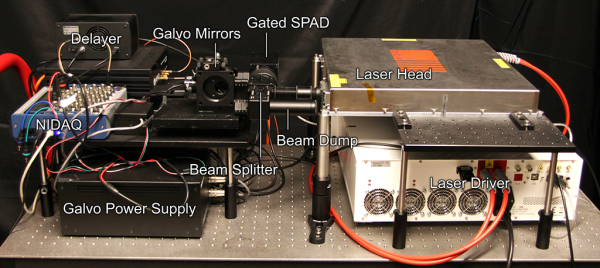
Main disadvantage with this method has been the low resolution and high susceptibility to noise. This led a team at Stanford University to experiment with ways to improve this. As detailed in an interview by Tech Briefs with graduate student [David Lindell], a major improvement came from an ultra-fast shutter solution that blocks out most of the photons that return from the wall that is being illuminated, preventing the photons reflected by the object from getting drowned out by this noise.

The key to getting the imaging quality desired, including with glossy and otherwise hard to image objects, was this f-k migration algorithm. As explained in the video that is embedded after the break, they took a look at what methods are used in the field of seismology, where vibrations are used to image what is inside the Earth’s crust, as well as synthetic aperture radar and similar. The resulting algorithm uses a sequence of Fourier transformation, spectrum resampling and interpolation, and the inverse Fourier transform to process the received data into a usable image.

This is not a new topic; we covered a simple implementation of this all the way back in 2011, as well as a project by UK researchers in 2015. This new research shows obvious improvements, making this kind of technology ever more viable for practical applications.

Continue reading “Looking Around Corners With F-K Migration”
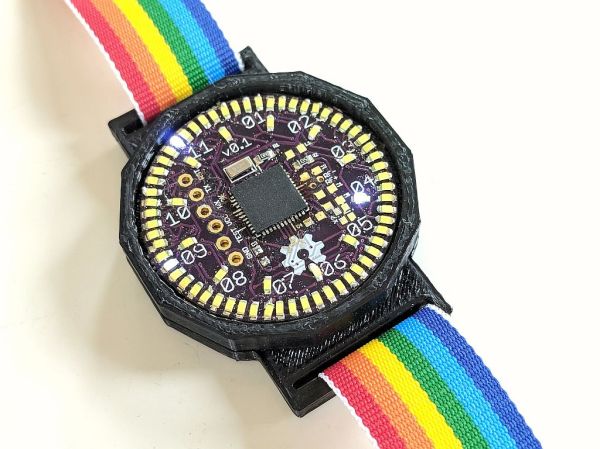
Returning Digital Watches To The Analog Age: Enter The Charliewatch

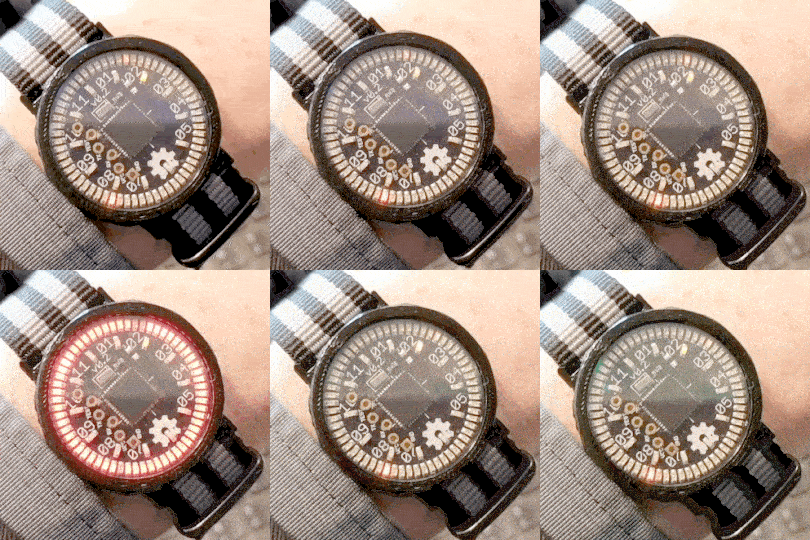
The Charliewatch by [Trammell Hudson] is one of those projects which is beautiful in both design and simplicity. After seeing [Travis Goodspeed]’s GoodWatch21 digital watch project based around a Texas Instruments MSP430-based SoC, [Trammell] decided that it’d be neat if it was more analog. This is accomplished using the CC430F5137IRGZR (a simpler member of the MSP430 family) and a whole bunch of 0603 SMD LEDs which are driven using Charlieplexing.

This time-honored method of using very few I/O pins to control many LEDs makes it possible to control 72 LEDs without dedicating 72 pins. The density makes animations look stunning and the digital nature melts away leaving a distinct analog charm.

A traditional sapphire crystal was sourced from a watchmaker for around 14€ as was the watch band itself. The rest is original work, with multiple iterations of the 3D printed case settling in on a perfect fit of the crystal, PCB, and CR2032 coin cell stackup. The watch band itself hold the components securely in the housing, and timekeeping is handled by a 32.768 kHz clock crystal and the microcontroller’s RTC peripheral.

The LEDs can be seen in both daylight and darkness. The nature of Charlieplexing means that only a few of the LEDs are ever illuminated at the same time, which does wonders for battery life. [Trammell] tells us that it can run for around six months before the coin cell needs replacing.

It’s completely open source, with project files available on the project’s Github page. We hope to see an army of these watches making appearances at all upcoming electronics-oriented events. Just make sure you lay off the caffeine as the process of hand-placing all those LEDs looks daunting.

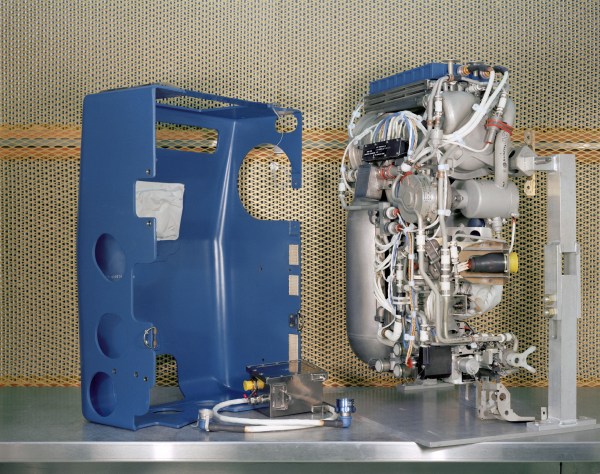
Apollo’s PLSS And The Science Of Keeping Humans Alive In Space

Ever since humans came up with the bright idea to explore parts of the Earth which were significantly less hospitable to human life than the plains of Africa where humankind evolved, there’s been a constant pressure to better protect ourselves against the elements to keep our bodies comfortable. Those first tests of a new frontier required little more than a warm set of clothes. Over the course of millennia, challenging those frontiers became more and more difficult. In the modern age we set our sights on altitude and space, where a warm set of clothes won’t do much to protect you.

With the launch of Sputnik in 1957 and the heating up of the space race between the US and USSR, many firsts had to be accomplished with minimal time for testing and refinement. From developing 1945’s then state-of-the-art V-2 sounding rockets into something capable of launching people to the moon and beyond, to finding out what would be required to keep people alive in Earth orbit and on the Moon. Let’s take a look at what was required to make this technological marvel happen, and develop the Portable Life Support System — an essential component of those space suits that kept astronauts so comfortable they were able to crack jokes while standing on the surface of the Moon.

Continue reading “Apollo’s PLSS And The Science Of Keeping Humans Alive In Space”

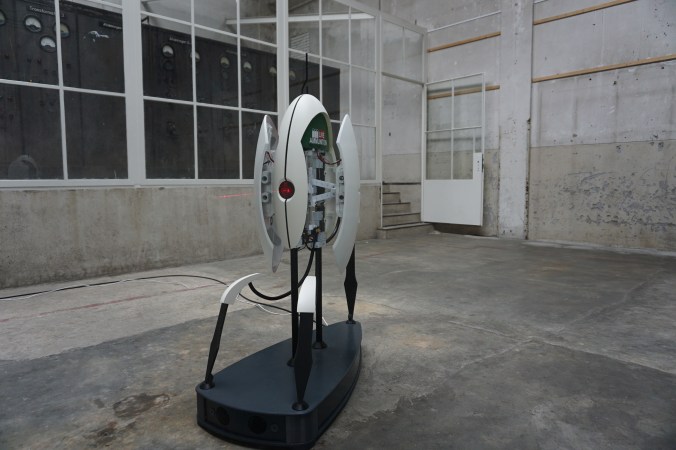
Locating Targets With Charm Courtesy Of A Life Size Portal Turret

What better way to count down the last 7 weeks to a big hacker camp like SHA2017 than by embarking on a last-minute, frantic build? That was [Yvo]’s thought when he decided to make a life-sized version of the adorably lethal turrets from the Valve’s Portal video games. Since that build made it to the finish line back then with not all features added, he finished it up for the CCC camp 2019 event, including the ability to close, open, target and shoot Nerf darts.

Originally based on the miniature 2014 turret (covered on Hackaday as well), [Yvo] details this new project in a first and second work log, along with a detailed explanation of how it all goes together and works. While the 2017 version took a mere 50 days to put together, the whole project took about 300 hours of 3D printing. It also comes with four Nerf guns which use flywheels to launch the darts.  The wheels are powered using quadcopter outrunner motors that spin at 25,000 RPM. The theoretical speed of a launched dart is over 100km/h, with 18 darts per gun and a fire rate of 2 darts per second.

The basic movement control for the system is handled by an Arduino Mega, while the talking and vision aspects are taken care of by a Raspberry Pi 3+, which ultimately also makes the decisions about how to move the system. As one can see in the video after the link, the system seems to work pretty well, with a negligible number of fatalities among company employees.

Though decidedly not a project for the inexperienced tinkerer, [Yvo] has made all of the design files available along with the software. We’re still dubious about the claims about the promised cake for completing one of these turrets, however.

Continue reading “Locating Targets With Charm Courtesy Of A Life Size Portal Turret”

Reon Pocket Keeps You Cool With A Peltier Element

With another summer of heatwaves leaving its mark on our planet, finding a way to stay cool during the day isn’t an easy task. From the morning and afternoon commute in public transport, to busy crowds outside during lunch hour, there are many times when you cannot just find a place inside an airconditioned room to deal with the heat. Exactly for this purpose Sony has successfully completed a kickstarter (in Japanese) on its corporate ‘First Flight’ crowdfunding platform for the Reon Pocket.

Many people probably aren’t aware of Sony’s crowdfunding platform, but it’s a way to gauge the interest from the public for more ‘out there’ products, which do not fit Sony’s usual business model. In this case the Reon Pocket is a Peltier-based device which is placed against the back of one’s neck, from where it can either lower or increase the body’s temperature, reportedly by -13 ℃ and +8.3 ℃ respectively.

Covered in more detail by Engadget and its Japanese sister site, the reported 24 hour battery life refers to the Bluetooth link that connects the device with one’s smartphone, whereas the battery lasts under two hours with the peltier element active. This is probably not too shocking to anyone who knows how a peltier element functions, and how much electricity they consume.

Still, the basic concept seems sound, and there are functioning prototypes. While a 2-hour battery life isn’t amazingly long, it can be just the thing one needs to keep one’s cool during that 15 minute walk to the office in a three-piece suit, without needing a shower afterwards. The device isn’t expensive either, with a projected ¥12,760 (about $117) supplied. Naturally the device will only be on sale in Japan.

Continue reading “Reon Pocket Keeps You Cool With A Peltier Element”

A Simple Way To Analyze Guitar Pickups

To the uninitiated an electric guitar seems fairly simple: you pluck a string and the electronics send the corresponding audio signal on the 6.3 mm jack output, all ready for for the amplifier to work its magic. Much of what makes a guitar like that sound good depends on the pickups, however. These are the devices which are placed between the guitar body and the strings. Depending on the guitar there can be one, two, or more of them, of varying types and configurations.

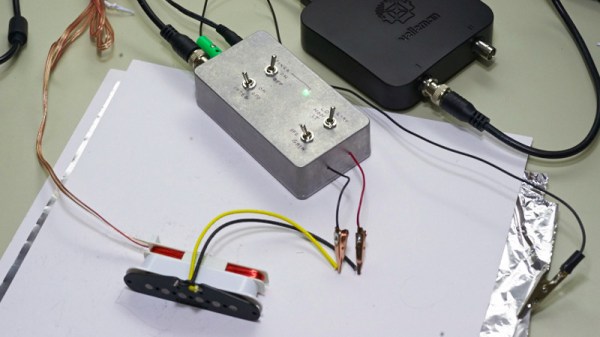
As a Gibson fan who upon getting introduced to a Fender Telecaster just had to replace its pickups with humbucking types, [Ken Willmott] found himself thrown into the wonderful world of pickup design and characterization. After two years of working through a number of designs and approaches, he eventually settled on a preamplifier design featuring a JFET opamp (LT1058) on a custom PCB which amplifies the pickup response from a test signal, acting as a front end signal conditioner.

Continue reading “A Simple Way To Analyze Guitar Pickups”

Add An Ant To Your Desk For Some Compact PCB Manufacturing

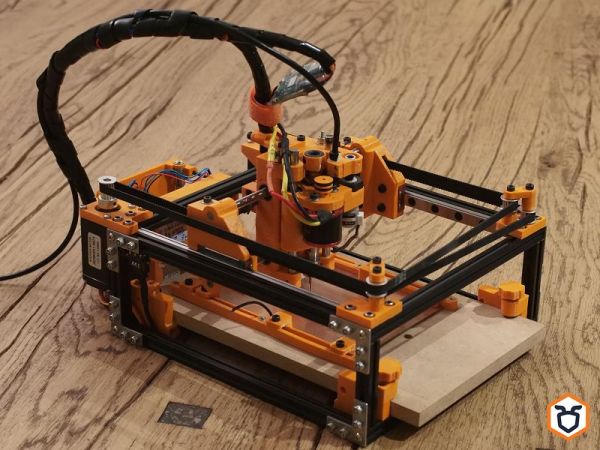
Usually when one thinks of using a CNC machine for producing PCBs, one thinks of those big, bulky CNC machines that pretty much fill an entire desk. But what if a CNC machine could be small enough to fit on a desk without getting in the way, yet still be useful enough to make single- and double-sided PCBs? This was the idea behind The Ant, the compact PCB manufacturing machine which [Mattia] and [Angelo] designed and open sourced.

In addition to the above linked Bitbucket repository for the project, the ‘Ant Team’ has a YouTube channel on which they have a range of rather professionally edited videos on the project, ranging from constructing the little machine, to various updates and more  Also see the video that is attached after the link for a visual introduction to the project.

Support and community interaction is mostly performed via the Reddit group for the project, where the diminutive machine finds a welcoming community as it continues to evolve. The machine itself is specified at this point as being able to built from commercially available and 3D printed parts, requiring no further tools for cutting or shaping. The precision is about 0.2 mm trace spacing.

Optical alignment for double-sided boards is achieved using a USB micro camera and the bCNC software, while the cost for materials is said to be quite inexpensive when compared with commercial solutions

Honestly, after seeing the machine in action, wouldn’t you want to have a CNC machine that’s so small and good-looking on your desk? If there’s one thing one might want to add, it’s probably a way to deal with the copper dust that’s produced while creating PCBs. Having to clean that off the desk after each PCB manufacturing session would get a bit cumbersome, we imagine.

Continue reading “Add An Ant To Your Desk For Some Compact PCB Manufacturing”