Author: Mike Szczys6403 Articles

Transcend DrivePro 200 Hack To Stream And Script; Begs For More
Transcend markets their DrivePro 200 camera for use as a car dashcam. We’re a bit surprised at the quality and apparent feature set for something relegated to a rather mundane task as this. But [Gadget Addict] poked around and found a nice little nugget: you can live stream the video via WiFi; the framerate, quality, and low-lag are pretty impressive. In addition to that, the next hack is just waiting for you to unlock it.
As it stands right now you turn on the camera’s built-in WiFi AP, telnet into two different ports on the device (sending it into smartphone connected mode) and you’ll be able to live stream the view to your computer using RTSP. Great, that in itself is a good hack and we’re sure that before long someone will figure out an automatic way to trigger this. [GA] also found out how to get the thing into script mode at power-on. He hasn’t actually executed any code… that’s where you come in. If you have one of these pull it out and get hacking! It’s a matter put putting files on the SD storage and rebooting. Crafting this file to enable shell access would open up an entire world of hacks, from things like time-lapse and motion sensing to special processing and filtering in real time. We think there’s huge potential so keep us up-to-date as you find new ways to pwn this hardware.
Continue reading “Transcend DrivePro 200 Hack To Stream And Script; Begs For More”

BMW Remote Unlock Wasn’t Using Secure HTTP
Ah, the old HTTP versus HTTPS. If you want to keep people out, that trailing ‘S’ should be the first thing you do, especially if you’re trying to keep people out of a luxury automobile. It turns out that BMW screwed up on that one.
BMW has an infotainment feature called ConnectedDrive which builds your favorite apps and services right into the dashboard. You can even unlock the vehicle using this system which is built around a piece of hardware that includes a GSM modem and permanent SIM card. A security research group recently discovered that the commands sent for this system were being pushed over HTTP, the unencrypted sibling of HTTPS. The firm, hired by German automobile club ADAC, disclosed the vulnerability and an over-the-air upgrade has already been pushed to patch the flaw. The patch is described to have “turned on” the HTTPS which makes us think that it was always meant to be used and just configured incorrectly in the roll-out. We’ll leave you to debate that point in the comments. Seriously, how does something like this happen? It certainly sheds a lot more light on thieves being able to magically unlock high-end cars. Was this how they were doing it?
[Thanks Fabian]

Emergency Power Based On Cordless Drill Batteries
[Don Eduardo] took matters into his own hands after experiencing a days-long power outage at his house. And like most of us have done at least one, he managed to burn his fingers on a regulator in the process. That’s because he prototyped a way to use power tool batteries as an emergency source — basing his circuit on a 7812 linear regulator which got piping hot in no time flat.
His next autodidactic undertaking carried him into the realm of switch-mode buck converters (learn a bit about these if unfamiliar). The device steps down the ~18V output to 12V regulated for devices meant for automotive or marine. We really like see the different solutions he came up with for interfacing with the batteries which have a U-shaped prong with contacts on opposite sides.
The final iteration, which is pictured above, builds a house of cards on top of the buck converter. After regulating down to 12V he feeds the output into a “cigarette-lighter” style inverter to boost back to 110V AC. The hardware is housed inside of a scrapped charger for the batteries, with the appropriate 3-prong socket hanging out the back. We think it’s a nice touch to include LED feedback for the battery level.
We would like to hear your thoughts on this technique. Is there a better way that’s as easy and adaptive (you don’t have to alter the devices you’re powering) as this one?
Continue reading “Emergency Power Based On Cordless Drill Batteries”
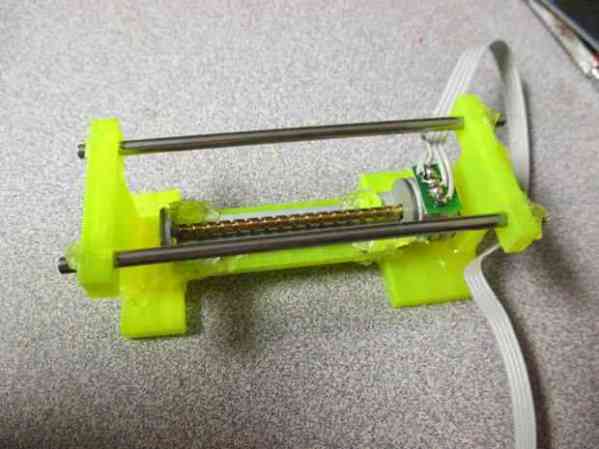
CNC Plotter Uses Only The Good DVD Drive Parts
It wasn’t that long ago that wanting to own your own 3D printer meant learning as much as you possibly could about CNC machines and then boostrapping your first printer. Now you can borrow time on one pretty easily, and somewhat affordably buy your own. If you take either of these routes you don’t need to know much about CNC, but why not use the tool to learn? This is what [Wootin24] did when building a 3D printed plotter with DVD drive parts.
Plotters made from scrapped floppy, optical drives, and printers are a popular hand, and well worth a weekend of your time. This one, however, is quite a bit different. [Wootin24] used the drives to source just the important parts for CNC precision: the rods, motors, motors, and bearings. The difference is that he designed and 3D printed his own mounting brackets rather than making do with what the optical drive parts are attached to.
This guide focuses on the gantries and the mechanics that drive them… it’s up to you to supply the motor drivers and electrical side of things. He suggests RAMPS but admins he used a simple motor driver and Arduino since they were handy.

Solar Tetroon Spooks Albuquerque
An interesting take on Hackerspace outreach is spooking the local community into calling the FAA and even the Air Force. It wasn’t exactly the plan at Quelab, but after an experimental solar tetroon got away from [Gonner Menning], one of the space’s members, that’s exactly what happened.
This is the first we remember hearing of solar tetroons. A tetroon is actually a fairly common weather balloon design using four triangle-shaped pieces. The solar part is pretty neat, it’s a balloon that uses the sun to heat air inside of a balloon. Instead of filling the bladder with a lighter-than-air gas it is filled with regular air and the sun’s rays heat it to become lighter than the surrounding ambient air.
For this particular flight the balloon was never supposed to be off the tether. Previous iterations had turned out to be rather poor fliers. Of course it figures that when [Gonner] finally tuned the design with an optimal weight to lift ratio it slipped its leash and got away. The GPS package tracked it for quite a while but ended up dying and the craft was nary to be found.
We weren’t going to embed the local news coverage video, but at the end the talking heads end up rolling around the word “Hackerspace” in their mouths like it’s foreign food. Good for a giggle after the break.
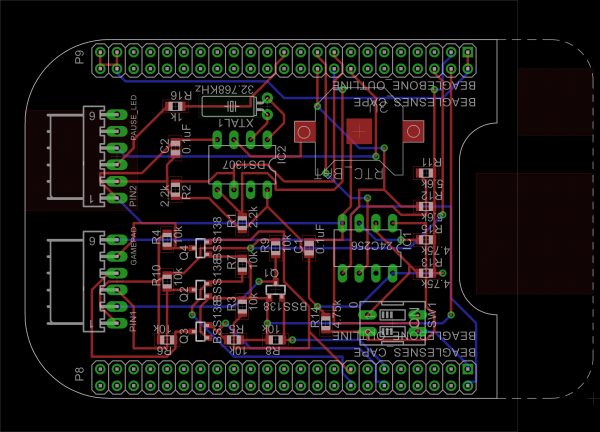
Passion Project Turns BeagleBone Into Standalone Super NES
So you want to play some retro games on your BeagleBone, just load up Linux and start your favorite emulator right? Not if you’re serious about it. [Andrew Henderson] started down this path with the BeagleBoard-xM (predecessor of the BeagleBone Black) and discovered that the performance with Snes9X wasn’t quite what he had in mind. He got the itch and created a full-blown distro called BeagleSNES which includes bootloader and kernel hacks for better peformance, a custom GUI, and is in the process of developing hardware for the embedded gaming rig. Check out the documentation that goes along with the project (PDF); it’s a blueprint for how open source project guides should be presented!
The hardware he’s currently working on is a Cape (what add-on boards for the BBB are called) that adds connectors for original Nintendo and Super Nintendo controllers. It also includes an RTC which will stand in for the real-time clock features included in some cartridges (Pokemon Yellow). Also in the works is a 3D printed enclosure which would turn it into a portable, something like this other BBB portable hack.
Check out a demo of what BeagleSNES can do in the video after the break.
Continue reading “Passion Project Turns BeagleBone Into Standalone Super NES”