
LEGO Router Case Bests Factory Finish

Stare at [Luke’s] LEGO router case; STARE AT IT! The router is nothing special, a WRT54GL that is fun to hack. We’ve seen it used as a robot, turned into a war driving box, and obviously this is where dd-wrt custom firmware started.

[Luke] designed the case in MLCAD and found a seller for the parts which came in just over $50. We think it’s much better looking than the stock case an if you used that for a different project, this is a way to replace it. We’ve embedded [Luke’s] assembly video after the break. If you like this case, take a look at his LEGO PC case as well.
Continue reading “LEGO Router Case Bests Factory Finish”

Cubicle-dwellers Rewarded For Reflexes

[youtube=http://www.youtube.com/watch?v=kUqRcLjFOUc]

[StudioJooj] is trying to torture or test his colleagues in his office. A lot of folks leave a candy jar on their desks for all to enjoy but he’s making his friends work for their reward. Like cubicle-dwelling lab subjects, they must successfully navigate his maze to be rewarded with chocolate. The game piece is an amazingly orb-like peanut M&M candy. The maze is constructed from plywood and moves on two axis with the help of a couple of servos. The user interface includes a couple of NES console buttons to release the game piece and a PS2 joystick to control the maze. [StudioJooj] was nice enough to include a music video in his project clip.

We wonder the M&Ms will disappear faster or slower than they would from a candy jar.

[via SparkFun]

Makita Battery Pack Repair

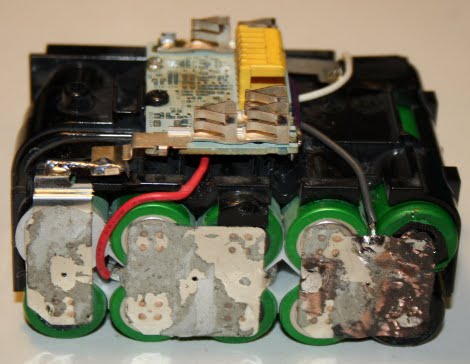
[Rob] grew tired of his Makita power tool battery packs dying so he figured out how to repair them himself. The video after the break walks us through the process which starts by cracking open the case. Inside there is a controller board and a battery of ten cells. [Rob] has pinpointed these battery failures to just the first cell, which is confirmed by measuring the cell voltages with a multimeter. The first cell in the demonstration battery reads zero volts and needs to be replaced. For some reason he’s got heck of a lot of these cells on hand, at the end of the video he shows off a massive block of them that provides one half of a kilowatt-hour of power.

To complete the resurrection he removed the control circuitry from the integrated PCB. It seems that the microcontroller on the battery’s PCB monitors it and bricks them when it thinks the life of the unit has ended. By hacking a charger he can now balance-charge the altered battery packs and get more use out of them before they hit the landfill.

Continue reading “Makita Battery Pack Repair”

Bike Trainer Computer: Speed, Cadence, Heartrate, Trainer Temp

[Kurt] was using a bike trainer to get in shape for warmer and dryer biking months. Unfortunately it’s pretty hard to train if you don’t have reliable data concerning how hard you’re working. There’s commercial solutions for trainer computers but he’d read some rough reviews about them and decided to build his own trainer computer. He’s done a great job of integrating a lot of different data collection sources. He picked up two replacement bike computer sensors to use on the back wheel for speed (the front wheel is stationary with this type of trainer) and on the crank for cadence. He also wears a heart rate monitor and sourced a SparkFun heart rate module to gather that data. Finally, an LM235 analog temperature sensor was combined with a spring clamp to detect the temperature of the trainer’s resistance module.

Data from the sensors is collected with a PIC16F73 microprocessor and fed to a computer over a serial connection. He’s got a screenshot of the realtime graphs that he’s using for feedback while on the bike. This is a useful and practical setup but when he get’s tired of exercising he’s just a few lines of code from converting this into a gaming controller.

[Thanks Justin]

Don’t Put That EPROM In Your Mouth!

[Jeremy] had some chips on hand that included EPROM.  We’re not talking about EEPROM, we mean EPROM that need a UV light source to erase. Most people don’t want to drop a few hundred dollars on a dedicated EPROM eraser, there must be another way.

Boy, EPROM really suck. But so do pacifiers and he already had a solution for exposing those to UV. He pulled out his $30 UV pacifier cleaner and tossed the chip inside. Two times through the cleaning cycle and the data was gone. We’ve looked into using UV LEDs to do the job but some experimentation shows that it doesn’t work. These pacifier cleaners are cheap and easy to get a hold of. The real question is are you still using chips that require UV for erasing?

Stroke To Unlock

If you’re into embedded clothing this stroke sensor is for you. As demonstrated in the video after the break, stroking the threads in a particular direction will create a circuit that senses and, in this case, turns on an LED. The concept uses two conductive buses on the back of a piece of neoprene. Conductive and non-conductive threads are then  added for a furry or bristly finish. When stroked perpendicular to the power buses the conductive threads come together and form a circuit.

For some reason this just seems a bit creepy to us but perhaps that’s only because we haven’t come up with the right application for the technology. We’re pretty sure that a sweatshirt with an LED marquee and a “hairy” back that you stroke to illuminate is the wrong application.

Continue reading “Stroke To Unlock”

Arduinome With Many Pots

[Aggaz] added 16 potentiometers to his Arduinome.The Arduinome is a monome clone based around the Arduino as a microprocessor. We seen some Arduinome builds in the past but [Aggaz’s] work augments the physical interface.

Potentiometers used in circuit bending allow for manipulation of the sounds coming out of the circuits. In this case the pots are connected to the microcontroller instead of the sound generation circuitry which means you can do whatever you want with them depending on how creative you are with the code. So far he’s just starting to get the new set of interfaces to play nicely over the serial connection. This could end up being quite popular as it only requires the addition of a multiplexer IC, the potentiometers, and the knobs.









