The Beat Goes On With This ESP32 Page Turner

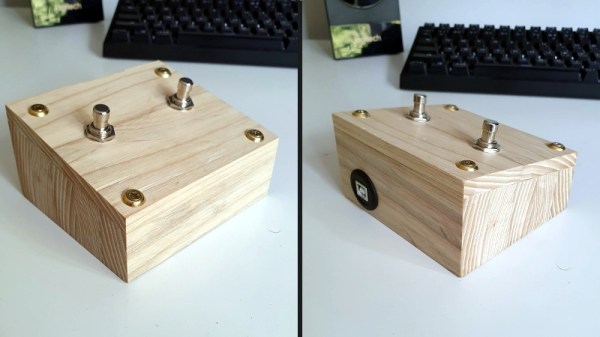
Looking for a hands-free way to page through sheet music on an iPad, [The_Larch] came up with this simple Bluetooth input device based on the ESP32. The microcontroller just needed to have two switches wired into the GPIO pins, in this case the same heavy-duty plungers you’d find on a guitar pedal, and a USB bulkhead pass-through to provide power. Thanks to the excellent ESP32-BLE-Keyboard library, it only took a few lines of code to fire off the appropriate key strokes when the left or right button was pressed.
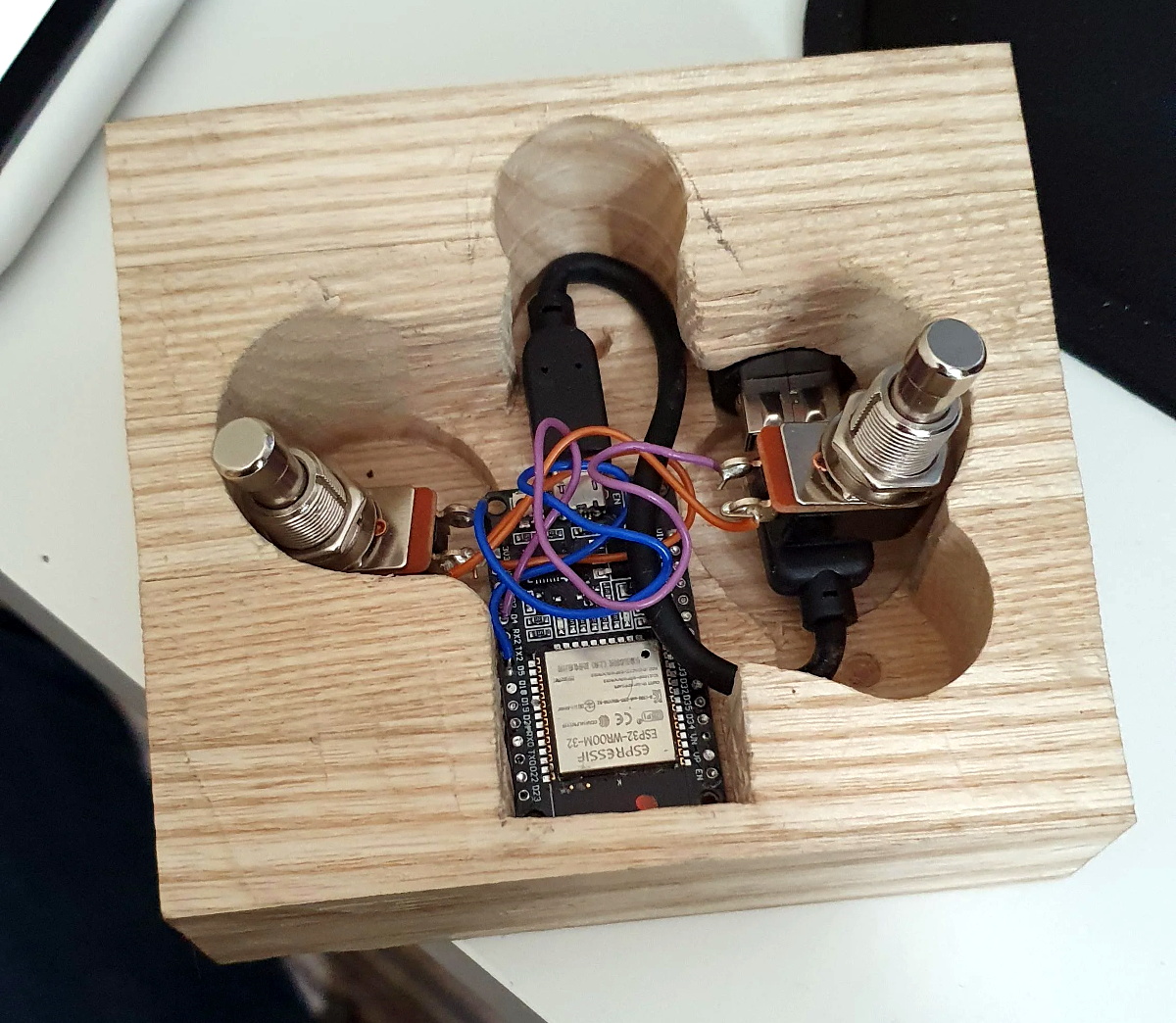
While undeniably a simple project from an electronics standpoint, the wooden enclosure [The_Larch] built is an interesting change of pace from the 3D printed fare we normally see around these parts. It started life as strips of oak reclaimed from an old kitchen table, which were laminated together to make a solid block. A large spade bit was then used to bore into the block to make a void for the electronics, and a second flat piece of oak was fashioned into a front panel.

Creating Bluetooth input devices with the ESP32 is so incredibly straightforward that we’re honestly a little surprised we don’t see the trick used more often. Especially when you consider all of the custom made keyboards that have graced these pages over the last couple of years. The tools are available for anyone who wants them, so you have to wonder if hackers just aren’t fond of using Bluetooth for something as important as a keyboard?


Unmasking The Identity Of An Unusual Nintendo DS

The Nintendo DS family encompasses a dizzying array of portable game systems released over a span of 17 years. The original DS received several refreshes and special editions, and when the next generation 3DS came along, it spawned a whole new collection of spin-offs. But even among all those machines there’s a name that even Mario himself would never have heard of: the Nintendo DS ML.

In a recent video, [The Retro Future] says he discovered this oddball system selling for around $25 USD on Chinese shopping site Taobao and bought one so he could get a closer look at it. Externally the system looks quite a bit like the refreshed DS Lite, but it’s notably larger and the screens look quite dated. That was already a strong hint to its true identity, as was the placement of its various buttons and controls.

Note the conspicuous absence of Nintendo’s name.

But it wasn’t until [The Retro Future] cracked the system open that he could truly confirm what he had on his hands. This was an original Nintendo DS, potentially a new old stock unit that had never been distributed, which was transplanted into a custom enclosure designed to look like one of the later upgraded models. As for what this seller meant by calling this chimera the DS ML is anyone’s guess, though one of the commenters on the video thought “Maybe Legal” had a nice ring to it.

Now assuming these really are brand new systems that were simply installed in fresh cases, $25 is arguably a good deal. So long as you aren’t concerned with playing the latest titles, anyway. But at the same time its a reminder that you get what you pay for when dealing with shady overseas sellers. It’s just as likely, perhaps even more so, that these were used systems that got spruced up to make a quick buck.

Fake components are everywhere. In fact there’s an excellent chance most of the people reading this site have received some fake parts over the years, even if they didn’t realize it at the time. When there’s fly by night companies willing to refurbish a nearly 20 year old Nintendo handheld for $25, what are the chances that Bosch actually made that $2 temperature sensor you just ordered on eBay?

Continue reading “Unmasking The Identity Of An Unusual Nintendo DS”

Tightly Packed Raspberry Pi Tricorder Impresses

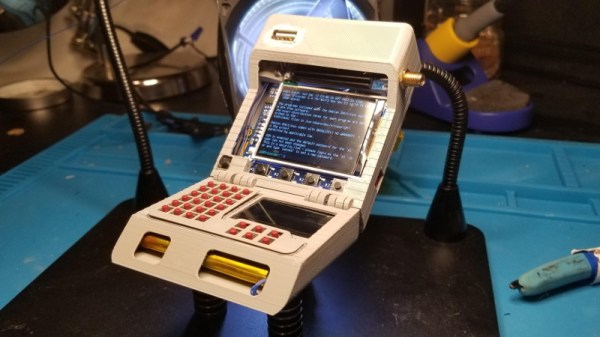
We’ll say upfront that we don’t have nearly as much information about this 3D printed Star Trek: The Next Generation tricorder as we’d like. But from the image galleries [Himmelen] has posted we know it’s running on the Raspberry Pi Zero W, has a color LCD in addition to a monochrome OLED, and that it’s absolutely packed with gear.

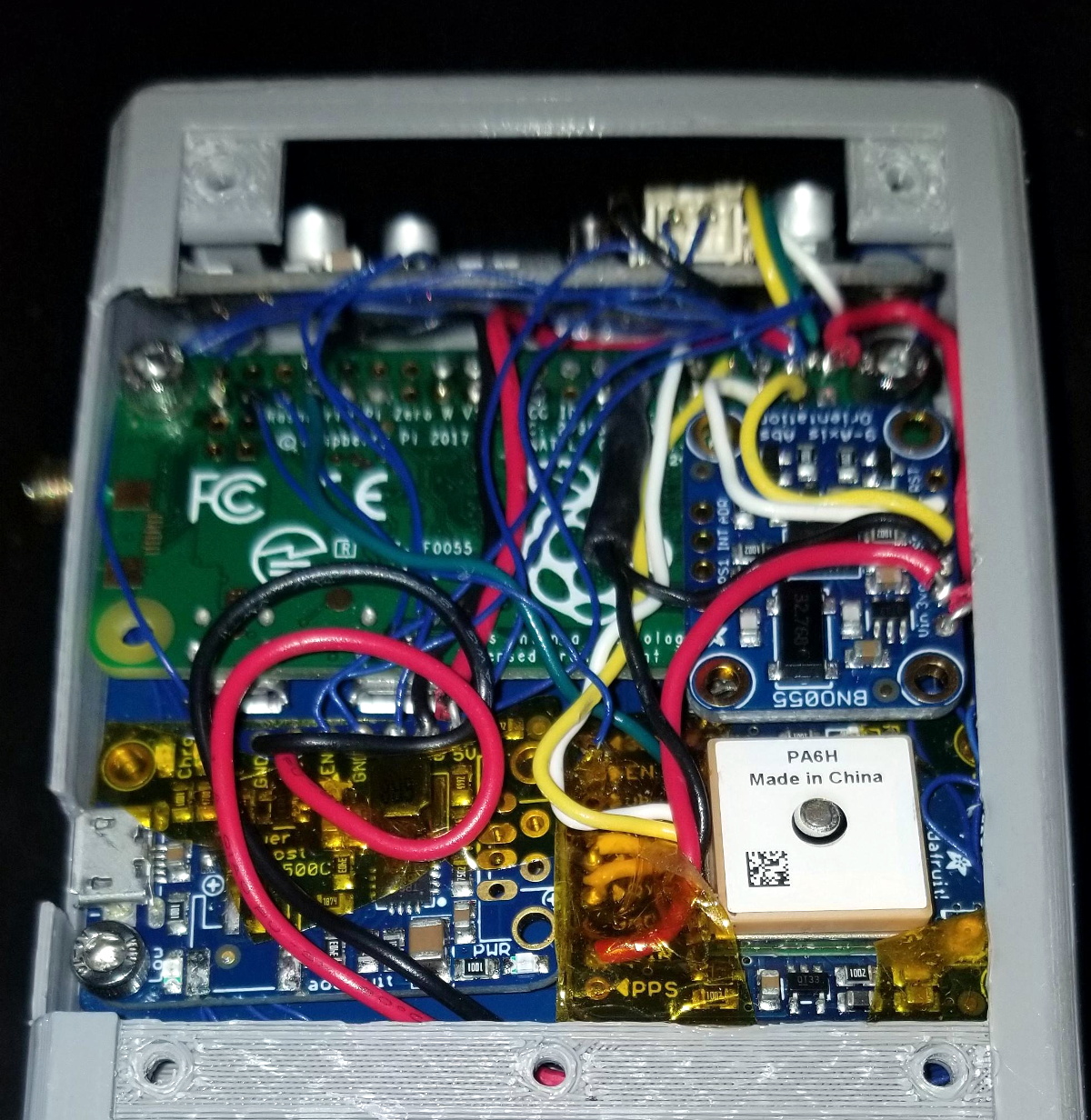
So far, [Himmelen] has fit an NESDR RTL-SDR dongle, a GPS receiver, an accelerometer, and the battery charging circuitry in the top half of the case. Calling it a tight fit would be something of an understatement, especially when you take into account all the wires snaking around in there. But as mentioned in the Reddit thread about the device, a custom PCB backplane of sorts is in the works so all these modules will have something a little neater to plug into.

There are a lot of fantastic little details in this build that have us very excited to see it cross the finish line. The female USB port that’s been embedded into the top of the device is a nice touch, as it will make it easy to add storage or additional hardware in the field. We also love the keyboard, made up of 30 individual tact switches with 3D printed caps. It’s hard to imagine what actually typing on such an input device would be like, but even if each button just fired off its own program or function, we’d be happy.

Judging by the fact that the LCD shows the Pi sitting at a login prompt in all the images, we’re going to go out on a limb and assume [Himmelen] hasn’t gotten to writing much software for this little gadget yet. Once the hardware is done and it’s time to start pushing pixels though, something like Pygame could be used to make short work of a LCARS-style user interface that would fit the visual style of The Next Generation. In fact, off the top of our heads we can think of a few turn-key projects out there designed for creating Trek UIs, though the relatively limited computational power of the Pi Zero might be a problem.

We’ve seen several projects that tried to turn the iconic tricorder into a functional device. Some have focused on the arguably more recognizable Next Generation style such as this one, and others have targeted the more forgiving brick-shaped unit from Kirk and Spock’s era. The Wand Company is even working on a officially licensed tricorder that will supposedly be as close to we can get to the real thing with modern tech and a $250 USD price tag, though we’d wager COVID has slowed progress down on that one. In any event, whether you build it or buy it, the tricorder seems destined to become reality before too long.

Heavy Metal Cyberdeck Has An Eye Towards Expansion

Whether we’re talking about Gibson’s Sprawl or our increasingly dystopian reality, one of the defining characteristics of a cyberdeck is that it can be easily customized and upgraded over time. While a few of the builds we’ve covered over the last couple of years have focused more on style than substance, we really appreciate the designs that embrace the concept of modularity to make sure the system can evolve to meet the changing demands of hacking on the go.

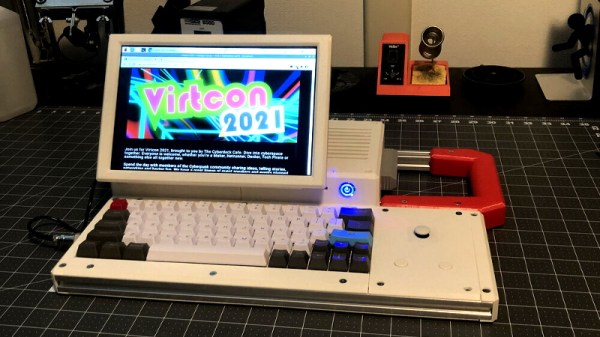
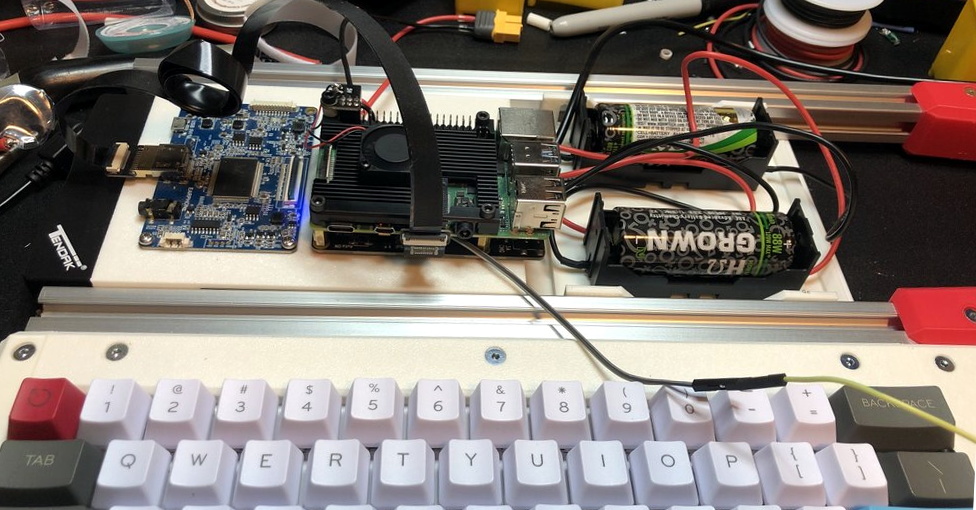
To that end, the M3TAL from [BlastoSupreme] is a perfect example of what a cyberdeck should be. Naturally it’s got the cyberpunk aesthetics we’ve come to expect, but more importantly, it’s designed so modifications and repairs are as quick and painless as possible. The trick is the use of a 2020 aluminum extrusion frame, which allows external panels and components to be attached anywhere along the length of the deck using T-Nuts. Similarly, by mounting internal components to “sleds” that ride between the pieces of extrusion, the electronics can easily be removed or swapped out as complete modules.

The M3TAL is currently outfitted with a Raspberry Pi 4 and a pair of 26650 batteries.

Furthering the idea of expandability, [BlastoSupreme] included an authentic 3.5 floppy drive on the M3TAL that allows him to pack an incredible 1.44 MB onto each rugged and portable disk. OK, so maybe the floppy drive isn’t terribly impressive compared to 2021 tech, but it does seem oddly appropriate for a cyberdeck. On the opposite side of the deck there’s a RetroCART slot, which cloaks modern USB devices in clunky faux cartridges. This provides a unified physical format for everything from removable storage to microcontrollers and software defined radio receivers.

Continue reading “Heavy Metal Cyberdeck Has An Eye Towards Expansion”

Crew Dragon’s Short Hop Begins The Era Of Valet Parking At The ISS

They weren’t scheduled to return to Earth until April 28th at the earliest, so why did NASA astronauts Michael Hopkins, Victor Glover, and Shannon Walker, along with Japan Aerospace Exploration Agency (JAXA) astronaut Soichi Noguchi, suit up and climb aboard the Crew Dragon Resilience on April 5th? Because a previously untested maneuver meant that after they closed the hatch between their spacecraft and the International Space Station, there was a chance they weren’t going to be coming back.

On paper, moving a capsule between docking ports seems simple enough. All Resilience had to do was undock from the International Docking Adapter 2 (IDA-2) located on the front of the Harmony module, itself attached to the Pressurized Mating Adapter 2 (PMA-2) that was once the orbital parking spot for the Space Shuttle, and move over to the PMA-3/IDA-3 on top of Harmony. It was a short trip through open space, and when the crew exited their craft and reentered the Station at the end of it, they’d only be a few meters from where they started out approximately 45 minutes prior.

The maneuver was designed to be performed autonomously, so technically the crew didn’t need to be on Resilience when it switched docking ports. But allowing the astronauts to stay aboard the station while their only ride home undocked and flew away without them was a risk NASA wasn’t willing to take.

What if the vehicle had some issue that prevented it from returning to the ISS? A relocation of this type had never been attempted by an American spacecraft before, much less a commercial one like the Crew Dragon. So while the chances of such a mishap were slim, the crew still treated this short flight as if it could be their last day in space. Should the need arise, all of the necessary checks and preparations had been made so that the vehicle could safely bring its occupants back to Earth.

Thankfully, that wasn’t necessary. The autonomous relocation of Crew Dragon Resilience went off without a hitch, and SpaceX got to add yet another “first” to their ever growing list of accomplishments in space. But this first relocation of an American spacecraft at the ISS certainly won’t be the last, as the comings and goings of commercial spacecraft will only get more complex in the future.

Continue reading “Crew Dragon’s Short Hop Begins The Era Of Valet Parking At The ISS”

Homebrew RISC-V Computer Has Beauty And Brains

Building your own CPU is arguably the best way to truly wrap your head around how all those ones and zeros get flung around inside of a computer, but as you can probably imagine even a relatively simple processor takes an incredible amount of time and patience to put together. Plus, more often than not you’re then left with a maze of wires and perfboards that takes up half your desk and doesn’t do a whole lot more than blink some LEDs.

An early prototype of the Pineapple ONE.

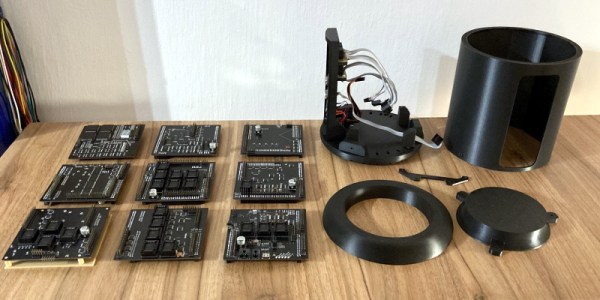
But the Pineapple ONE, built by [Filip Szkandera] isn’t your average homebrew computer. Oh sure, it still took two years for him to design, debug, and assemble, his 32-bit RISC-V CPU and all its associated hardware; but the end result is a gorgeous looking machine that runs C programs and offers a basic interactive shell over VGA. In fact with its slick 3D printed enclosure, vertically stacked construction, and modular peripheral connections, it looks more like some kind of high-tech scientific instrument than a computer; homebrew or otherwise.

[Filip] says he was inspired to build this 500 kHz (yes, kilohertz) beauty using only discrete logic components by [Ben Eater]’s well known 8-bit  breadboard computer and [Robert Baruch]’s LMARV-1 (Learn Me A RISC-V, version 1). He spent six months simulating the machine before he even started creating the schematics, let alone design the individual boards. He tried to keep all of his PCB’s under 100 x 100 mm to take advantage of discounts from the fabricator, which ultimately led to the decision to align the nine boards vertically and connect them together with pin headers.

In the video below you can see [Filip] start up the computer, call up a bit of system information, and even play a rudimentary game of snake before peeking and poking some of the machine’s 512 kB of RAM. It sounds like there’s still some work to be done and bugs to squash, but we’ve already seen enough to say this machine has more than earned entry into the pantheon of master-crafted homebrew computers.

Continue reading “Homebrew RISC-V Computer Has Beauty And Brains”

Teardown: Linkimals Musical Moose

Like so many consumer products these days, baby toys seem to get progressively more complex with each passing year. Despite the fact that the average toddler will more often than not be completely engrossed by a simple cardboard box, toy companies are apparently hell-bent on producing battery powered contraptions that need to be licensed with the FCC.

As a perfect example, we have Fisher-Price’s Linkimals. These friendly creatures can operate independently by singing songs and flashing their integrated RGB LEDs in response to button presses, but get a few of them in the room together, and their 2.4 GHz radios kick in to create an impromptu mesh network of fun.

They’ll soon be back, and in greater numbers.

Once connected to each other, the digital critters synchronize their LEDs and sing in unison. Will your two year old pay attention long enough to notice? I know mine certainly wouldn’t. But it does make for a compelling commercial, and when you’re selling kid’s toys, that’s really the most important thing.

On the suggestion of one of our beloved readers, I picked up a second-hand Linkimals Musical Moose to take a closer look at how this cuddly pal operates. Though in hindsight, I didn’t really need to; a quick browse on Amazon shows that despite their high-tech internals, these little fellows are surprisingly cheap. In fact, I’m somewhat embarrassed to admit that given its current retail price of just under $10 USD, I actually paid more for my used moose.

But you didn’t come here to read about my fiscal irresponsibility, you want to see an anthropomorphic woodland creature get dissected. So let’s pull this smug Moose apart and see what’s inside.

Continue reading “Teardown: Linkimals Musical Moose”