Media Streamer With E-Ink Display Keeps It Classy

The Logitech SqueezeBox was a device you hooked up to your stereo so you could stream music from a Network Attached Storage (NAS) box or your desktop computer over the network. That might not sound very exciting now, but when [Aaron Ciuffo] bought it back in 2006, it was a pretty big deal. The little gadget has been chugging all these years, but the cracks are starting to form. Before it finally heads to that great electronics recycling center in the sky, he’s decided to start work on its replacement.

Thanks to the Raspberry Pi, building a little device to stream digital audio from a NAS is easy these days. But a Pi hooked up to a USB speaker isn’t necessarily a great fit for the living room. [Aaron] didn’t necessarily want his replacement player to actually look like the SqueezeBox, but he wanted it to be presentable. While most of us probably would have tried to make something that looked like a traditional piece of audio gear, he took his design is a somewhat more homey direction.
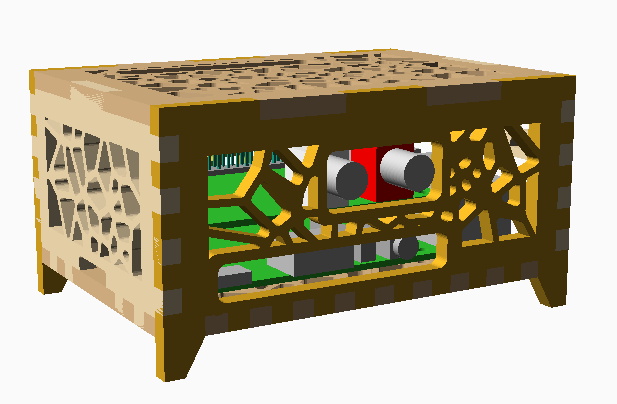
An OpenSCAD render of the enclosure.

The Raspberry Pi 4 and HiFiBerry DAC+ Pro live inside of a wooden laser cut case that [Aaron] designed with OpenSCAD. We generally associate this tool with 3D printing, but here he’s exporting each individual panel as an SVG file so they can be cut out. We especially like that he took the time to add all of the internal components to the render so he could be sure everything fit before bringing the design into the corporeal world.

While the case was definitely a step in the right direction, [Aaron] wasn’t done yet. He added a WaveShare e-Paper 5.83″ display and mounted it in a picture frame. Software he’s written for the Raspberry Pi shows the album information and cover art on the display while the music is playing, and the current time and weather forecast when it’s idle. He’s written the software to plug into Logitech’s media player back-end to retain compatibility with the not-quite-dead-yet SqueezeBox, but we imagine the code could be adapted to whatever digital media scheme you’re using.

Over the years, we’ve seen a number of SqueezeBox replacements. Many of which have been powered by the Raspberry Pi, but even the ESP8266 and ESP32 have gotten in on the action recently.
Latest FlexLED Milestone Refines The POV Display

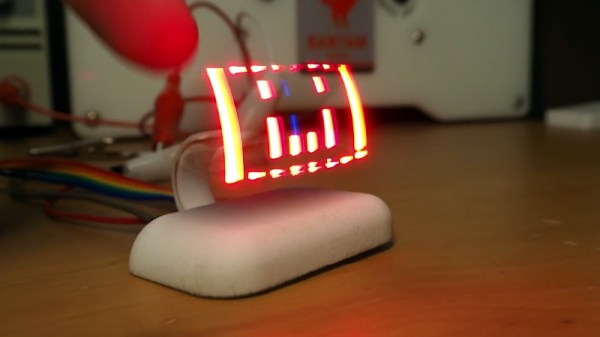
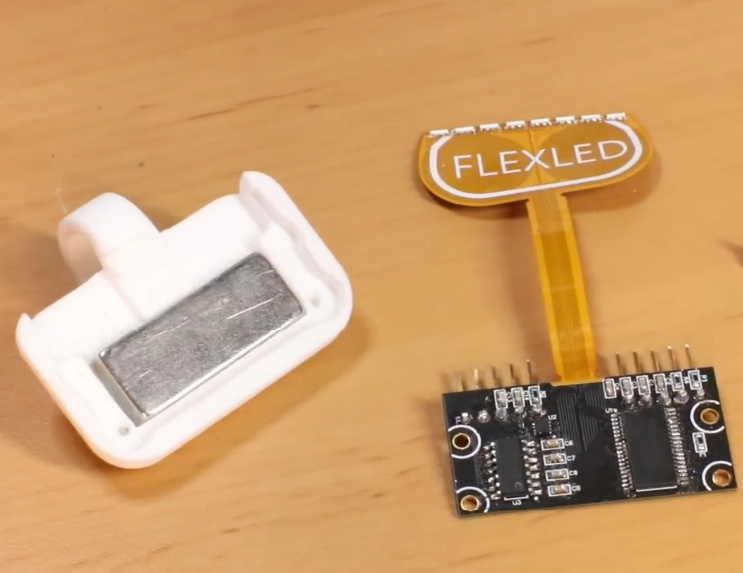
With his FlexLED project, [Carl Bugeja] is trying to perfect a simple and affordable persistence of vision (POV) display capable of generating “holographic” characters in mid-air. Traditionally POV systems spin LEDs rapidly to create the desired illusion, but that means motors, slip rings, and noise. As the name implies, the goal with this project is to do away with all that and replace it with a self-actuating flexible PCB.

The device is able to quickly move the LEDs back and forth quietly and efficiently thanks to a permanent magnet and magnetic coils integrated into the flexible PCB. With no motors or gears, the whole unit is smaller and less complex than other POV displays. As an added bonus, there’s no danger to the operator or the device should a curious user stick their finger into it.

The last time we took a look at this project, [Carl] had entered an earlier single-LED version into the 2019 Hackaday Prize. Competition was tough last year, and unfortunately FlexLED didn’t get selected as a Finalist. But we’re still extremely interested in seeing the project develop, and we imagine so are you.

The recently completed second version of the display features an improved coil design, eight RGB LEDs and a 3D printed base with integrated magnet. With more LEDs onboard, a single display is able to show multiple characters and even rudimentary animations. A large array of these flapping elements promises to be quite a sight.

But before you get too excited, [Carl] does have some bad news. For one, the cost of building them in small quantities is high, which is always tough for a single hacker trying to iterate a design. Worse, some of the LEDs seem to have died on this prototype already. He says it likely has something to do with the stress of flexing back and forth so quickly, which is obviously a bit troubling. He’s looking to get some feedback from the community, and is hoping to address these issues in the next version.

For an interesting look into his flexible PCB actuator projects, check out the interview [Carl] did with us at the 2018 Hackaday Superconference.

Continue reading “Latest FlexLED Milestone Refines The POV Display”

Astra Readies Secretive Silicon Valley Rocket; Firm Exits Stealth Mode, Plans Test Launch

After the end of the Second World War the United States and the Soviet Union started working feverishly to perfect the rocket technology that the Germans developed for the V-2 program. This launched the Space Race, which thankfully for everyone involved, ended with boot prints on the Moon instead of craters in Moscow and DC. Since then, global tensions have eased considerably. Today people wait for rocket launches with excitement rather than fear.

That being said, it would be naive to think that the military isn’t still interested in pushing the state-of-the-art forward. Even in times of relative peace, there’s a need for defensive weapons and reconnaissance. Which is exactly why the Defense Advanced Research Projects Agency (DARPA) has been soliciting companies to develop a small and inexpensive launch vehicle that can put lightweight payloads into Earth orbit on very short notice. After all, you never know when a precisely placed spy satellite can make the difference between a simple misunderstanding and all-out nuclear war.

More than 50 companies originally took up DARPA’s “Launch Challenge”, but only a handful made it through to the final selection. Virgin Orbit entered their air-launched booster into the competition, but ended up dropping out of contention to focus on getting ready for commercial operations. Vector Launch entered their sleek 12 meter long rocket into the competition, but despite a successful sub-orbital test flight of the booster, the company ended up going bankrupt at the end of 2019. In the end, the field was whittled down to just a single competitor: a relatively unknown Silicon Valley company named Astra.

Should the company accomplish all of the goals outlined by DARPA, including launching two rockets in quick succession from different launch pads, Astra stands to win a total of $12 million; money which will no doubt help the company get their booster ready to enter commercial service. Rumored to be one of the cheapest orbital rockets ever built and small enough to fit inside of a shipping container, it should prove to be an interesting addition to the highly competitive “smallsat” launcher market.

Continue reading “Astra Readies Secretive Silicon Valley Rocket; Firm Exits Stealth Mode, Plans Test Launch”

RC Ground Effect Vehicle Skims Over The Water

In the 1960s the Soviet Union began experimenting with what they called ekranoplans, ground effect vehicles (GEVs) that were something of a hybrid between a ship and a large airplane. Their stubby wings didn’t provide enough lift for the vehicle to fly in the traditional sense, the craft essentially rode on a cushion of pressurized air produced by the aerodynamic interaction between the wings and the surface of the water. But after decades of testing, the ekranoplan never became much more than a curiosity for American intelligence agencies to ponder over.

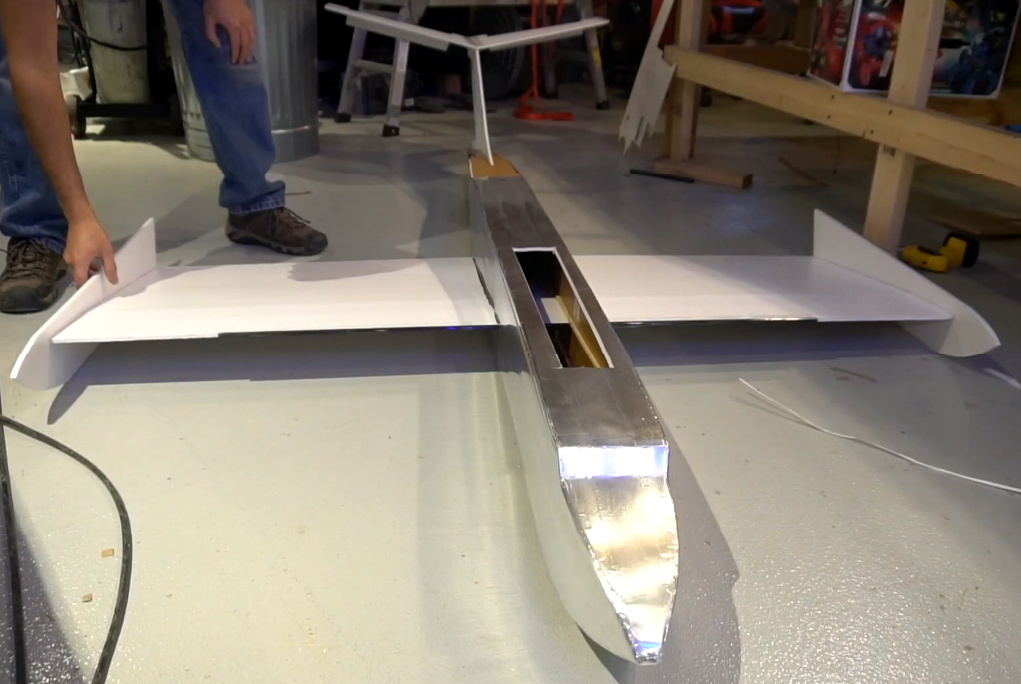
Now [Peter Sripol] has built his own version of what the CIA dubbed the “Caspian Sea Monster”, and judging by the video of him “flying” it around a lake, the design seems to tick all the boxes. The advantage of a GEV is that it’s far faster than a ship and more fuel efficient than an aircraft of similar size. They also operate low enough to avoid enemy radar, which made them very appealing for military applications. Not that any of those characteristics apply to an RC vehicle, but at least it looks cool.

Ironically, it took some extra effort for [Peter] to keep his scratch built ekranoplan from getting airborne. Built out of foam covered with aluminum tape, the craft was light enough that even the tiny wings were enough to break it free from the ground effect if it got going fast enough. It didn’t help that the electric ducted fan motors used were probably a bit too powerful as well.

But by carefully adjusting the throttle and control surfaces, [Peter] was able to keep his craft firmly planted in the ground effect most of the time. Seeing the large RC craft floating just a few inches over the water is very impressive, and thanks to the application of some Soviet-style iconography on its burnished aluminum body, it looks like found-footage from a Cold War test program.

Hackaday readers will likely be familiar with [Peter] and his exploits. From building his own human-scale airplane out of foam board to convincing a cordless drill that it can fly, he’s creations have never been overly concerned with the status quo.

Continue reading “RC Ground Effect Vehicle Skims Over The Water”

Raspberry Pi 4 Offers Up 2 GB For The Price Of One

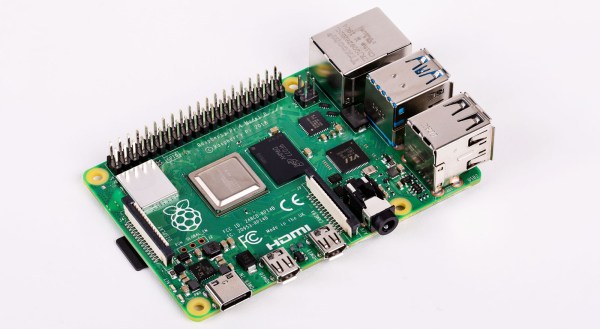
The Raspberry Pi 4 represents a significant performance increase over previous generations, unlocking potential applications that were simply beyond the abilities of these diminutive Single Board Computers (SBCs) in the past. Some would even argue that the Pi 4, with a quad-core Cortex-A72 running at 1.5 GHz, now holds its own as a lightweight ARM desktop computer for those interested in finally breaking free from x86.

In light of the considerable upgrade in processing power, the choice to outfit the base model Pi 4 with just 1 GB of RAM always seemed a bit odd. So it’s little surprise that the Raspberry Pi Foundation has decided to shift things around and lower the price of the 2 GB model to the traditional $35. In a blog post this morning, Eben Upton said that with RAM prices falling over the last year, the company thought it was time they passed the savings onto the customer.

This change comes just two days before the Pi’s 8th birthday. There has been speculation that the Pi 4 is capable of operating with 8 GB of RAM and unveiling that news to coincide with this anniversary would have been a clever marketing move. Alas, it looks like we’ll have to continue to wait.

For those who are invested in the 1 GB model, have no fear. Rather than delete the product from the lineup entirely, the company will be keeping it available for anyone who needs it. So if you’ve got a commercial or industrial application that might not take kindly to the hardware getting switched out, you’ll still have a source of spares. That said, the pricing for the 1 GB model won’t be changing, so there’s no cost advantage to using it in new designs.

Combined with news that compatibility issues the Pi 4 had with generic USB-C power supplies was fixed with an under the radar board revision, it seems there’s never been a better time to upgrade to the latest and greatest version of everyone’s favorite Linux board. Happy Birthday, Raspberry Pi.

LoRa Mesh Network With Off-the-Shelf Hardware

An ideal application for mesh networking is off-grid communication; when there’s no cellular reception and WiFi won’t reach, wide-area technologies like LoRa can be used to create ad hoc wireless networks. Whether you’re enjoying the outdoors with friends or conducting a rescue operation, a cheap and small gadget that will allow you to create such a network and communicate over it would be a very welcome addition to your pack.

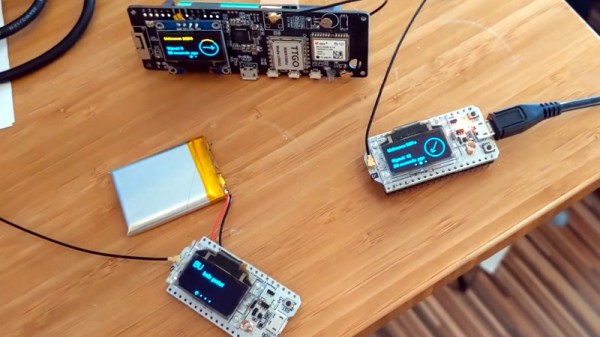
That’s exactly the goal of the Meshtastic project, which aims to take off-the-shelf ESP32 LoRa development boards and turn them into affordable mesh network communicators. All you need to do is buy one of the supported boards, install the firmware, and starting meshing. An Android application that will allow you to use the mesh network to send basic text messages is now available as an alpha release, and eventually you’ll be able to run Signal over the LoRa link.

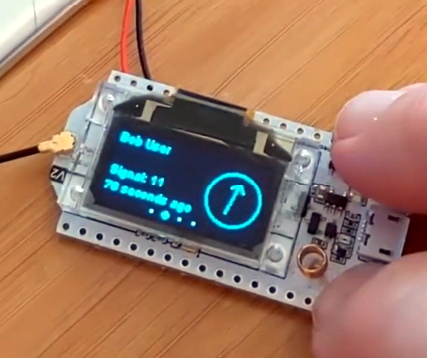
Navigating to another node in the network.

Developer [Kevin Hester] tells us that these are still the very early days, and there’s plenty of work yet to be done. In fact, he’s actively looking to bring a few like-minded individuals onto the project. So if you have experience with the ESP32 or mobile application development, and conducting private communications over long-range wireless networks sounds like your kind of party, this might be your lucky day.

From a user’s perspective, this project is extremely approachable. You don’t need to put any custom hardware together, outside of perhaps 3D printing a case for your particular board. The first time around you’ll need to flash the firmware with esptool.py, but after that, [Kevin] says future updates can be handled by the smartphone application.

Incidentally, the primary difference between the two boards is that the larger and more expensive one includes GPS. The mesh networking side of things will work with either board, but if everyone in your group has the GPS-equipped version, each user will be able to see the position of everyone else in the network.

This isn’t the first time we’ve seen LoRa used to establish off-grid communications, and it surely won’t be the last. The technology is perfect for getting devices talking where there isn’t any existing infrastructure, and we’re excited to see more examples of how it can be used in this capacity.

Levitating Starship Model Comes In For A Landing

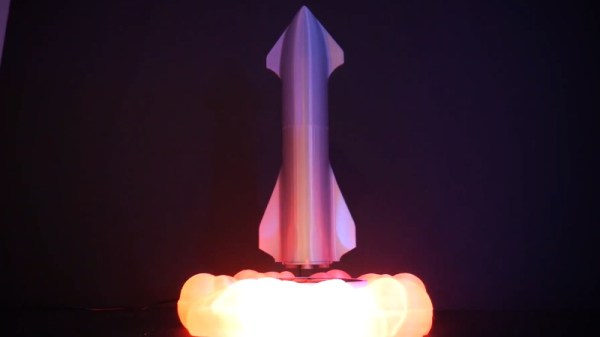
If everything goes according to plan, Elon Musk says the first generation of SpaceX’s massive Starship will make an orbital flight before the end of 2020. That’s a pretty bold claim, but when you’ve made landing rockets on their tails as in the old science fiction pulp magazines seem routine, we suppose you’ve earned the right to a bit of bravado. We’re excited to see the vehicle evolve over the next several months, but even if the real one stays grounded, we’ll gladly take this “flying” Starship model from [Chris Chimienti] as a consolation prize.

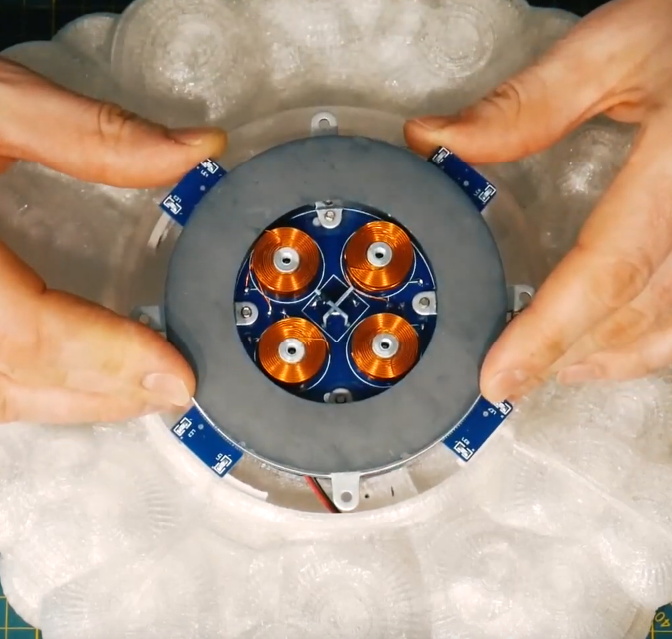
A magnetic levitation module, we’re officially in the future.

Feeling a bit let down by the 3D printable models of the Starship he found online, [Chris] set out to build his own. But it wasn’t enough to just make his bigger, stronger, and more accurate to Starship’s current design; he also wanted to make it a bit more exciting. Some RGB LEDs an Arduino embedded in the “cloud” stand the rocket sits on was a good start, and the landing pad inspired by SpaceX’s real autonomous spaceport drone ship Just Read the Instructions looks great all lit up.

But this is Starship we’re talking about, a vehicle that could literally push humanity towards being a multi-planet species. To do it justice, you’ve really got to knock it out of the park. So [Chris] found a magnetic levitation module online that could support a few hundred grams, and set to work on making his plastic Starship actually hover over the landing pad.

As you might imagine, it was a bit tricky. The first versions of the rocket looked great but came out too heavy, so he switched over to printing the model in so-called “spiral vase mode” which made it entirely hollow. Now far lighter and with a magnetic plate fit into the bottom, it was stable enough to float on its own. For the final touch, [Chris] added some red LEDs and a coin cell battery to the base of the Starship so it looks like the sleek craft is performing a last-second landing burn with its “impossible” full-flow staged combustion engines.

This isn’t the first time we’ve seen a model rocket with an electronic glowing cloud under it, but it’s certainly the first one we’ve seen that could levitate in mid-air. While this little rocket might not make it all the way to Mars, we wouldn’t be surprised to see it touching down on the desks of other hackers and makers in the near future.

Continue reading “Levitating Starship Model Comes In For A Landing”