Svelte VR Headsets Coming?

According to Standford and NVidia researchers, VR adoption is slowed by the bulky headsets required. They want to offer a slim solution. A SIGGRAPH paper earlier this year lays out their plan or you can watch the video below. There’s also a second video, also below, covers some technical questions and answers.

The traditional headset has a display right in front of your eyes. Special lenses can make them skinnier, but this new method provides displays that can be a few millimeters thick. The technology seems pretty intense and appears to create a hologram at different apparent places using a laser, a geometric phase lens, and a pupil-replicating waveguide.

Continue reading “Svelte VR Headsets Coming?”

Young Inventor Builds Motor Without Rare Earths

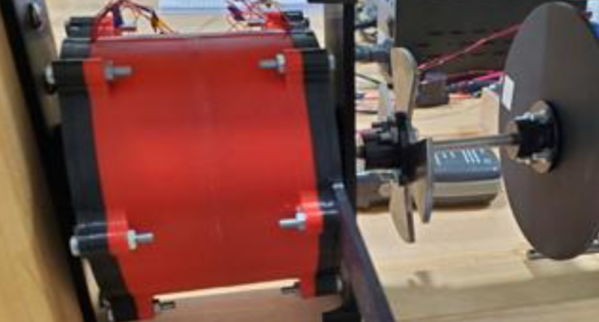
[Robert Sansone] is a 17-year-old from Florida and, like most of us, he likes to tinker. He’s apparently got the time for it because he’s completed at least 60 projects ranging from animatronic hands to a high-speed go-kart. However, his interest in electric vehicles coupled with his understanding of the issues around them led him to investigate synchronous reluctance motors — motors that don’t depend on expensive rare earth magnets. His experiments have led to a novel form of motor that has greater torque than existing designs.

Rare earths are powerful but expensive, costing much more than common metals like copper or steel. Traditionally, synchronous reluctance motors use steel rotors and air gaps and exploit the difference in reluctance — a term for magnetic resistance– to generate rotation. [Robert’s] idea was to replace the air gap with a different material to increase the ratio of reluctance between the rotor and the gap. Reconfiguring the motor to a more traditional configuration shows startling results: the new design generated almost 40% more torque and did so more efficiently, as well.

His work has earned him first prize, and $75,000, in this year’s Regeneron International Science and Engineering Fair. It took 15 tries to get the motor to its current state, something made easier with 3D printing. There are plans for a 16th version that [Robert] hopes will perform even better. We can’t wait to see what he’ll do next.

Electric vehicles have made people look into many motor design topologies. The reluctance motor has been around for a long time, but controlling them has become significantly easier. That’s true of many kinds of motors.

Continue reading “Young Inventor Builds Motor Without Rare Earths”

Hack Your Engine Virtually

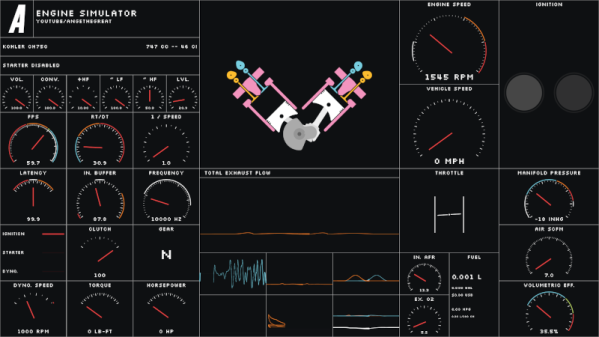
It is no secret that we like simulating circuits before we build something and there are plenty of great tools for that. But what about those of us who work on cars? Well, you might try engine-sim which is a real-time internal combustion engine simulation. Honestly, the program freely admits that it isn’t accurate enough to do engineering or engine tuning. But on the plus side, it has audio output and is at least good as an educational tool to show an engine running and how different parameters might affect it. You can see a video of the tool below.

[Ange-Yaghi] mentions that the code was primarily to power the YoutTube demo. However, the Readme hints that it might be better — or at least different — and collaboration to make it better is welcome.

Continue reading “Hack Your Engine Virtually”

Linux Fu: The Chrome OS Flex Virtualization

The Flex Desktop is user-friendly and responsive

You’ve probably heard about Google Chromebooks. Like Android, Chrome OS is based on some variant of Linux, but it is targeted at the “cloud first” strategy so Chromebooks typically don’t have a huge amount of storage or compute power. If you have a real Chromebook, you can also use it to run certain other kinds of programs via virtualization. However, Google has recently pushed out Chrome OS Flex which is meant to install on a spare laptop you might happen to have hanging around. Seems attractive to take that only Windows 7 laptop and repurpose it to run Chrome OS, especially if you can run Linux apps on it. Unfortunately, Chrome OS Flex has a very different use case and I would only recommend installing it if you meet the exact use case it addresses.

The other option, of course, is to just install Linux on that old hardware. There are several distributions that are made for that purpose and, honestly, even most of the major distributions will work fine on older hardware with a little tweaking to turn off some of the more resource-costly features. That assumes you know how to install, tweak, and maintain Linux.

Continue reading “Linux Fu: The Chrome OS Flex Virtualization”

AI Creates Your Spreadsheets, Sometimes

We’ve been interested in looking at how AI can process things other than silly images. That’s why the “Free AI Bot that Generates the Excel Formula for Any Problem” caught our eye. Based on GPT-3, it supposedly transforms your problem description into a formula suitable for Excel or Google Sheets.

Our first prompt didn’t work out very well. But that was sort of our fault. When they say “Excel formula” they mean that quite literally. So trying to describe the actual result you want in terms of columns or rows seems to be beyond it. Not realizing that, we asked:

If the sum of column H is greater than 50, multiply column A by 0.33

And got:

=IF(SUM(H:H)>50,A*0.33,0)

A Better Try

Which is close, but not really how anyone even mildly proficient with Excel would interpret that request. But that’s not fair. It really needs to be a y=f(x) sort of problem, we suppose.

Continue reading “AI Creates Your Spreadsheets, Sometimes”

Real Robot One Is… Real

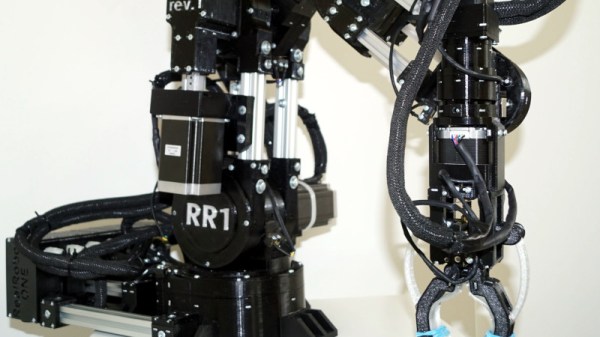
Most of the robot arms we see are cool but little more than toys. Usually, they use RC servos to do motion and that’s great for making some basic motion, but if you want something more industrial and capable, check out [Pavel’s] RR1 — Real Robot One. The beefy arm has six degrees of freedom powered by stepper motors and custom planetary gearboxes. Each joint has an encoder for precise position feedback. The first prototype is already working, as you can see in the video below. Version two is forthcoming.

When you see the thing in action, you can immediately tell it isn’t a toy. There are four NEMA23 steppers and three smaller NEMA17 motors. While there are 3D printed parts, you can see a lot of metal in the build, also. You can see a video of the arm lifting up a 1 kilogram barbell and picking up a refreshing soft drink.

Continue reading “Real Robot One Is… Real”

Homemade CAT Scan Shouldn’t Scan Cats

[Pyrotechnical] thought about buying a CAT scanner and found out they cost millions of dollars. So he decided to build one for about $200 using a salvage X-ray tube and some other miscellaneous parts. A scintillating detector provides the image for pick up with a camera phone. The control? An Arduino, what else? You can watch the video below, but due to plenty of NSFW language, you might want to put your headphones on if you don’t want to shock anyone.

Of course, you need to be careful when working with energetic X-rays. To keep away from the X-ray source, [Pyrotechnical] used a Roku remote and an IR sensor to control the device from afar. The electronics is pretty easy. You just have to rotate a turntable and trigger the camera while lighting up the X-ray tube.

Continue reading “Homemade CAT Scan Shouldn’t Scan Cats”