The History Of Neon Lights

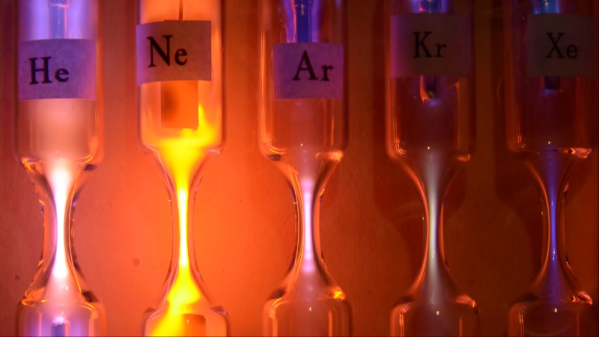
We always enjoy history videos from [The History Guy] but they don’t always cover technology history. When they do, though, we enjoy them twice as much as with the recent video he posted on the history of neon signs. Of course, as he points out, many neon lights don’t have actual neon in them — they use various noble gasses depending on the color you want. Sure, some have neon, but the name has stuck.

The back part of the video is more about the signs themselves, but the early portion talks about [William Ramsay], a Scot chemist who started extracting component gasses out of the atmosphere. The first one found was argon and then helium. Krypton and neon were not far behind. The other noble gas, Xenon, also fell to his experiments. He and another scientist won the Nobel for this work.
Continue reading “The History Of Neon Lights”

Projecting Moving Images In Air With Lasers

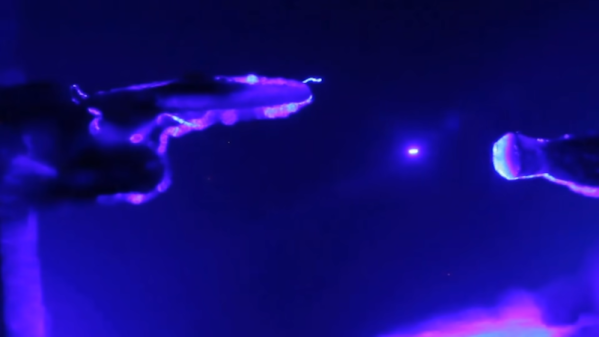
You’ve seen it a million times in science fiction movies and TV shows: a moving holographic display. From Princess Leia asking for help to virtual tennis on Total Recall, it is a common enough idea. [Dan Smalley]’s team at BYU has made progress in projecting moving 3D images in thin air. While they might not be movie quality, they are a start, and, after all, you have to start somewhere.

The display traps a small particle in the air with a laser beam and then moves that particle around, leaving behind an illuminated path in the air. You can see the effect in the video below. The full paper explains how a type of ray tracing allows the relatively small optical trap display to appear larger and more fluid. While it does make images seem to appear behind the display’s actual volume, it also requires eye tracking to work since the illusion only works from a certain perspective.

These are not, of course, technically holograms. That’s actually an advantage in some cases because holograms require a tremendous amount of data that increases rapidly as the size of a display scales up. The optical trap display uses a much more manageable data rate.

We’ve seen optical trap displays before. In fact, volumetric displays seem to be all the rage lately.

Continue reading “Projecting Moving Images In Air With Lasers”

Thought Control Via Handwriting

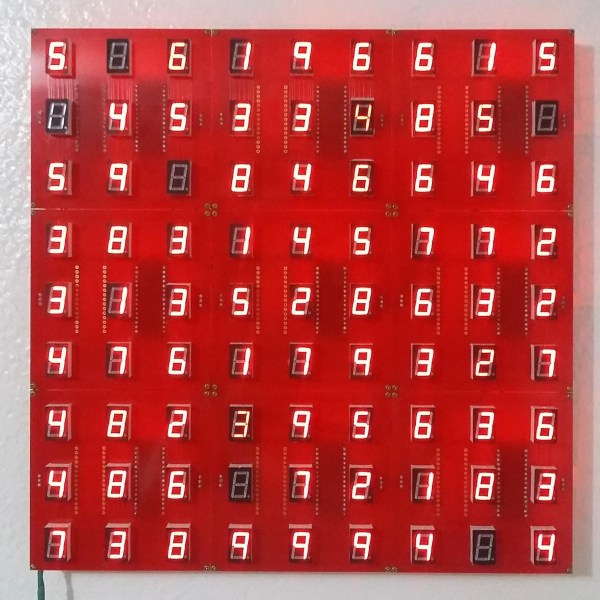
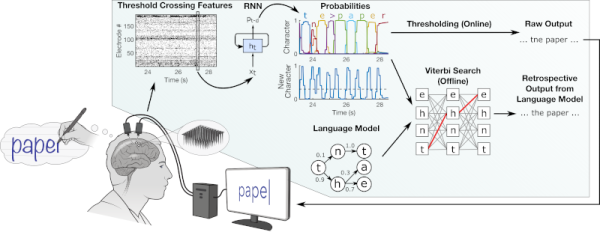
Computers haven’t done much for the quality of our already poor handwriting. However, a man paralyzed by an accident can now feed input into a computer by simply thinking about handwriting, thanks to work by Stanford University researchers. Compared to more cumbersome systems based on eye motion or breath, the handwriting technique enables entry at up to 90 characters a minute.

Currently, the feat requires a lab’s worth of equipment, but it could be made practical for everyday use with some additional work and — hopefully — less invasive sensors. In particular, the sensor used two microelectrode arrays in the precentral gyrus portion of the brain. When the subject thinks about writing, recognizable patterns appear in the collected data. The rest is just math and classification using a neural network.

If you want to try your hand at processing this kind of data and don’t have a set of electrodes to implant, you can download nearly eleven hours of data already recorded. The code is out there, too. What we’d really like to see is some easier way to grab the data to start with. That could be a real game-changer.

More traditional input methods using your mouth have been around for a long time. We’ve also looked at work that involves moving your head.

Apple Gets CP/M

In case you wanted to run WordStar on your Mac, [Tom Harte] offers CP/M for OS/X, and it looks like it would be a lot of fun. Of course you might be happier running Zork or Turbo Pascal, and you can do that, too.

There are plenty of Z80 emulators that can run CP/M, but what we found most interesting about this one is that it is written in Objective C, a language with a deep history in the Mac and NeXT worlds.

Continue reading “Apple Gets CP/M”

Nuclear Reactors Get Small

Steve Martin was ahead of his time when he told us “Let’s get small!” While you usually think of a nuclear reactor as a big affair, there’s a new trend towards making small microreactors to produce power where needed instead of large centralized generation facilities. The U.S. Department of Energy has a video about the topic, you can watch below.

You probably learned in science class how a basic nuclear fission reactor works. Nuclear fuel produces heat from fission while a moderator like water prevents it from melting down both by cooling the reactor and slowing down neutrons. Control rods further slow down the reaction or — if you pull them out — speed it up. Heat creates steam (either directly or indirectly) and the steam turns a conventional electric generator that is no more high tech than it ever has been.

Continue reading “Nuclear Reactors Get Small”

3D Printing Restores Bandsaw

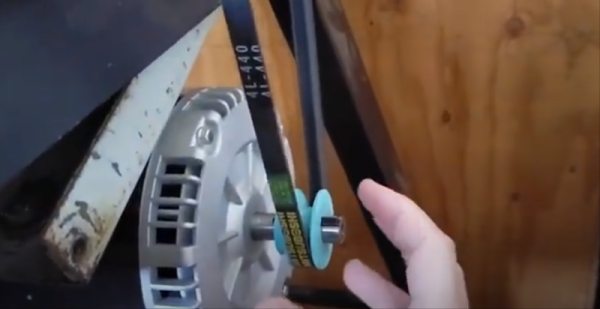
A great addition to a home shop is a bandsaw, but when [Design Prototype Test] got a well-used one, he found it wasn’t in very good shape. The previous owner put in an underpowered motor and made some modifications to accommodate the odd-sized blade. Luckily, 3D printing allowed him to restore the old saw to good working order.

There were several 3D printed additions. A pulley, a strain relief, and even an emergency stop switch. Honestly, none of this stuff was something you couldn’t buy, but as he points out, it was cheaper and faster than shipping things in from China. He did wind up replacing the initial pulley with a commercial variant and he explains why.

Continue reading “3D Printing Restores Bandsaw”

Less Stinky Resin Two Ways

After watching [Uncle Jessy’s] video about soy-based 3D printing resin from Elegoo and their miniature air purifiers, we couldn’t decide if the resin doesn’t smell as bad as some other resins or if the air purifier works wonders. Maybe it is a bit of both.

We’ve used Eryone super low odor resin and it has less smell than, say, paint. It sounds like the Elegoo is similar. However, we are always suspicious of claims that any resin is really made with natural ingredients. As [Brent], who apparently has a PhD in chemistry, pointed out, AnyCubic Eco resin makes similar claims but is likely only partially made from soy. Sure, a little less than half is soy-based, but then there’s the other half. Still, we suppose it is better than nothing. That video (also below) is worth watching if you ever wondered why resin solidifies under UV light or what a monomer is.

Continue reading “Less Stinky Resin Two Ways”