Circuit VR: Sink Or Swim With Current Sources

If you got your start in electronics sometime after 1980 your first project might well have been to light up an LED. Microcontroller projects often light up an LED, too, and a blinking LED is something of the “hello world” program for embedded systems. If you tried lighting up your LED with a 9 V battery directly — not that you’d admit to it — you found it would light up. Once, anyway. The excess current blows up the LED which is why you need a current-limiting resistor. However, those current limiting resistors are really a poor excuse for a current source or sink. In many applications, you need a real current source and luckily, they aren’t hard to create.

As always with Circuit VR, we’ll be using LT Spice to examine the circuits. If you need a quick tutorial, start here and come back after that. If you use Linux, don’t be dismayed. I run LT Spice under WINE and it works great. You can find all the Spice files on GitHub.

Continue reading “Circuit VR: Sink Or Swim With Current Sources”

Raspberry Pi Is Up Up And Away

BACAR — Balloon Carrying Amateur Radio — is just what it sounds like. A high-altitude balloon carries experiments and communicates via amateur radio. [ZR6AIC] decided to fly a payload in a local BACAR experiment. The module would send its GPS position via the APRS network and also send a Morse code beacon every seven minutes. It also sends other data such as temperature, and has an optional camera fitted.

The hardware used was the ubiquitous Raspberry Pi along with an associated daughterboard for transmitting on the 2 meter ham band. An RTL dongle took care of the receive portion and another dongle provided GPS. A DS18B20 temperature sensor provides the temperature data.

Continue reading “Raspberry Pi Is Up Up And Away”

Oddball Mercury Vapor Rectifier Is A Tube Geek’s Delight

Even if you aren’t a tube aficionado, you can’t help but be mesmerized by the blue glow inside a mercury vapor rectifier when it operates. It looks less like early 20th century tech and more like something that belongs on a Star Trek set. [Uniservo] acquired an 866 rectifier that was interesting due to the markings, which he explains in detail in the video below. Most people though will probably want to skip to closer to its end to see that distinctive blue glow. The exact hue depends on the mercury vapor pressure and usually contains a fair amount of ultraviolet light.

These tubes have an interesting history dating back to 1901, the year [Peter Cooper Hewitt] developed a mercury vapor light which was much more efficient than conventional bulbs. They had two main problems, they required some special process to get the mercury inside to vaporize when you turned them on, but worse still, the light was blue-green which isn’t really appropriate for home and office lighting. In 1902 though, [Hewitt] realized the tube would act as a rectifier. Electrons could readily flow out of the mercury vapor that was the cathode, while the carbon anodes didn’t give up electrons as readily. This was important because up until then, there wasn’t an easy way to convert AC to DC. The usual method was to use an AC motor coupled to a DC generator or a similar mechanical arrangement known as a rotary converter.

In later decades the mercury vapor lamp would wind up with a phosphor coating that converted the ultraviolet light to cool white light and became the fluorescent bulb, so while the rectifier mostly gave way to more efficient methods, [Hewitt’s] bulb has been in use for many years.

Continue reading “Oddball Mercury Vapor Rectifier Is A Tube Geek’s Delight”

Hair Today, Gone Tomorrow, Via Electrolysis

We think of electrolysis as a way to split things like water into oxygen and hydrogen using electricity, but it has a second meaning which is to remove hair using electricity. An electrologist inserts very thin needles into each hair follicle and uses a burst of electricity to permanently remove the hair. [Abbxrdy] didn’t want to buy a cheap unit because they don’t work well and didn’t want to spend on a professional setup, so designing and building ensued.

You’ll have to read through the comments to find some build details and the schematic. The device uses commercial electrolysis needles and a DE-9 connector socket as a holder. The device can supply 6 to 22V at up to 2mA. A timer can restrict the pulse to 5 seconds or less.

Continue reading “Hair Today, Gone Tomorrow, Via Electrolysis”

Tiny Arduino + FPGA = Sno

Alorium rolled out a new product late last year that caught our attention. The Sno (pronounced like “snow”) board is a tiny footprint Arduino board that you can see in the video below. By itself that isn’t that interesting, but the Sno also has an Altera/Intel Max 10 FPGA onboard. If you aren’t an FPGA user, don’t tune out yet, though, because while you can customize the FPGA in several ways, you don’t have to.

Like Alorium’s XLR8 product, the FPGA comes with preprogrammed functions and a matching Arduino API to use them. In particular, there are modules to do analog to digital conversion, servo control, operate NeoPixels, and do floating point math.

Continue reading “Tiny Arduino + FPGA = Sno”

3D Printing Electronics Direct To Body

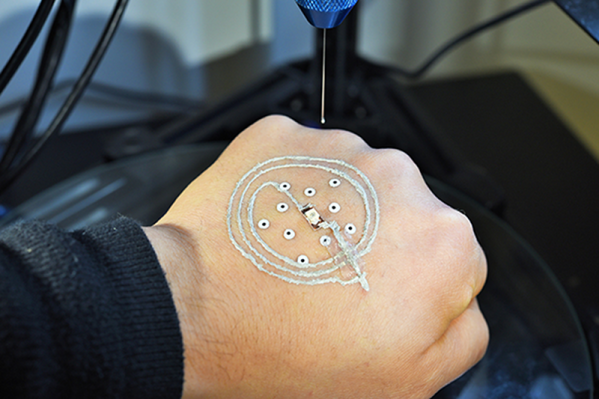
Some argue that the original Star Trek series predicted the flip phone. Later installments of the franchise used little badges. But Babylon 5 had people talking into a link that stuck mysteriously to the back of their hand. This might turn out to be true if researchers at the University of Minnesota have their way. They’ve modified a common 3D printer to print electronic circuits directly to the skin, including the back of the hand, as you can see in the video below. There’s also a preview of an academic paper available, but you’ll have to pay for access to that, for now, unless you can find it on the gray market.

In addition, the techniques also allowed printing biologically compatible material directly on the skin wound of a mouse. The base printer was inexpensive, an Anycubic Delta Rostock that sells for about $300.

Continue reading “3D Printing Electronics Direct To Body”

Core Memory Upgrade For Arduino

Linux programs, when they misbehave, produce core dumps. The reason they have that name is that magnetic core memory was the primary storage for computers back in the old days and many of us still refer to a computer’s main memory as “core.” If you ever wanted to have a computer with real core memory you can get a board that plugs into an Arduino and provides it with a 32-bit core storage. Of course, the Arduino can’t directly run programs out of the memory and as designer [Jussi Kilpeläinen] mentions, it is “hilariously impractical.” The board has been around a little while, but a recent video shined a spotlight on this retro design.

Impractical or not, there’s something charming about having real magnetic core memory on a modern CPU. The core plane isn’t as dense as the old commercial offerings that could fit 32 kilobits (not bytes) into only a cubic foot. We’ll leave the math about how much your 8-gigabyte laptop would have to grow to use core memory to you.

Continue reading “Core Memory Upgrade For Arduino”