Holograms Can’t Be Too Thin

We’ve seen the 3D phone fad come and go, with devices like the Evo 3D, that used a parallax barrier to achieve autostereoscopy (that is, 3D viewing without glasses). These displays aren’t holograms, they are just showing your eyes two different images like a 3D movie or a stereopticon. However, researchers from Australia and China are hoping to change that. They’ve developed a nano-hologram (their term) that is about 1000 times thinner than a human hair. You can see a video about the invention, below.

Conventional holograms modulate the phase of light to give the illusion of three-dimensional depth. But to generate the required phase shifts, those holograms need to be as thick as the optical wavelengths involved. The researchers claim the holograms are “simple” to make, but that depends on what you compare it to. You need some exotic materials, vacuum deposition gear, and a laser that can do femtosecond-long pulses.

The research team has broken this thickness limit with a 25 nanometer hologram. Their technique relies on a topological insulator material a novel quantum material that holds a low refractive index in the surface layer but a much higher refractive index in the bulk of the material. This forms an intrinsic optical resonant cavity which can enhance the phase shifts and makes holography possible.

The next step is to develop a rigid thin film to overlay an LCD screen. The current version has pixels at least ten times too large to be practical for that application, so that’s another hurdle to overcome.

We’ve seen screens that shoot 3D images on movies like Star Wars for years. This isn’t it yet, but it is the next step. Imagine a phone, a wrist watch, or a contact lens that could generate a holographic image. Or a garbage-can-sized robot.

Continue reading “Holograms Can’t Be Too Thin”

540 PCBs Make A Giant LED Cube

Just about anyone can make a simple LED cube. But what if you want to make a 1-meter cube using 512 LEDs? [Hari] wanted to do it, so he created two different kinds of LED boards using EasyEDA. There are 270  of each type of board, for a total of 540 (there are only 512 LEDs, so we guess he got some spares due to how the small boards panelized). The goal is to combine these boards to form a cube measuring over three feet on each side.

To simplify wiring, the boards are made to daisy chain like a cordwood module. However, to get things to line up, each column of LED boards have to rotate 90 degrees. You can see several videos about the project below.

Continue reading “540 PCBs Make A Giant LED Cube”

Inside A Microswitch

We’ve taken a few microswitches apart, mostly to fix those pesky Logitech mice that develop double-click syndrome, but we’ve never made a video. Luckily, [Julian] did, and it is worth watching if you want to understand the internal mechanism of these components.

[Julian] talks about the way the contacts make and break. He also discusses the mechanical hysteresis inherent in the system because of the metal moving contact having spring-like qualities

Continue reading “Inside A Microswitch”

Disco Flashlight Binary Analog Clock?

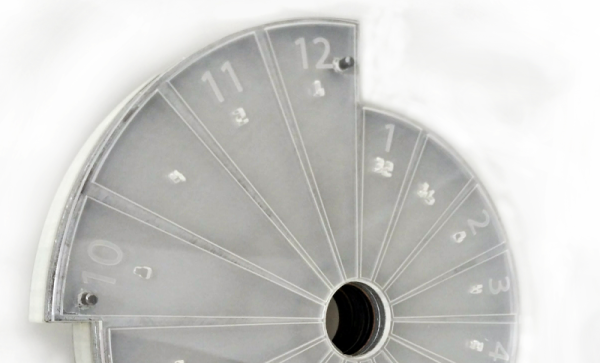
As multitools have lots of different functions in one case, so [Shadwan’s] clock design incorporates a multitude of features. He started the design as a binary clock using a Fibonacci spiral for the shape. However, the finished clock has four modes. The original binary clock, an analog clock, a flashlight (all lights on), and a disco mode that strobes multiple lights.

[Shadwan] used Rhino to model the case and then produced it using a laser cutter. The brains are — small wonder — an Arduino. A 3D-printed bracket holds everything together. You can see the result in the video below.

Continue reading “Disco Flashlight Binary Analog Clock?”

Digital Clock Goes With The Grain

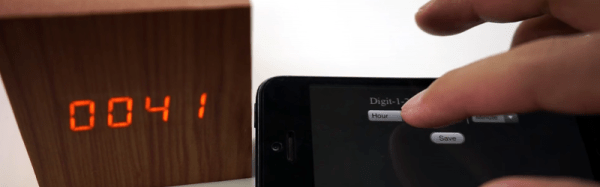
This good-looking clock appears to be made out of a block of wood with LED digits floating underneath. In reality, it is a block of PLA plastic covered with wood veneer (well, [androkavo] calls it veneer, but we think it might just be a contact paper or vinyl with a wood pattern). It makes for a striking effect, and we can think of other projects that might make use of the technique, especially since the wood surface looks much more finished than the usual 3D-printed part.

You can see a video of the clock in operation below. The clock circuit itself is nothing exceptional. Just a MAX7218 LED driver and a display along with an STM32 ARM processor. The clock has a DHT22 temperature and humidity sensor, as well as a speaker for an alarm.

Continue reading “Digital Clock Goes With The Grain”

IMSAI 8080 Resurrection

When MITS introduced the Altair 8800–about 43 years ago–it spawned the first personal computer clone: the IMSAI 8080. The clone had several improvements and MITS had difficulty filling orders for real Altairs, so they sold pretty well. [IMSAI Guy] has one of these vintage computers that has been in storage for over 30 years. He’s restoring the thing and there are 26 (and counting) videos of his progress. You can see the second video below, but be sure to check out the others, too.

The IMSAI is famous for being in the movie Wargames. We miss computers with switches and LEDs on a working front panel.

Continue reading “IMSAI 8080 Resurrection”

The Internet Of Cigars

We know, we know. They are bad for you. You shouldn’t start, but some people do love a cigar. And a fine cigar is pretty particular about drying out. That’s why tobacconists and cigar aficionados store their smokes in a humidor. This is anything from a small box to a large closet that maintains a constant humidity. Of course, who could want such a thing these days without having it connected to the Internet?

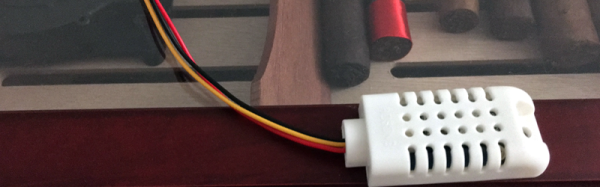
This fine-looking humidor uses a Raspberry Pi. When the humidity is low, an ultrasonic humidifier adds moisture to the air. If it gets too high, a fan circulates the air until it balances out. Who knew cigar smoking could be so high-tech? The humidity sensor is an AM2302. There’s also a smart USB hub that can accept commands to turn the fan and humidifier on and off.

The wooden cabinet was an existing humidor, apparently. [Atticakes] says he spent about $100 total but that a commercial equivalent would have been at least $250. You can find his source code on GitHub.

If you are vehemently anti-cigar, we should point out that there are other uses for such a device. Because of Denver’s low humidity, for example, the Colorado Rockies baseball team store game balls in a large humidor.

For the record, a zip lock bag can do in a pinch. Without something, the experts say the cigar starts to change negatively in two or three days.

First networkable humidor we’ve seen? Hardly. If you need something to light that stogie, we suggest a laser.