Millimeter Wave RADAR Tracks Gestures

If we believe science fiction — from Minority Report to Iron Man, to TekWar — the future of computer interfaces belongs to gestures. There are many ways to read gestures, although often they require some sort of glove or IR emitter, which makes them less handy (no pun intended).

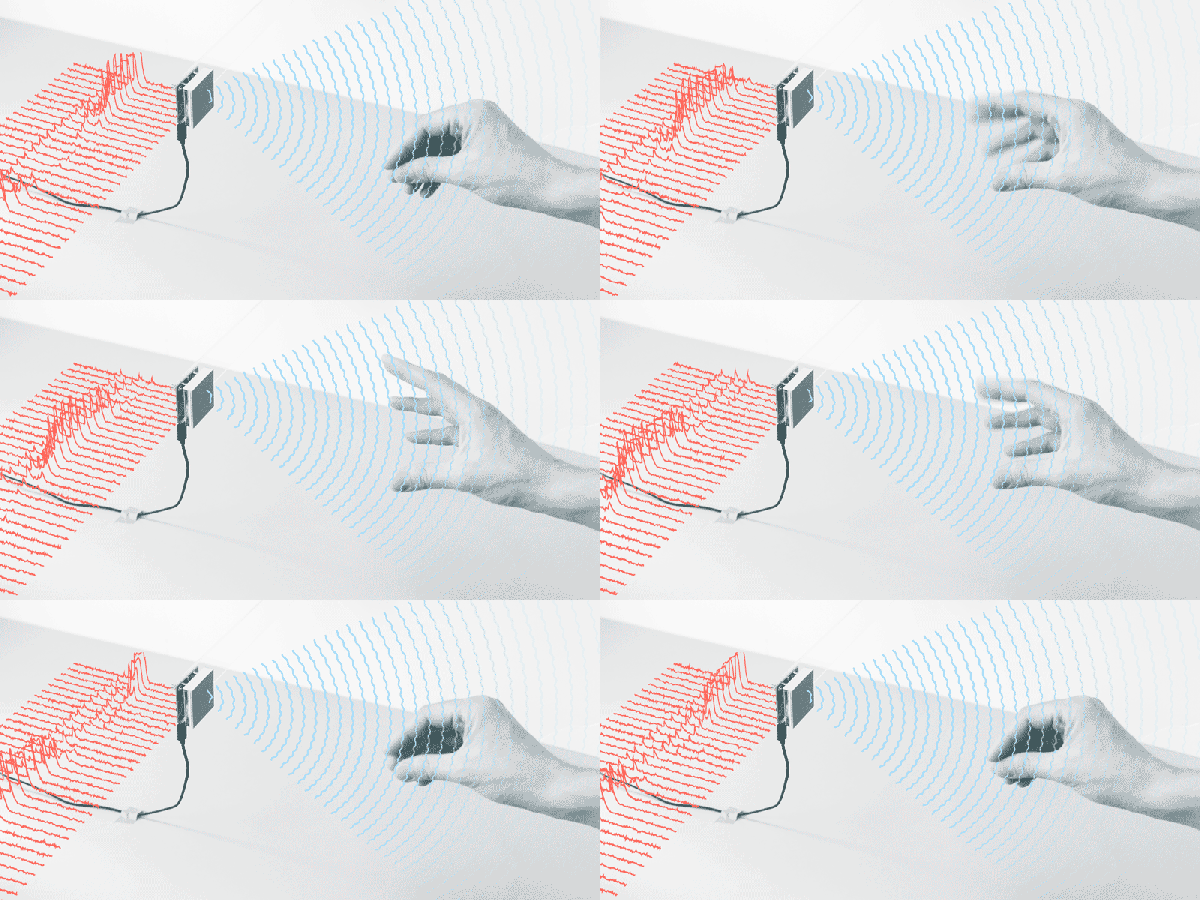
Some, like the Leap Motion, have not proved popular for a variety of reasons. Soli (From Google’s Advanced Technology and Projects group) is a gesture sensor that uses millimeter-wave RADAR. The device emits a broad radio beam and then collects information including return time, energy, and frequency shift to gain an understanding about the position and movement of objects in the field. You can see a video about the device, below.

You naturally think of using optical technology to look at hand gestures (the same way humans do). However, RADAR has some advantages. It is insensitive to light and can transmit through plastic materials, for example. The Soli system operates at 60 GHz, with sensors that use Frequency Modulated Continuous Wave (FMCW) and Direct-Sequence Spread Spectrum (DSSS). The inclusion of multiple beamforming antennas means the device has no moving parts.

Clearly, this is cutting-edge gear and not readily available yet. But the good news is that Infineon is slated to bring the sensors to market sometime this year. Planned early applications include a smart watch and a speaker that both respond to gestures using the technology.

Interestingly, the Soli processing stack is supposed to be RADAR agnostic. We haven’t investigated it, but we wonder if you could use the stack to process other kinds of sensor input that might be more hacker friendly? Barring that, we’d love to see what our community could come up with for solving the same problem.

We’ve seen Raspberry Pi daughter-boards (ok, hats) that recognize gestures used to control TVs. We’ve even built some crude gesture sensing using SONAR, if that gives you any ideas. Are you planning on using Soli? Or rolling your own super gesture sensor? Let us know and document your project for everyone over on Hackaday.io.
Continue reading “Millimeter Wave RADAR Tracks Gestures”

3D Printer Transforms To CNC

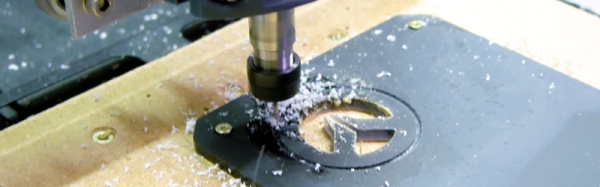
Superficially, it is easy to think about converting a 3D printer into a CNC machine. After all, they both do essentially the same thing. They move a tool around in three dimensions. Reducing this to practice, however, is a problem. A CNC tool probably weighs more than a typical hotend. In addition, cutting into solid material generates a lot of torque.

[Thomas Sanladerer] knew all this, but wanted to try a conversion anyway. He had a few printers to pick from, and he chose a very sturdy MendelMax 3. He wasn’t sure he’d wind up with a practical machine, but he wanted to do it for the educational value, at least. The result, as you can see in the video below, exceeded his expectations.

Continue reading “3D Printer Transforms To CNC”

Arduino Video Isn’t Quite 4K

Video resolution is always on the rise. The days of 640×480 video have given way to 720, 1080, and even 4K resolutions. There’s no end in sight. However, you need a lot of horsepower to process that many pixels. What if you have a small robot powered by a microcontroller (perhaps an Arduino) and you want it to have vision? You can’t realistically process HD video, or even low-grade video with a small processor. CORTEX systems has an open source solution: a 7 pixel camera with an I2C interface.

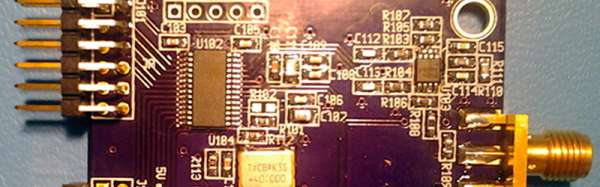
The files for SNAIL Vision include a bill of materials and the PCB layout. There’s software for the Vishay sensors used and provisions for mounting a lens holder to the PCB using glue. The design is fairly simple. In addition to the array of sensors, there’s an I2C multiplexer which also acts as a level shifter and a handful of resistors and connectors.

Continue reading “Arduino Video Isn’t Quite 4K”

Robo-Flute Whistles MIDI

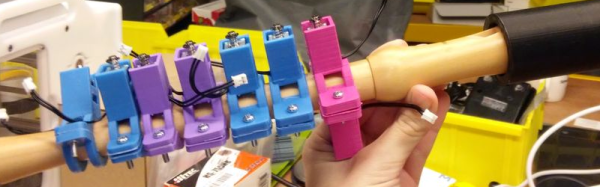
We aren’t sure this technically qualifies as music synthesis, but what else do you call a computer playing music? In this case, the computer is a Teensy, and the music comes from a common classroom instrument: a plastic recorder. The mistaken “flute” label comes from the original project. The contraption uses solenoids to operate 3D printed “fingers” and an air pump — this is much easier with a recorder since (unlike a flute) it just needs reasonable air pressure to generate sound.

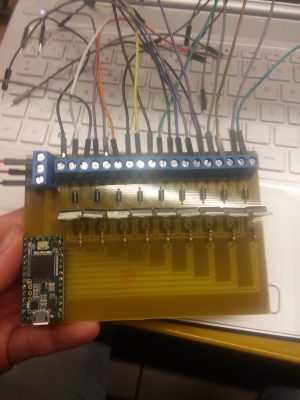
automated-recorder-solenoid-driverA Teensy 3.2 programmed using the Teensyduino IDE drives the solenoids. The board reads MIDI command sent over USB from a PC and translates them into the commands for this excellent driver board. It connects TIP31C transistors, along with flyback diodes, to the solenoids via a terminal strip.
On the PC, a program called Ableton sends the MIDI messages to the Teensy. MIDI message have three parts: one sets the message type and channel, another sets the velocity, and one sets the pitch. The code here only looks at the pitch.

This is one of those projects that would be a lot harder without a 3D printer. There are other ways to actuate the finger holes, but being able to make an exact-fitting bracket is very useful. Alas, we couldn’t find a video demo. If you know of one, please drop the link in the comments below.

We have seen bagpipe robots (in fact, we’ve seen several). We’ve also seen hammering shotguns into flutes, which is certainly more melodious than plowshares.

Ice, Ice, Radio Uses FPGA

Building a software defined radio (SDR) involves many trades offs. But one of the most fundamental is should you use an FPGA or a CPU to do the processing. Of course, if you are piping data to a PC, the answer is probably a CPU. But if you are doing the whole system, it is a vexing choice. The FPGA can handle lots of data all at one time but is somewhat more difficult to develop and modify. CPUs using software are flexible–especially for coding user interfaces, networking connections, and the like) but don’t always have enough horsepower to cope with signal processing tasks (and, yes, it depends on the CPU).

[Eric Brombaugh] sidestepped that trade off. He used a board with both an ARM processor and an ICE FPGA at the heart of his SDR design. He uses three custom boards: one is the CPU/FPGA board, another is a 10-bit converter that can sample at 40 MSPS (sufficient to decode to 20 MHz), and an I2S DAC to produce audio. Each board has its own page linked from the main project.

Continue reading “Ice, Ice, Radio Uses FPGA”

Paper Toy Can Save Lives

Although there is a lot of discussion about health care problems in big countries like the United States, we often don’t realize that this is a “first world” problem. In many places, obtaining health care of any kind can be a major problem. In places where water and electricity are scarce, a lot of modern medical technology is virtually unobtainable. A team from Standford recently developed a cheap, easily made centrifuge using little more than paper, scrap material like wood or PVC pipe, and string.

A centrifuge is a device that spins samples to separate them and–to be effective–they need to spin pretty fast. Go to any medical lab in a developed country and you’ll find at least one. It will be large, heavy, expensive, and it will require electricity. Some have tried using hand-operated centrifuges using mechanisms like an egg beater or a salad spinner, but these don’t really move fast enough to work well. At the least, it takes a very long time to get results with a slow centrifuge.

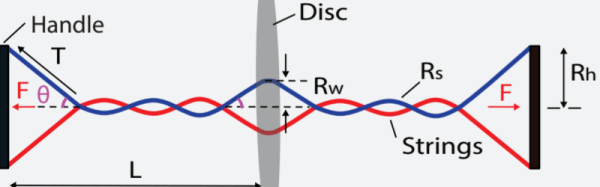
[M. Saad Bhamla] and his colleagues at Stanford started brainstorming on this problem. They thought about toys that rotate, including a yo-yo. Turns out, those don’t spin all that fast, either. Then they considered a whirligig. We had forgotten what those are, but it is the real name for a toy that has a spinning disk and (usually) a string. When you pull on the string, the disk spins and the more you pull, the faster the disk spins. These actually have an ancient origin appearing in medieval tapestries and almost 2,500 years ago in China.

[Bhamla] found that how the toy worked was poorly understood (from a scientific standpoint)  and took pictures of one in operation with a high-speed camera. The team was able to create the “paperfuge”, a human-powered centrifuge that would spin at 125,000 RPM, enough to separate plasma from blood in under two minutes and isolate malaria parasites in 15. Some versions of the device could cost as little as twenty cents and don’t require anything more exotic than paper and string. You can see a video about the paperfuge, below.

Continue reading “Paper Toy Can Save Lives”

Newton’s Cradle For Those Too Lazy To Procrastinate

Desk toys are perfect for when you don’t want to work. There’s a particularly old desk toy called the Newton’s cradle. If you don’t know the name, you’d still recognize the toy. It is some ball bearings suspended in midair on strings. If you pull back, say, two balls and let them swing to impact the other balls, the same number of balls on the other side will fly out. When they return, the same number will move on the other side and this repeats until friction wears it all down.

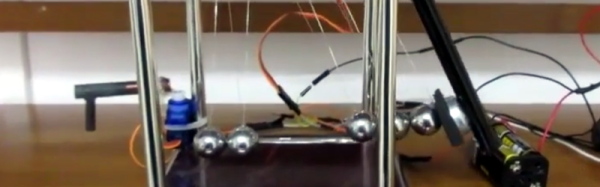
We think [JimRD] might be carried away on procrastination. You see, he not only has a Newton’s cradle, he has automated it with an Arduino. According to [Jim], this is his third attempt at doing so. You can see the current incarnation in the video, below.

Continue reading “Newton’s Cradle For Those Too Lazy To Procrastinate”