Bringing A Ruined Game Boy Cart Back To Life With Tons Of Soldering

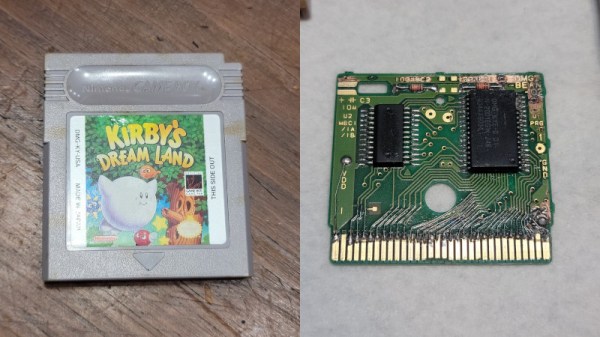
Retro consoles and handhelds are full of nostalgia and happy memories for many. However, keeping these machines and their media going can be a difficult job at times. [Taylor] was challenged to rescue a copy of Kirby’s Dream Land for the original Game Boy, and set about the task.
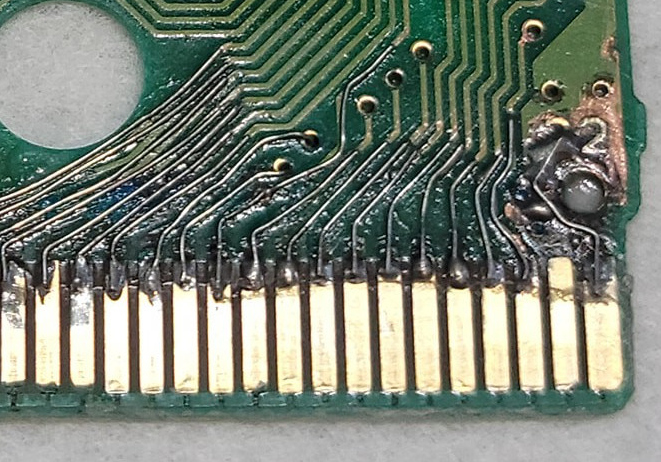
The cartridge was badly corroded, with many of the traces eaten through, rendering the game inoperable. First, all the components were removed, and the board was cleaned. This allowed easy access to the traces across the whole board. Then, the job was to delicately remove some solder mask from the parts of the traces still remaining, and bridge the gaps with fine copper wire. Even worse, several vias were damaged, which [Taylor] tackled by feeding jumper wires through the board and executing a repair on each side.

It’s a simple enough repair for the experienced hand, but virtually magic to a retro gaming fan that doesn’t know how to solder. [Taylor] has given us a great example of how to deal with corroded carts properly, with enough detail to be quite educational to the beginner.

We’ve seen other great work in this vein too, like an Amiga 2000 brought back from a horrible creeping green death. If you’ve done your own retro rescue, be sure to drop us a line!

Continue reading “Bringing A Ruined Game Boy Cart Back To Life With Tons Of Soldering” →

German Experiment Shows Horses Beating Local Internet Connections

These days, we’re blessed with wired and wireless networks that can carry huge amounts of data in the blink of an eye. However, some areas are underprovisioned with bandwidth, such as Schmallenberg-Oberkirchen in Germany. There, reporters ran a test last December to see which would be faster: the Internet, or a horse?

The long and the short of it is that Germany faces issues with disparate Internet speeds across the country. Some areas are well-served by high-speed fiber services. However, others deemed less important by the free market struggle on with ancient copper phone lines and subsequently, experience lower speeds.

Thus, the experiment kicked off from the house of photographer [Klaus-Peter Kappest], who started an Internet transfer of 4.5GB of photos over the Internet. At the same time, a DVD was handed to messengers riding on horseback to the destination 10 kilometers away. The horses won the day, making the journey in about an hour, while the transfer over [Kappest’s] copper connection was still crawling along, only 61% complete.

Obviously, it’s a test that can be gamed quite easily. The Internet connection would have easily won over a greater distance, of course. Similarly, we’ve all heard the quote from [Andrew Tanenbaum]: “Never underestimate the bandwidth of a station wagon full of tapes hurtling down the highway.”

Notably, [Kappest’s] home actually had a fiber line sitting in the basement, but bureaucracy had stymied any attempts of his to get it connected. The stunt thus also served as a great way to draw attention to his plight, and that of others in Germany suffering with similar issues in this digital age.

Top speeds for data transfer continue to rise; an Australian research team set a record last year of 44.2 terabits per second. Naturally, the hard part is getting that technology rolled out across a country. Sound off below with the problems you’ve faced getting a solid connection to your home or office.

The World’s First Autonomous Electric Cargo Ship Is Due To Set Sail

Maritime shipping is big business, with gigantic container ships responsible for moving the vast majority of the world’s goods from point A to points B, C and D. Of course, there’s a significant environmental impact from all this activity, something ill befitting the cleaner, cooler world we hope the future will be. Thus, alternatives to the fossil fuel burning ships of old must be found. To that end, Norwegian company Yara International has developed a zero-emission ship by the name of Yara Birkeland, which aims to show the way forward into a world of electric, autonomous sea transport. 

Continue reading “The World’s First Autonomous Electric Cargo Ship Is Due To Set Sail” →

Making A Car Key From A Ratcheting Wrench

Car keys these days are remarkably complex beasts. Covered in buttons and loaded with security transponders, they often cost hundreds of dollars to replace if you’re unlucky enough to lose them. However, back in the day, keys used to just be keys — a hunk of metal in a mechanical pattern to move some levers and open a door. Thus, you could reshape a wrench into a key for an old car if that was something you really wanted to do.

The concept is simple. Take a 12mm ratcheting wrench, and shape the flat section into a profile matching that of a key for an older car without any electronic security features. The first step is to cut down the shaft, before grinding it down to match the thickness and width of the original key.

The profile of the key is then drawn onto the surface, and a Dremel used with a cutting disc to create the requisite shape.  Finally, calipers are used to mark out the channels to allow the key to slide into the keyway, before these are also machined with the rotary tool.

Filing and polishing cleans up the final result to create a shiny, attractive ratchet wrench key. Even better, it does a great job of opening the car, too.

Similar machining techniques can be used to duplicate a key from just a photo (something I did back in 2019 to prank my friend). Alternatively, 3D printing can be great for reproducing even high-security keys. Video after the break.

Continue reading “Making A Car Key From A Ratcheting Wrench” →

You Can 3D Print Your Own RC Motorbikes

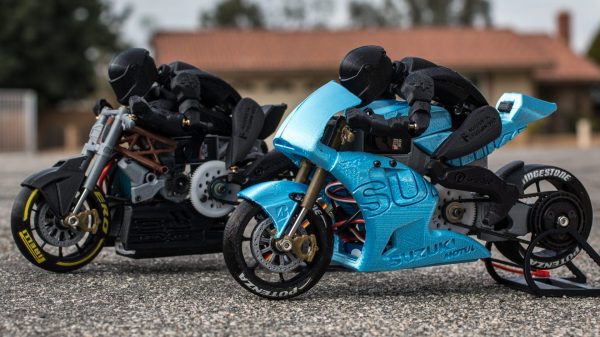
Radio control cars have been a popular toy for decades, but their motorcycle counterparts have always lagged behind due to balance issues and compromised agility. At the same time, a little toy motorbike can be mesmerizing in action. [brettt3] built a few of his own design that look remarkably fun to play with.

Modeled after the Ducati Draxter and Suzuki GSX-RR, the 3D printed bodies do a great job of aping their full-size counterparts. With a lick of paint and some finer touches, these could be absolutely exquisite, but they look awesome in the bare plastic nonetheless. The bikes use a belt drive to deliver power from a motor in the body to the rear wheel. To keep them upright, a weighted front wheel is used as a passive gyroscope for stabilization.

But the finest touch is arguably the rider which sits atop each motorcycle. Articulated and with hands resting on the handlebars, the rider moves with the steering of the bike, creating an eerie realism that we can’t get enough of. There’s even a tiny micro-servo in the head which allows the rider to swivel and look in the direction of motion as you’d expect.

Files are available for those wishing to recreate these designs at home. Alternatively, dive deeper into gyro-stabilised designs to learn more about how it all works. Video after the break.

Continue reading “You Can 3D Print Your Own RC Motorbikes” →

NASA Are Squaring Up Against The Asteroid Threat

The world faces many terrestrial crises right now, so it’s easy to forget that giant space rocks may one day threaten the very existence of entire civilizations. Yes, the threat of asteroid strikes is a remote one, but nevertheless something humanity may have to face one day, and one day soon.

NASA takes the issue seriously, and has staffed its Planetary Defence Coordination Office since 2016. In service to these efforts, it’s also developing a mission to research how dangerous androids may be deflected. The Double Asteroid Redirection Test, or DART, is set to launch within the next year. Continue reading “NASA Are Squaring Up Against The Asteroid Threat” →

GateBoy Is A Game Boy Emulated At Gate Level

Old game systems are typically the most popular targets for emulation. With huge communities of fans wanting to recreate the good times of yesteryear, most old systems have all been brought back to life in this manner. However, some simply dive into emulation for the technical challenge, and [Austin Appleby] has done just that with GateBoy.

GateBoy is a project to emulate the Game Boy logic gate by logic gate. It’s a lower level approach that builds upon earlier work [Austin] did on a project called MetroBoy, which we featured previously.

The emulator was created by painstakingly reverse-engineering the logic of the Game Boy. This was done by poring over die shots of the actual DMG-01 CPU silicon. GateBoy emulates most of the chip, though avoids the audio hardware at this stage.

Presently, GateBoy runs at roughly 6-8 frames per second on a modern 4GHz CPU. As it turns out, emulating all those gates and the various clock phases at play in the DMG-01 takes plenty of processing power. However, compilation optimizations do a lot of heavy lifting, so in some regards, GateBoy runs impressively quickly for what it is.

[Austin] still has plenty of work to do before GateBoy is completely operational, and there are some strange quirks of the Game Boy hardware that still need to be figured out. Regardless, it’s a fantastic academic exercise and a noble effort indeed. Meanwhile, you might like to check out the Game Boy emulator that runs just one single game.