RC Controller Becomes XInput Controller

XInput is an API that is used by applications to interface with the Xbox 360 Controller for Windows. The 360 controller became somewhat of a “standard” PC gamepad, and thus many games and applications support the XInput standard.

[James] is working on an entry for a robotics competition, and wanted a controller to use with their PC that was more suited to their build. They took an RC controller, and converted it to work with XInput instead.

The controller in question is the JJRC Q35-01, a trigger-type RC controller available for under $20. The conversion is executed neatly, with the original STM microcontroller being removed from the board, and the PCB traces instead being connected to a Teensy 3.5 which takes over running the show.

The conversion is remarkably complete, with the team not stopping at just reading the buttons and steering potentiometer. A USB logic analyzer was used to figure out how to control the LCD, and a calibration mode implemented just in case.

[James] has shared the work on Github so it’s reproducible for the average maker. We’ve seen plenty of builds in this space, like this tilt controller from [Electronoobs]. Video after the break.


Continue reading “RC Controller Becomes XInput Controller” →

Google Assistant, Now Available On Ham Radio

Depending on who you talk to, Google Assistant is either a tool capable of quickly and clearly answering audio queries in natural langauge, or a noisier and less useful version of Wolfram Alpha. [William Franzin] decided it would be particularly cool to make the service available over ham radio – and that’s exactly what he did.

[William] got the idea for this project after first playing with the Internet Radio Linking Project, a system which uses VoIP technologies to link radio networks over the internet. Already having an IRLP node, it seemed only natural to make it into a gateway to the wider internet through integration with Google Assistant. Early work involved activating the assistant via DTMF tones, but [William] didn’t stop there – through the use of Picovoice, it became possible to use the system with the custom wakeword “Bumblebee”.

[William]’s project could prove particularly useful for when he’s out of cell coverage, but needs a little information like a weather report or a piece of trivia to settle an argument round the campfire. Additionally, it’s even possible to control the IRLP node through voice commands, too.

If you’re just getting started with ham radio, check out this build to get you started for under $100. Video after the break.

Continue reading “Google Assistant, Now Available On Ham Radio” →

A Foggy Lightsaber Build

Lightsabers have enchanted audiences since their appearance in the very first Star Wars film in 1977. Unfortunately, George Lucas hasn’t shared the technology in the years since then with the broader public, so we’re left to subsist on pale imitations. This is just such a build.

The closest human analog to Jedi technology is the laser, and this build uses 8 of them in combination with two LEDs. They’re aimed to coincide at a fixed distance above the hilt. A CO2 bicycle inflater is then used to blow through an e-cigarette to create a fog. This makes the red lasers readily visible to the human eye.

This ersatz lightsaber does have its limitations – fast motion tends to scatter the fog, making it once again invisible, and it’s really at its best held in a vertical orientation. There’s also some divergence beyond the focused point. With that said, it does look somewhat impressive when held still, smouldering away.

Until we gain a better mastery of plasma physics, perhaps you can make do with this fire-based build? Video after the break.

[Thanks to qrp-gaijin for the tip!]

Continue reading “A Foggy Lightsaber Build” →

The Mystery Of The Clacking Clanking Scraping Sound

Hackers tend to face household problems a little differently than ordinary folk. Where the average person sees a painful repair bill or a replacement appliance, the hacker sees a difficult troubleshooting job and the opportunity to save some cash. [trochilidae] was woken one day by the dreaded Clacking Clanking Scraping Sound, or CCSS, and knew that something had to be done.

[trochilidae] reports that usually, the CCSS is due to the child of the house destroying his lodgings, but in this case, the source was laundry based. The Miele tumble dryer was acting up, and in need of some attention. What follows is a troubleshooting process [AvE] would be proud of – careful disassembly to investigate the source of the problem. Initial efforts found a loose bulb that was unrelated, before landing on a mysterious spring that wouldn’t fit back into place. In the end, that’s because it had no right to be there at all – an underwire had escaped from a bra, before becoming entangled in the dryer’s bearing. With the culprit identified and removed, it was a simple reassembly job with some attention also paid to the condenser and filters to keep things in ship-shape.

It just goes to show – a bad noise, if properly investigated in a prompt manner, doesn’t have to be the end of the world. A bit of investigation goes a long way, and can save you a lot of money and heartache.

We’ve seen appliances giving hackers trouble before – like this aging washing machine that got its mechanical brain replaced with an Arduino.

Why Converting Classic Cars To Electric Drive Is A Thing

A vintage British sportscar is a wonderful thing. Inimitable style and luxury, beautiful curves, and a soundtrack that could make even Vinnie Jones shed a tear. However, even under the most diligent maintenance schedule, they are known, above all, for their unreliability. As the value of such cars is tied heavily to their condition as unmodified examples, owners are typically reluctant to make modifications to remedy these issues.

However, things are starting to change. Cities across the world are enacting measures to ban fossil fuel vehicles from their streets, and sales of such vehicles are similarly going to be banned entirely. The automotive industry is preparing for a major pivot towards electric drivetrains, and no carmaker will be left untouched. In this landscape, it’s not just Tesla and Nissan who are selling electric cars anymore. Luxury brands are beginning to deliver electric vehicles, too.

Continue reading “Why Converting Classic Cars To Electric Drive Is A Thing” →

Pokemon Cries And How They Work

If you grew up watching the Pokémon TV series, you’d naturally be familiar with the cries of all your favourite Pocket Monsters. Most of the creatures in the anime tend to say their own name, over and over again. Pour one out for the legions of parents who, upon hearing a distant “PIKA PIKA!”,  still involuntarily twitch to this day.

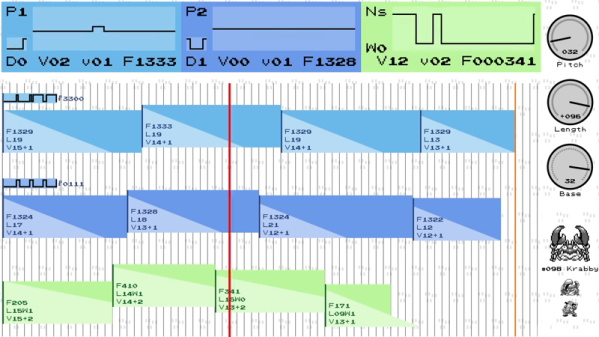
However, the games differ heavily in this area. Generation I of Pokémon was released on the Game Boy, which simply didn’t have the sound capabilities to deliver full bitstream audio. Instead, sounds were synthesized for the various Pokémon based on various parameters. It’s quite a deep and involved system, but never fear – help is at hand via [Retro Game Mechanics Explained].

The video breaks down, at a bitwise level, how the parameters are stored for each Pokémon’s cry, and how they are synthesized. It’s broken down into easily understandable chunks, explaining first how the Game Boy’s sound hardware works, with two pulse channels and a noise channel, before later expanding upon why some Pokémon have the same or similar cries.

It’s a tour de force in retro game reverse engineering, and expertly presented with high quality graphical guides as to what’s going on at the software level. There’s even an emulator you can use to explore the various cries from the original game, and generate your own, too.

Now that we’re up to speed with Pokémon, how about fixing bugs in a 37 year old game? Video after the break.

Continue reading “Pokemon Cries And How They Work” →

2600-Inspired Handheld Brings The Faux Woodgrain

The Atari 2600 is a console from a very different time, when home appliances, furniture, and even automobiles were all covered in fake vinyl woodgrain veneer. Somehow it was the in thing for a decade, and then immediately became tacky overnight. Regardless, if you want to evoke the era, that’s what you do – and that’s exactly what [Christian] did with this handheld RetroPie build.

An early concept sketch shows off [Christian]’s art skills.
The technical side of things is fairly routine in these parts – a Pi Zero runs RetroPie so you can play emulated games from the mid-90s and earlier. It’s the visual presentation that we particularly enjoy. The look of the early Atari is evoked through clever use of materials. The body is in black plastic, with blocky red buttons for controls. It’s finished with a vinyl woodgrain applique around the screen, and we think it’s a wonderful aesthetic.

The files to print your own are available on Thingiverse, and [Christian] has provided a basic guide to sourcing similar parts. It’s all common stuff, readily available on eBay or elsewhere.

We love seeing retro throwbacks like this – the tiny Macintosh Plus from the 2017 Superconference is a particular highlight.