An Easy Way To MIDI Sync Your Eurorack Build

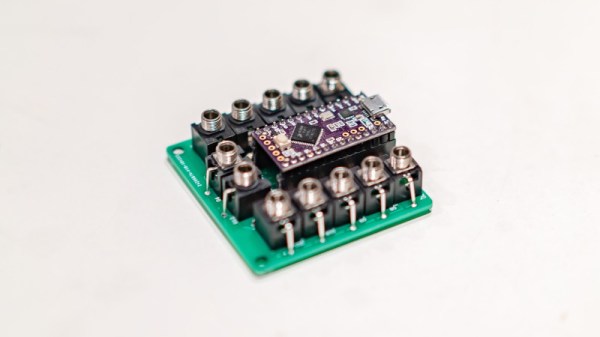
Eurorack synthesizer builds are known for a lot of things; simplicity isn’t necessarily one of them. However, not everything on a modular synthesizer build has to be inordinately complicated, a mess of wires, or difficult to understand. [little-scale] has built a neat and tidy module that might just find a place in your setup – the Chromatic Drum Gate Sync. The handy little device is based on a Teensy, and uses its USB MIDI libraries to make synchronizing hardware a snap.

The device has 12 channels, each responding to a single MIDI note. A note on message is used to set a gate high, and a note off message to set it low again. This allows very fine grained control of gates in a modular setup. The device can also output a variety of sync signals controlled by the USB MIDI clock – useful for keeping your modular rack in time with other digitally controlled synths.

It’s a build that espouses [little-scale]’s usual aesthetic – clean and tidy, with a focus on compactness. All the required details to build your own are available on Github.

We’ve seen the collision of [little-scale] and Teensy hardware before – with this rig playing 8 SEGA soundchips in unison.
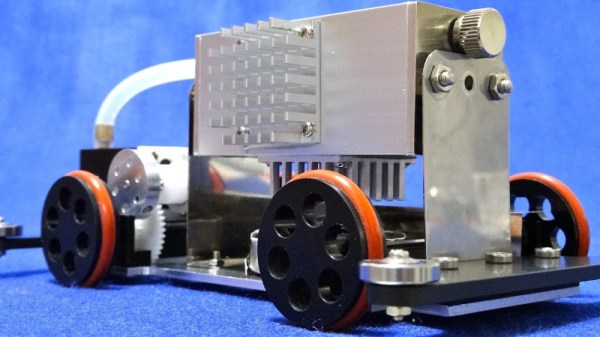

Custom Mini 4WD Runs On Steam

Tamiya’s Mini 4WD toy line primarily consists of small 1:32 scale toy cars powered by AA batteries, which have no remote control and are guided around a plastic track by horizontally oriented drive guide wheels. Tuning and racing these cars is popular in many parts of the world, but this build is a little different.

After initial experiments with a modified Tamiya chassis are unsuccessful, a fresh build using a bespoke aluminium chassis is begun. A sturdy boiler is created, feeding into a piston which is used to drive all four wheels through a series of driveshafts.

It’s interesting to watch the iterative design process solve various problems such as piston wear and gearing. Performance is underwhelming for those used to the immense speed of the electric toys, but we’d love to see a competition series using steam powered racers.

We don’t see a whole lot of steam hacks around here, but the Hudspith steam bicycle is something to marvel at. Video after the break.

Continue reading “Custom Mini 4WD Runs On Steam” →

Use Your Game Boy As A Wireless Controller

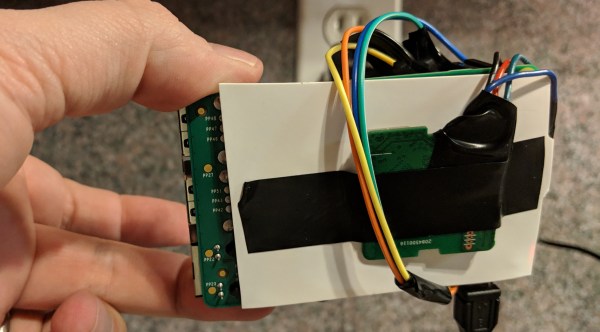
Like many retro favourites, the Game Boy is in no way dead — development continues apace through its many fans.But what about the hardware side? This is a particularly interesting one: [Alex] wondered if a Game Boy could be readily used as a wireless controller. Set out to make it happen, the final product is a game cartridge that makes the classic handheld a wireless controller.

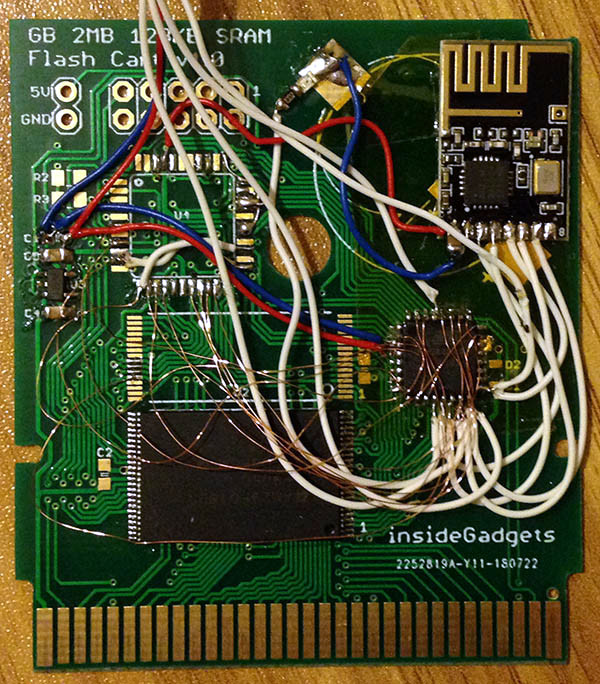
It’s achieved quite elegantly, with a custom cartridge used to turn the Game Boy into a controller while requiring no modification to the handheld. The cartridge contains a flash chip to store the ROM, along with an ATmega48PA microcontroller and an NRF24L01 to do the talking. Upon powerup, the Game Boy runs code from the ROM, and the microcontroller is in charge of reading button states and sending them to the NRF24L01 for transmission. The program stored on the ROM also allows configuration changes to be made from the Game Boy itself, such as choosing the appropriate wireless channel.

The cartridge transmitter can be used with a variety of receivers. [Andy] has developed a USB HID joystick emulator to allow the Game Boy to be used with PCs, as well as a receiver for the GameCube, too. Yes, that’s right — you can now play Super Smash Bros. with a weirder controller than all your friends. A Super Nintendo version is also in the works. Perhaps the coolest feature, however, is that the cart can use its radio link to communicate with another Game Boy running the same cartridge. [Andy] demonstrates this with a basic game of Pong being played between two Game Boy Advances.

Working on retro hardware can be great fun — things are well documented, parts are cheap, and there’ll be plenty of fans cheering you on, too. [Andy] has even made the hardware available for purchase on Tindie and his website if you’re not quite comfortable rolling your own.

The Game Boy platform remains ripe for hacking – you can even take screenshots with a logic analyzer these days. Video after the break.

Continue reading “Use Your Game Boy As A Wireless Controller” →

Forcing Amazon Alexa Compatible Stuff To Speak To Google Assistant

It took a long time, but it’s 2019, and we’re starting to get used to the concept of talking to a computer to make it control things around the house. It’s not quite as cool as it seemed when we saw it in films way back when, but that’s just real life. The problem is, there’s a multitude of different systems and standards and they don’t all necessarily work together. In [Blake]’s case, the problem is that Woods brand hardware only works with Amazon Alexa, which simply won’t do.

[Blake] went through the hassle of getting an Amazon Alexa compatible WiFi outlet to work with Google Assistant. It’s a bit of a roundabout way of doing things, but it works. A TP-Link HS-105 WiFi plug is used, which can be controlled through Google Assistant voice commands. The part consists of two PCBs – a control board that speaks WiFi, and a switching board with relays. [Blake] used the control board and hooked it up to a Raspberry Pi. When switched on by a command from Google, the HS-105 sets a pin high, which is detected by the Raspberry Pi. The Raspberry Pi then runs a software implementation of the KAB protocol used by the Woods hardware, triggering it when it receives the signal from the TP-Link hardware.

If we understand correctly, [Blake] had to go to this trouble in order to make his special outdoor-rated outlets work with his Google Home setup. Hopefully interoperability improves in years to come, but we won’t hold our breath.

We’ve seen some pretty convoluted projects in this space before, often using IFTTT — like this ESP8266 voice controlled tank.

A Smartwatch You Can Easily Build Yourself

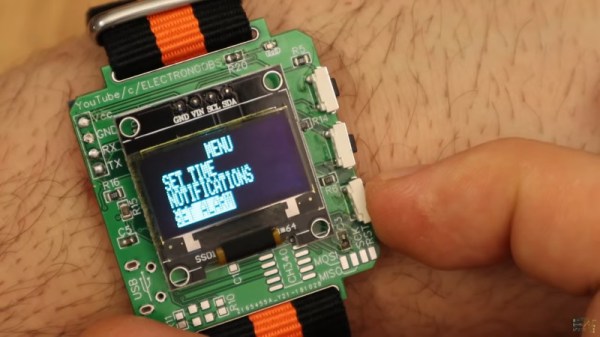
The concept of a smartwatch was thrown around for a long time before the technology truly came to fruition. Through the pursuit of miniaturisation, modern smartwatches are sleek, compact, and remarkably capable for their size. Companies such as Apple and Samsung throw serious money into research and development, but that doesn’t mean you can’t create something of your own. [Electronoobs] has done just that, with this Arduino-based smartwatch build.

The brain of the watch is that hacker staple, the venerable ATmega328, most well known for its use in the Arduino Uno and Nano platforms. An FTDI module is used for USB communication, making programming the board a snap. Bluetooth communication is handled by another pre-built module, and a smartphone app called Notiduino handles passing notifications over to the watch.

This is a build that doesn’t do anything crazy or difficult to understand, but simply combines useful parts in a very neat and tidy way. The watch is impressively thin and compact for a DIY build, and has a host of useful functions without going overboard.

We’ve seen other DIY builds in this space, too – such as this ESP8266-based smartwatch. Video after the break.

Continue reading “A Smartwatch You Can Easily Build Yourself” →

Infinity Cube Is Gorgeous Yet Simple

Typically when we hear the words “LED” and “Cube”, we think of small blinking devices on protoboard designed to flex one’s programming and soldering skills. However, while [Heliox]’s Cube Infini could be described as “a cube of LEDs”, it’s rather a different beast (video in French, subtitles available).

The cube starts with a 3D printed frame, designed in Fusion 360. The devil really is in the details — [Heliox] puts in nice touches, such as the artistic cube relief on the base, and the smart integrated cable management in the edges. The faces of the cube are plexiglass sheets, covered with a one-way reflective film that is applied in a similar manner to automotive window tint. For lighting, a high-density LED strip is fitted to the inside edges, chosen for maximum visual effect. It’s controlled by an IR remote and a cheap control module from Amazon.

While the build contains no particularly advanced tools, materials, or techniques, the final result is absolutely stunning. It’s a piece we’d love to have as a lamp in a stylish loungeroom or study. [Heliox] does a great job of explaining how the cube is designed and fits together, and it’s a testament to just what can be achieved with a little ingenuity and hard work.

Once you’re done here, check out this ping-pong based build.

Continue reading “Infinity Cube Is Gorgeous Yet Simple” →

Can This Fire Fighting Robot Take The Heat?

Firefighting is a difficult and dangerous job, which puts humans on the front line to save life and property on a regular basis. It’s a prime candidate for some robot helpers, and [Ivan] has stepped in with a fun build that, while it won’t be serving in your municipal department any time soon, gets us thinking about the possibilities.

It’s a radio controlled robot with an Arduino Uno for the brains. A couple of motor driver boards are used to run four windscreen wiper motors for propulsion. Long before the days of online shopping, the wiper motor was a hacker staple – a cheap, readily available high torque motor that could be easily driven for a range of hobby projects. They say only 90’s kids remember.

As far as water delivery goes, this robot is a little short on credentials, carrying only 1 litre of water. However, we appreciate [Ivan]’s use of a Tupperware container as a tank – with a few add-on fittings, this could be a great way to hold water in other projects. The small DC-powered pump is controlled by an industrial solid state relay – a good choice for a robot that may get wet. There’s an onboard CO2 extinguisher as well, but it’s sadly not plumbed into anything just yet.

This build is an [Ivan] classic – big, fun, and 3D printed on a much larger scale then we’re used to. It’s a strong  follow up to his impressive tank build we saw earlier. Video after the break.

[Thanks to Baldpower for the tip!]

Continue reading “Can This Fire Fighting Robot Take The Heat?” →