Studying Airplane Radio Reflections With SDR

A property of radio waves is that they tend to reflect off things. Metal surfaces in particular act as good reflectors, and by studying how these reflections work, it’s possible to achieve all manner of interesting feats. [destevez] decided to have some fun with reflections from local air traffic, and was kind enough to share the results.

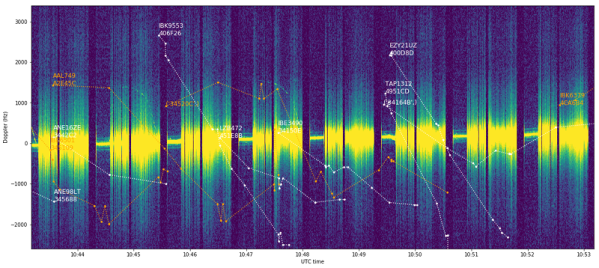
The project centers around receiving 2.3 GHz signals from a local ham beacon that have been reflected by planes taking off from the Madrid-Barajas airport. The beacon was installed by a local ham, and transmits a CW idenfication and tone at 2 W of power.

In order to try and receive reflections from nearby aircraft, [destevez] put together a simple but ingenious setup.

ADS-B data was plotted on a map and correlated with the received reflections.

A LimeSDR radio was used, connected to a 9 dB planar 2.4 GHz WiFi antenna. This was an intentional choice, as it has a wide radiation pattern which is useful for receiving reflections from odd angles. A car was positioned between the antenna and the beacon to avoid the direct signal overpowering reflected signals from aircraft.

Data was recorded, and then compared with ADS-B data on aircraft position and velocity, allowing recorded reflections to be matched to the flight paths of individual flights after the fact. It’s a great example of smart radio sleuthing using SDR and how to process such data. If you’re thirsty for more, check out this project to receive Russian weather sat images with an SDR.

[Thanks to Adrian for the tip!]
Smartphone Mod Goes Out On A Limb

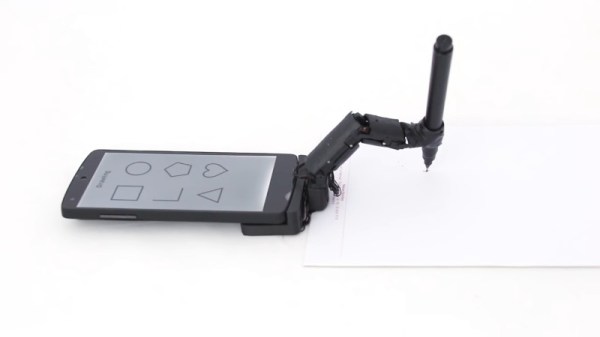
The modern smartphone has a variety of ways to interact with its user – the screen, the speakers, and of course, the vibration motor. But what if your phone could interact physically? It might be unnerving, but it could also be useful – and MobiLimb explores exactly this possibility.

Yes, that’s right – it’s a finger for your mobile phone. MobiLimb has five degrees of freedom, and is built using servomotors which allow both accurate movement as well as positional feedback into the device. Additionally, a touch-sensitive potentiometer is fitted, allowing the robofinger to respond to touch inputs.

The brains behind the show are provided by an Arduino Leonardo Pro Micro, and as is usual on such projects, the mechanical assembly is 3D printed – an excellent choice for producing small, complex parts. Just imagine the difficulty of trying to produce robotic fingers with classic machine tools!

The project video shows many different possibilities for using the MobiLimb – from use as a basic notification device, to allowing the smartphone to crawl along a table. We frankly can’t wait until there’s a fully-functional scorpion chassis to drop an iPhone into – the sky really is the limit here.

Interested in other unique ways to interact with your smartphone? Check out these nifty 3D printed physical buttons.

3D Printed Sneakers Are Now A Thing

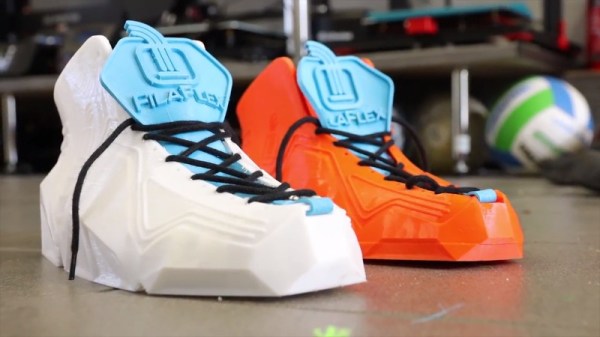
Shoes may seem simple at face value, but are actually rather complex. To create a comfortable shoe that can handle a full day of wear without causing blisters, as well as deal with the stresses of running and jumping and so on, is quite difficult. Is it possible to create a shoe that can handle all that, using a 3D printer?

[RCLifeOn] discovered these sneakers by [Recreus] on Thingiverse, and decided to have a go printing them at home. While [Recreus] recommend printing the shoes in their Filaflex material, for this build, one shoe was printed in thermoplastic polyurethane, the other in Ninjaflex. As two filaments that are both commonly known to be pliable and flexible, the difference in the final parts is actually quite significant. The Ninjaflex shoe is significantly more flexible and cushions the foot better, while the rigidity of the TPU shoe is better for ankle support.

Our host then takes the shoes on a long run through the woods, battling dirt, mud, and other undesirables. Both shoes hold up against the abuse, although [RCLifeOn] notes that the Ninjaflex shoe is much more comfortable and forgiving for longer duration wear.

We’ve seen other 3D printed shoe hacks before, too – like these nifty shoelace locks.

Displaying Bitmaps On The Apple II

The Apple II was the popular darling that truly kicked off the ascention of the company that would later bring you darlings such as the iMac, iPod, and iPhone. The brainchild of the legendary Steve Wozniak, it was a low-cost home computer that made use of some interesting compromises to create video output with the bare minimum components. This can make it difficult if you want to output full-bitmap graphics on the Apple II – but it is certainly possible.

[cybernesto] set about completing this task, and released VBMP on GitHub. Programmed in assembly, it builds upon the work of democoder Arnaud Cocquière to display bitmap images on the vintage 6502-powered machine. Capable of displaying monochrome images in 560 x 192 or sixteen colors in 140 x 192, it loads slowly but does get the job done.

We’ve seen similar development underway elsewhere, too – on this vintage satellite tracker project. [Keplermatic] reports that their code runs at a similar speed to the VBMP loader, despite doing several things differently. It’s also available over at GitHub, for your reading pleasure.

If you’re looking to achieve something similar with your vintage hardware, it’s worth a look. Having the source available makes integrating it into further projects a snap. Learning to program these older machines can be challenging, but that’s half the fun – and when you build something awesome, be sure to drop it on the tips line.

Artistic Collaboration With AI

Ever since Google’s Deep Dream results were made public several years ago, there has been major interest in the application of AI and neural network technologies to artistic endeavors. [Helena Sarin] has been experimenting in just this field, exploring the possibilities of collaborating with the ghost in the machine.

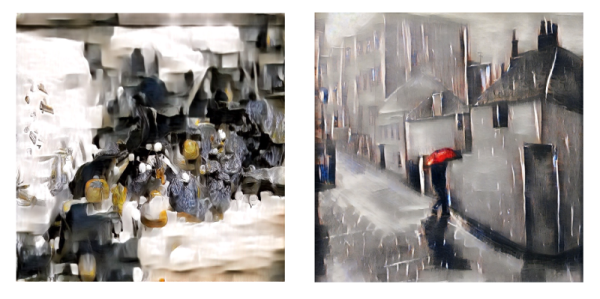
This image was generated with a landscape model using a dataset containing covers of Japanese poetry books.

The work is centered around the use of Generative Adversarial Networks, or GANs. [Helena] describes using a GAN to create artworks as a sort of game. An apprentice attempts to create new works in the style of their established master, while a critic attempts to determine whether the artworks are created by the master or the apprentice. As the apprentice improves, the critic must become more discerning; as the critic becomes more discerning, the apprentice must improve further. It is through this mechanism that the model improves itself.

[Helena] has spent time experimenting with CycleGAN in the artistic realm after first using it in a work project, and has primarily trained it on her own original artworks to create new pieces with wild and exciting results. She shares several tips on how best to work with the technology, around the necessary computing and storage requirements, as well as ways to step out of the box to create more diverse outputs.

Neural networks are hot lately, with plenty of research going on in the field. There’s plenty of fun projects, too – like this cartoonifying camera we featured recently.

Experimenting With Extruded Elements

Conventional 3D printing and other additive manufacturing methods are highly effective at producing parts of irregular geometries that are difficult or impossible to create with other methods. However, there is a whole set of compromises that come with it – material uniformity, strength, and size are just some that come to mind. There are, however, other techniques that can be used in conjunction with these technologies, and the use of so-called “extruded elements” may be one of them.

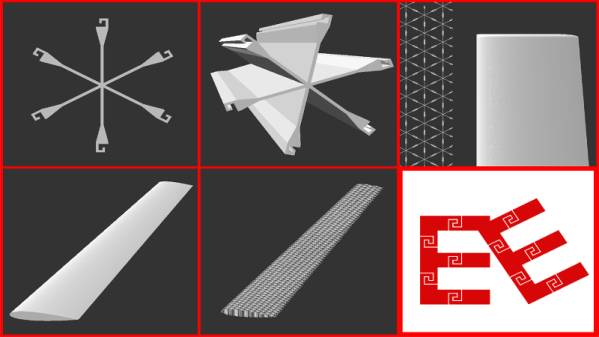
The idea is to break up large models into a series of smaller mutually interlocking pieces of an extruded form. This is done by importing an STL model into OpenSCAD and processing it with a special script. This script essentially intersects a matrix of extruded forms upon the original part geometry, allowing it to be printed as a series of seperate pieces that can later be assembled. The instructions are long and detailed, but are an accurate guide of how to create your own extruded element parts.

There are options to customise the process, allowing for filled and skeleton type extrusions and various ways of interlocking the parts. There are interesting implications for this technology, thanks to the benefits of interlocking parts. Particularly, it could have great benefits for the repair of damaged structures and for building objects that exceed the size of the build platform on a smaller 3D printer. The technique looks especially good for building up lightweight cores for big objects. [Toby] is working on a stand-up paddle board.

We look forward to seeing how this particular project develops. We’ve seen other techniques to build large printed structures, before, too – like this giant RC F1 car.

Fallout Watch Build Triumphs In Adverse Conditions

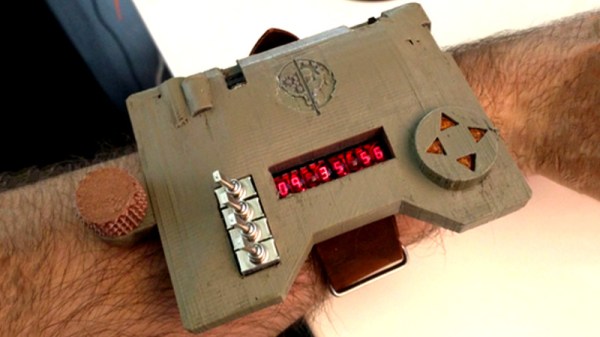
Is it a badge? Is it a watch? Well, it’s [Sarif’s] take on a wrist-mounted computer from the Fallout series, so you’re free to choose your own designation! We think the Brotherhood of Steel would be proud to have this piece of kit.

[Sarif] commenced the build after first getting their feet wet with the pipman, a watch inspired by Metro 2033 and Steins;;gate as much as Bethesda’s popular post-apocalyptic RPG. It features all the fruit – GPS, compass, a TV-B-Gone – and perhaps the coolest feature, long-since-deprecated bubble LED displays and flippy switches for that Altair-esque charm.

The build log is full of details, from the components used and the debugging battles involved in the journey. [Sarif] learned about using transistors, burning up a few along the way – some say setting the lab on fire is the quickest way to learn important lessons, anyway. On top of that, there were some software niggles but in the end, the watchputer made it to DEFCON 26 anyway!

Builds like this that start from limited experience and go deep into the trials and tribulations involved are an excellent way to learn about what goes into the average DIY electronics project, particularly when talking about embedded systems. And if you’re keen to check out the work of [Sarif’s] contemporaries, we’ve got a collection of all the awesome badges from DEFCON 26. Enjoy!