Automatic Water Turret Keeps Grass Watered

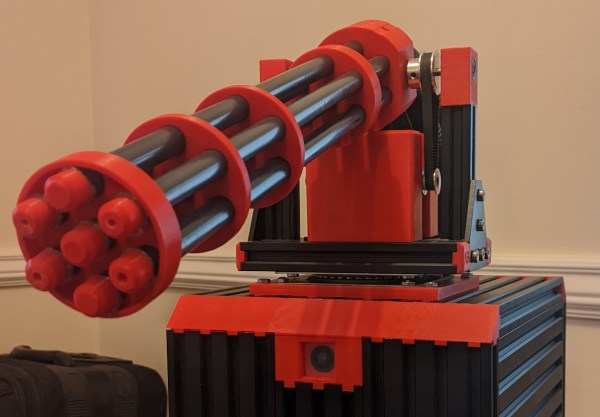
Summer is rapidly approaching (at least for those of us living in the Northern Hemisphere) and if you are having to maintain a lawn at your home, now is the time to be thinking about irrigation. Plenty of people have built-in sprinkler systems to care for their turf, but this is little (if any) fun for any children that might like to play in those sprinklers. This sprinkler solves that problem, functioning as an automatic water gun turret for anyone passing by.

This project was less a specific sprinkler build and more of a way to reuse some Khadas VIM3 single-board computers that the project’s creator, [Neil], wanted to use for something other than mining crypto. The boards have a neural processing unit (NPU) in them which makes them ideal for computer vision projects like this. The camera input is fed into the NPU which then directs the turret to the correct position using yaw and pitch drivers. It’s built out of mostly aluminum extrusion and 3D printed parts, and the project’s page goes into great details about all of the parts needed if you are interested in replicating the build.

[Neil] is also actively working on improving the project, especially around the turret’s ability to identify and track objects using OpenCV. We certainly look forward to more versions of this build in the future, and in the meantime be sure to check out some other automated sprinkler builds we’ve seen which solve different problems.

Continue reading “Automatic Water Turret Keeps Grass Watered”
Saving Birds With 3D Printed Boats

Montana, rightfully nicknamed the big sky country, is a beautiful state with abundant wide open landscapes, mountains, and wildlife. It’s a fantastic place to visit or live, but if you happen to reside in the city of Butte, that amazing Montana landscape is marred by the remnants of an enormous open pit mine. Not only is it an eyesore, but the water that has filled the pit is deadly to any bird that lands there. As a result, a group of people have taken to some ingenious methods to deter birds from landing in the man-made toxic lake for too long.

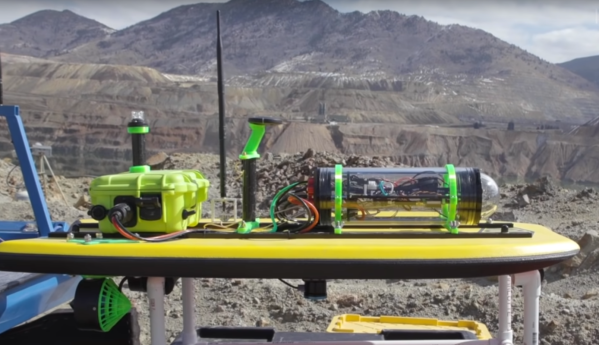
When they first started, the only tool they had available was a rifle. Scaring birds this way is not the most effective way for all species, though, so lately they have been turning to other tools. One of which is a custom boat built on a foam bodyboard which uses a plethora of 3D printed parts and sensors to allow the operator to remotely pilot the boat on the toxic lake. The team also has a drone to scare birds away, plus an array of other tools like high-powered lasers, propane cannons, and various scopes in order to put together the most effective response to help save wildlife.

While this strategy runs the gamut of the tools most commonly featured here, from 3D printers to drones to lasers, the only thing that’s missing is some automation like we have seen with other drone boat builds we’ve featured in the past. It takes quite a bit of time to continually scare birds off this lake, even through the winter, so every bit of help the team can get could go even further.

Continue reading “Saving Birds With 3D Printed Boats”

Retrotechtacular: Clay Pipe The Hard Way

Troll YouTube long enough and chances are good that you’ll come across all kinds of videos of the “How It’s Made” genre. And buried in with the frying pans and treadmills and dental floss manufacturers, there no doubt will be deep dives on how pipe is made. Methods will vary by material, but copper, PVC, cast iron, or even concrete, what the pipe factories will all have in common is the high degree of automation they employ. With a commodity item like pipe, it’s hard to differentiate yourself from another manufacturer on features, so price is about the only way to compete. That means cutting costs to the bone, and that means getting rid of as many employees as possible.

Such was not always the case, of course, as this look at how Irish Stoneware & Fireclays Ltd. made clay pipe, drain tiles, and chimney flues back in the 1980s shows. The amount of handwork involved in making a single, simple piece of clay pipe is astonishing, as is the number of hands employed at the various tasks. The factory was located in Carrickmacross, County Monaghan, Ireland, near an outcropping of shale that forms the raw material for its products. Quarrying the shale and milling it into clay were among the few mechanized steps in the process; although the extrusion of the pipe itself was also mechanized, the machines required teams of workers to load and unload them.

Continue reading “Retrotechtacular: Clay Pipe The Hard Way”

Remote Screen Viewer Is Text-Only

Have you been slowly falling down a rabbit hole of Stallman-like paranoia of computers ever since installing Ubuntu for the first time in 2007? Do you now abhor anything with a GUI, including browsers? Do you check your mail with the command line even though you’re behind seven proxies? But, do you still want to play Minecraft? If so, this command-line-only screen viewer might just be the tool to use a GUI without technically using one.

This remote screen viewer is built in Python by [louis-e] and, once installed, allows the client to view the screen of the server even if the client is a text-only console. [louis-e] demonstrates this from within a Windows command prompt. The script polls the server screen and then displays it in the console using the various colors and textures available. As a result, the resolution and refresh rate are both quite low, but it is still functional enough to play Minecraft and do other GUI-based tasks as long as there’s no fine text to read anywhere.

The video below only shows a demonstration of the remote screen viewer, and we can imagine plenty of uses beyond this proof-of concept game demonstration. Installing a desktop environment and window manager is not something strictly necessary for all computers, so this is a functional workaround if you don’t want to waste time and resources installing either of those components. If you’re looking for remote desktop software for a more specific machine, though, take a look at this software which enables remote desktop on antique Macs.

Continue reading “Remote Screen Viewer Is Text-Only”

A man playing a pipe organ through a MIDI keyboard

How To Move A Full-Sized Church Organ From A House To A Museum

As electronics hobbyists we are grateful to our spouses and flatmates who gracefully tolerate all of our weird equipment and chaotic projects in their homes. But it takes a different level of dedication to share one’s home with a pipe organ enthusiast: back in the 1970s, one organist in Bristol went to the effort of installing a full-sized church organ into their house, effectively turning the modest dwelling into one giant musical instrument. Recently however, the house passed on to new owners who, understandably anxious to reclaim some space, listed the whole system on eBay.

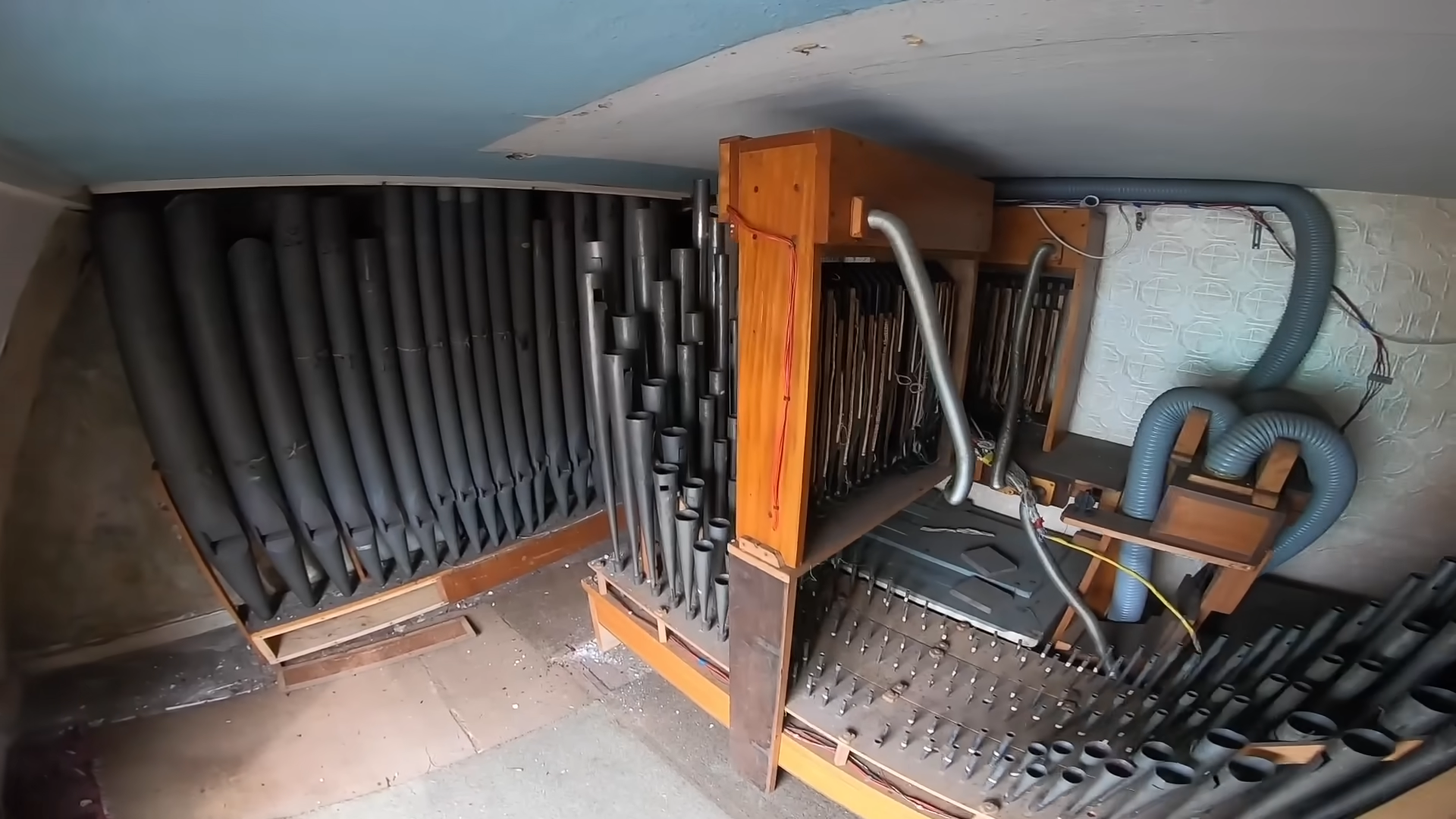
A pipe organ installed into an attic
No cash in this attic; just lots of zinc pipes and pneumatic tubing.

Thankfully, the auction was won not by some scrap metal dealer but by [Look Mum No Computer], our favourite expert on odd musical instruments. He drove out all the way from Kent to help disassemble the organ and stuff the dozens of pipes, miles of cable and numerous valves, tubes, latches and switches into his van. Once back home, he faced the daunting task of reassembling the whole lot into something capable of playing music, which he’s currently documenting in a video series.

The organ’s new home is This Museum Is (Not) Obsolete, where it has its own room decorated in a style similar to the house it spent much of its life in. The first step to getting it working was to fire up the blower, which is effectively a powerful electric air pump together with a pressure-regulating mechanism. Once this was working, one row of pipes was added to test the actuation system. This consists of a set of solenoids that simply open or close the air supply to each pipe. [LMNC] still had an Arduino-based organ driver system from an earlier project, which allowed him to connect a MIDI keyboard to the partially-complete instrument and play a few notes on it.

There’s still a lot to be done, but we’re definitely impressed by what [LMNC] has achieved so far and can’t wait to see the organ restored to its former glory. We already knew that you could control pipe organs through MIDI, and we’ve seen much smaller organs built from scratch. Thanks for the tip, [hackbyte]! Continue reading “How To Move A Full-Sized Church Organ From A House To A Museum”

At Last! A Cyberdeck You Might Want To Use

Cyberdecks make for interesting projects, some are a bit rough while others are beautiful, but it’s maybe something that even the most ardent enthusiast might agree — these home-made portable computers aren’t always the most convenient to use. Thus we’re very pleased to see this machine from [TRL], as it takes the cyberdeck aesthetic and renders it in a form that looks as though it might be quite practical to use.

It takes a Raspberry Pi and a Waveshare 1280×400 capacitive touch screen, and mounts this combo with a keyboard in an uncommonly well-designed 3D printed chassis.  With the screen flat it resembles the venerable TRS-80 Model 100 “slab” computer of the early 1980s, but flip it up, and a surprisingly usable laptop appears. Power comes from an external battery pack with a lead, but this is due more to thermal management issues with PSU boards than it is to necessity. The finishing touch is a stylish custom laptop bag, making for a combo we’d take on the train to bang out Hackaday articles any day.

Looking around, we think perhaps it might give the Clockwork DevTerm a run for its money. Alternatively, you might take a look at this upgraded TRS-80 model 100.

Continue reading “At Last! A Cyberdeck You Might Want To Use”

Junk I Bought: My PSU Just Won’t Do

I have an Acer monitor that I’ve owned for around 15 years, and thanks to my having paid extra at the time for the model sporting a DVI socket for HDMI compatibility it still finds a place as one of my desktop monitors. It has a power brick that supplies it with 1 2V at 4.5 A, and over the years this has developed an annoying whine. Something’s loose in the magnetics, and I really should replace it. So off to AliExpress I went, and dropped in an order for a 12 V, 5 A power brick.

It’s No Heavyweight

A PSU brick, marked as 12V 5A
So far so good…

These units are pretty standard, a box about 130 mm by 60 mm with an IEC socket at one end and a trailing cable at the other for the low voltage. I’ve had enough of them pass through my hands over the years to know what to expect, so I was dismayed to find when I received my PSU that it was suspiciously light. 86 g compared to the around 250 g I’d expect, so I began to smell a rat. Time for a teardown, and a descent into the world of small switch-mode mains power supplies.

Normally it should be easier to break into Fort Knox than to crack open a mains power supply, because for safety they are ultrasonic welded together. The few times I’ve done it have required some Dremel time and a bit of swearing, so when this case turned out to open fairly easily by levering with a screwdriver it was evident this wasn’t a high-quality item. Sure enough my suspicions were confirmed, for there inside was a much smaller board. It’s clear this isn’t a 5 A power supply, so just what have I received? Continue reading “Junk I Bought: My PSU Just Won’t Do”