Earlier this month, Lawrence Livermore National Laboratory (LLNL) announced to the world that they had achieved a record 1.3 MJ yield from a fusion experiment at their National Ignition Facility (NIF). Yet what does this mean, exactly? As their press release notes, the main advancement of these results will go towards the US’s nuclear weapons arsenal.
This pertains specifically to the US’s nuclear fusion weapons, which LLNL along with Los Alamos National Laboratory (LANL) and other facilities are involved in the research and maintenance of. This traces back to the NIF’s roots in the 1990s, when the stockpile stewardship program was set up as an alternative to nuclear weapons testing. Much of this research involves examining how today’s nuclear weapons degrade over time, and ways to modernize the existing arsenal.
In light of this, one may wonder what the impact of these experimental findings from the NIF are beyond merely ensuring that the principle of MAD remains intact. To answer that question, we have to take a look at inertial confinement fusion (ICF), which is the technology at the core of the NIF’s experiments.
We like regenerative receivers. They perform well and they are dead simple to create. Example? [Radio abUse] modified a few existing designs and built a one-transistor receiver. Well, one transistor if you don’t count the dozens that are probably on the audio amplifier IC, but we won’t quibble. You can watch a video about the simple receiver — which looks good on a neatly done universal board — below.
The coil of #22 wire dominates the visual layout, and we imagine winding it might have been the most time-consuming part of the project. The layout would work with a single-sided PCB and would be a great board to produce by hand if you were inclined to develop that skill.
Regenerative receivers work by holding an amplifier just shy of oscillating at a certain frequency. This provides extremely high gain at a particular frequency which allows just a single stage to really pull in signals.
We were a little sad to find out there was a plan to tear the radio down to build something else. But, we suppose, that’s progress. We’d be tempted to make a module out of the audio amplifier and then keep the RF section intact. But, then again, we have a lot of partial projects like that gathering dust on the shelf, so maybe that’s not such a great idea.
While regenerative receivers aren’t the most common architecture today, they still have their place. The inventor, Edwin Armstrong, developed quite a bit of radio tech that we still use today.
3D printers have come a long way over the past several years, but the process of bed leveling remains a pain point. Let’s take a look at the different ways the problem has been tackled, and whether recent developments have succeeded in automating away the hassle.
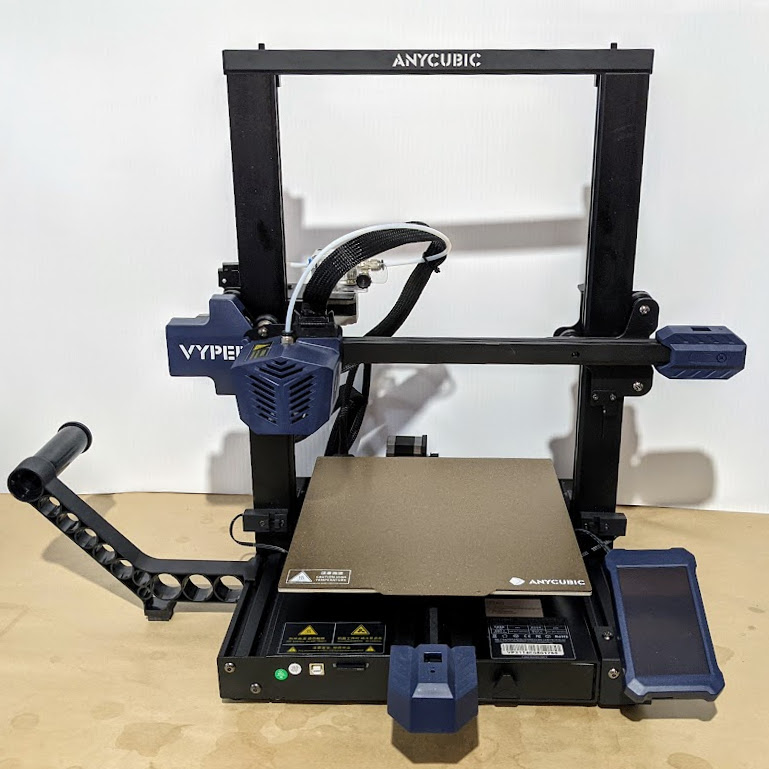
Anycubic Vyper, with an auto-leveling feature we decided to take a closer look at.
Bed leveling and first layer calibration tends to trip up novices because getting it right requires experience and judgment calls, and getting it wrong means failed prints. These are things 3D printer operators learn to handle with time and experience, but they are still largely manual processes that are often discussed in ways that sound more like an art than anything else. Little wonder that there have been plenty of attempts to simplify the whole process.
Some consumer 3D printers are taking a new approach to bed leveling and first layer calibration, and one of those printers is the Anycubic Vyper, which offers a one-touch solution for novices and experienced users alike. We accepted Anycubic’s offer of a sample printer specifically to examine this new leveling approach, so let’s take a look at the latest in trying to automate away the sometimes stubborn task of 3D printer bed leveling.
Keyless entry has become a standard feature on virtually all cars, where once it was a luxury option. However, it’s also changed the way that thieves approach the process of breaking into a car. After recent research, [HackingIntoYourHeart] claims that many modern Honda and Acura vehicles can be accessed with a simple replay attack using cheap hardware.
It’s a bold claim, and one that we’d love to see confirmed by a third party. The crux of the allegations are that simply recording signals from a Honda or Acura keyfob is enough to compromise the vehicle. Reportedly, no rolling code system is implemented and commands can easily be replayed.
Given these commands control features like unlocking the doors, opening the trunk, and even remote starting the vehicle, it’s a concerning situation. However, it’s also somewhat surprising. Rolling code technology has been around for decades, and makes basic replay attacks more difficult. Range extender attacks that target keyfobs sitting inside homes or gas stations are more common these days.
Whether Honda has made a security faux pas, or if there’s something more at play here, remains to be seen. If you’ve got more information, or have been able to recreate the same hack on your own Honda, be sure to let us know.
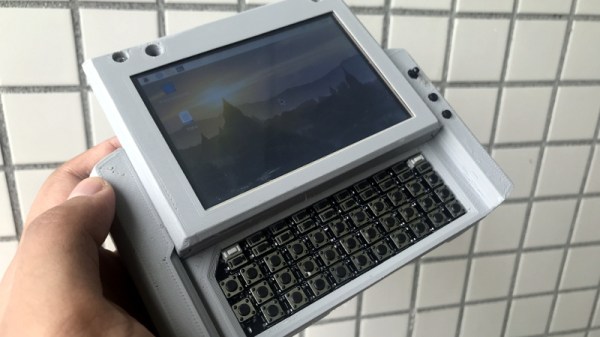
Back in 2019 we first came across the mutantC, an open source 3D printable Raspberry Pi handheld created by [rahmanshaber] that took more than a little inspiration from Sony’s VAIO ultra-mobile PCs (UMPCs) from the early 2000s. It was an impressive first effort, but it clearly had a long way to go before it could really be a practical mobile device.
Well after two years of development and three iterative versions of this Linux powered QWERTY slider, [rahmanshaber] is ready to show off the new and improved mutantC_v4. Outwardly it looks quite similar to the original version, with the notable addition of a tiny thumbstick and a pair of programmable buttons on the right side that can be used for input in addition to the touch screen. But inside it’s a whole other story, with so many changes and improvements that we hardly even know where to start.
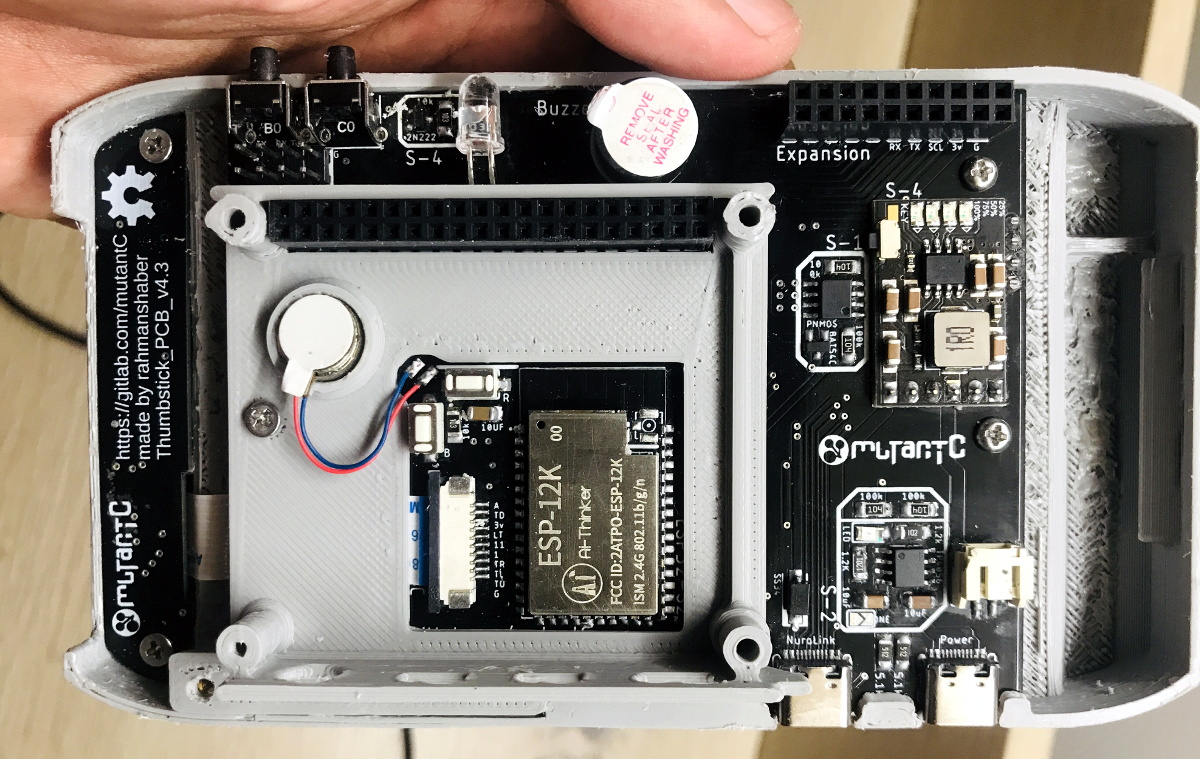
Inside the mutantC_v4, showing off the ESP32-S2
Probably the most notable improvement is the addition of an ESP32-S2, specifically a bare ESP-12K module, to the main PCB. Previous versions of the hardware used an Arduino Pro Micro to interface with all the hardware, but the added horsepower of the ESP32 should come in handy with the array of sensors, controls, and NeoPixels that [rahmanshaber] has tasked the chip with. There’s even a buzzer and a coin-style vibration motor in there to provide some feedback to the user. While the board has changed significantly, it still retains compatibility with the Pi Zero, 2, 3, and 4.
Another notable addition is the expansion connector on the bottom of the handheld that has pins for I2C, UART, and 3.3 V. In the video below, [rahmanshaber] mentions that this feature was previously implemented with a standard 2×6 female header block, but is now using a far slimmer female USB-C port. We do wonder if it’s not a bit confusing to have this faux-USB port right next to the real one that’s actually used to charge the system, but with such cramped quarters occasionally you’ve got to make some tough decisions like that.
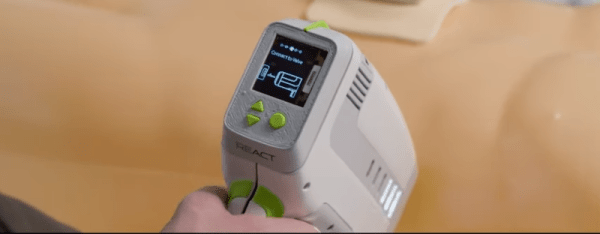
The device has two parts: a medical-grade silicone sleeve and a handheld actuator. The sleeve actually inserts into the stab wound and the actuator pressurizes the sleeve based on the location of the wound. The actuator has a user interface to allow the operator to select the area of the body affected.
We don’t know much about emergency medicine, but apparently, the current method is to apply pressure externally and this doesn’t do much for internal bleeding. The sleeve solves that and [Bentley] thinks the device can save many lives if brought to market. Of course, getting a medical device actually on the market is a long road fraught with regulatory peril. We hope the Dyson award will help [Bentley] get the product in the hands of people who can use it to good purpose.
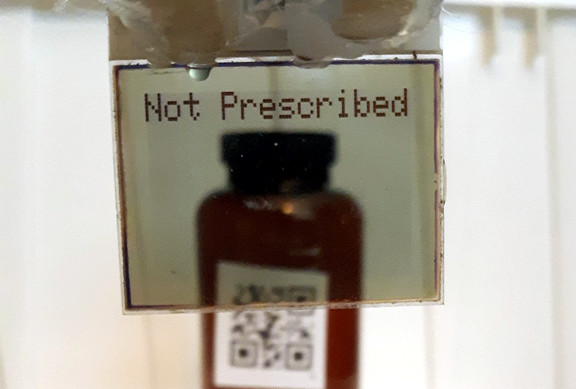
These days everyone’s excited about transparent OLED panels, but where’s the love for the classic Nokia 5110 LCD? As the prolific [Nick Bild] demonstrates in his latest creation, all you’ve got to do is peel the backing off the the late 90s era display, and you’ve got yourself a see-through cyberpunk screen for a couple bucks.
View through the modified LCD.
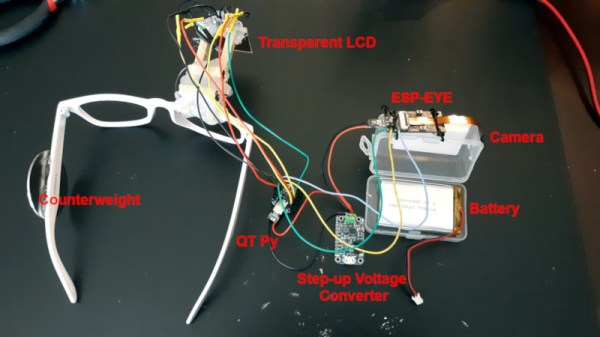
In this case, [Nick] has attached the modified display to a pair of frames, and used an Adafruit QT Py microcontroller to connect it to the ESP32 powered ESP-EYE development board and OV2640 camera module. This lets him detect QR codes within the wearer’s field of vision and run a TensorFlow Lite neural network right on the hardware. Power is provided by a 2000 mAh LiPo battery running through an Adafruit PowerBoost 500.
The project, intended to provide augmented reality reminders for medical professionals, uses the QR codes to look up patient and medication information. Right now the neural network is being used to detect when the wearer has washed their hands, but obviously the training model could be switched out for something different as needed. By combining these information sources, the wearable can do things like warn the physician if a patient is allergic to the medication they’re currently looking at.