Already Have That Book? Get The ISBN 411 Over IoT

Have you ever been at the bookstore and stumbled across a great book you’ve been looking for, but had a nagging feeling that you already had it sitting at home? Yeah, us too. If only we’d had something like [Kutluhan Aktar]’s ISBN verifier the last time that happened to say for sure whether we already had it.

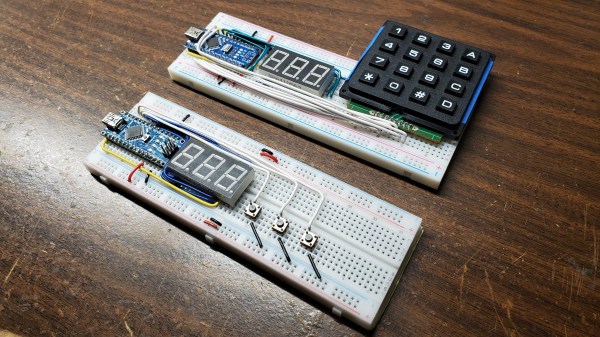
To use this handy machine, [Kutluhan] enters the International Standard Book Number (ISBN) of the book in question on the 4 x 4 membrane keypad. The Arduino Nano 33 IoT takes that ISBN and checks it against a PHP web database of book entries [Kutluhan] created with the ISBN, title, author, and number of pages. Then it lets [Kutluhan] know whether they already have it by updating the display from a Nokia 5110.

If you want to whip one of these up before your next trip to the bookstore, this project is completely open source down the web database. You might want to figure out some sort of enclosure unless you don’t mind the shy, inquisitive stares of your fellow bookworms.

Stalled out on reading because you don’t know what to read next? Check out our Books You Should Read column and get back to entertaining yourself in the theater of the mind.

Via r/duino

Hackaday Links Column Banner

Hackaday Links: September 27, 2020

Hardly a week goes by without a headline screaming about some asteroid or another making a close approach to Earth; it’s only by reading the fine print that we remember what an astronomer’s definition of “close” means. Still, 2020 being what it is, it pays to stay on top of these things, and when you do the story can get really interesting. Take asteroid 2020 SO, a tiny near-Earth asteroid that was discovered just last week. In a couple of weeks, 2020 SO will be temporarily captured into Earth orbit and come with 50,000 km near the beginning of December. That’s cool and all, but what’s really interesting about this asteroid is that it may not be a rock at all. NASA scientists have reverse-engineered the complex orbit of the object and found that it was in the vicinity of Earth in late 1966. They think it may be a Centaur booster from the Surveyor 2 moon mission, launched in September 1966 in the runup to Apollo. The object will be close enough for spectral analysis of its. surface; if it’s the booster, the titanium dioxide in the white paint should show up loud and clear.

Lasers are sort of forbidden fruit for geeks — you know you can put an eye out with them, and still, when you get your hands on even a low-power laser pointer, it’s hard to resist the urge to shine it where you shouldn’t. That includes into the night sky, which as cool as it looks could be bad news for pilots, and then for you. Luckily, friend of Hackaday Seb Lee-Delisle has figured out a way for you to blast lasers into the night sky to your heart’s content. The project is called Laser Light City and takes place in Seb’s home base of Brighton int he UK on October 1. The interactive installation will have three tall buildings with three powerful lasers mounted on each; a smartphone app will let participants control the direction, shape, and color of each beam. It sounds like a load of fun, so check it out if you’re in the area.

We got an interesting story from a JR Nelis about a quick hack he came up with to help his wife stay connected. The whole post is worth a read, but the short version of the story is that his wife has dementia and is in assisted living. Her landline phone is her social lifeline, but she can’t be trusted with it, lest she makes inappropriate calls. His solution was to modify her favorite cordless phone by modifying the keypad, turning it into a receive-only phone. It’s a sad but touching story, and it may prove useful to others with loved ones in similar situations.

We pay a lot of attention to the history of the early computer scene, but we tend to concentrate on computers that were popular in North America and the UK. But the Anglo-American computers were far from the only game in town, and there’s a new effort afoot to celebrate one of the less well-known but still important pioneer computers: the Galaksija. Aside from having a cool name, the Yugoslavian Z80 computer has a great story that will be told in documentary form, as part of the crowdsourced Galaksija project. The documentary stars our own Voja Antonic, who was key to the computer’s development. In addition to the film, the project seeks to produce a replica of the Galaksija in kit form. Check out the Crowd Supply page and see if it’s something you’re willing to back.

There’s an interesting new podcast out there: the Pick, Place, Podcast. Hosted by Chris Denney and Melissa Hough, it comes out every other week and is dedicated to the electronic assembly industry. They’ve currently got eight episodes in the can ranging from pick and place assembly to parts purchasing to solder paste printing. If you want to learn a little more about PCB assembly, this could be a real asset. Of course don’t forget to make time for our own Hackaday Podcast, where editors Mike and Elliot get together to discuss the week in hardware hacking.

Food Dispenser Shakes And Rattles

[Elite Worm] follows a strict diet that involves regularly mixing dry ingredients in varying proportions. The task grew tedious, and thus automation became a tantalising prospect. Enter the DIY shaking food dispenser.

The machine has a simple touch screen interface, with an Atmega328P running the show behind the scenes. The user can store a series of profiles, which each correspond to a different mixture of four base ingredients. Dealing with dry ingredients like oats, chia, and flax, shaking is often necessary to get things moving. To achieve this, the rig packs a hefty DC motor up top, which turns an eccentric shaft, shaking the whole rig. Each ingredient hopper has a servo-controlled nozzle, so ingredients can be dispensed in turn, with a load cell in the base measuring the weight delivered.

It’s a neat system, though [Elite Worm] notes that the device shakes just a little too much, and suspects it won’t hold up in the long term. We suspect a less violent, higher frequency vibration might be less hard on the components, but we’re sure there’ll be some quality engineering going into the next build. We’ve seen [Elite Worm]’s work here before, too. Video after the break.

Continue reading “Food Dispenser Shakes And Rattles”

DIYing A High End Camera Arm

One of the first purchases for anyone looking to shoot video should be a tripod. Key to getting clean and stable shots, they can nevertheless be limiting in their range of motion. Wanting something a little more high-end, but dissatisfied with the high cost of commercial options, [Alexandre Chappel] decided to build his own camera arm.

The build is based around square alumiunium tubing, with the high-tolerance material acting as the arm’s vertical and horizontal rails. 3D printed brackets and adapters are used to bolt everything together, along with several printed components used as drilling guides to help accurately machine the aluminium tubes. Adjustment is built into the carriages that travel along the rails, to help account for any slop in the 3D printed parts. A counterweight system is then installed to ensure the camera doesn’t hit the floor when not in the locked position.

It’s a tidy build, and one that has given [Alexandre] far more flexibility to shoot than his existing tripods. Additionally, adjusting the camera position is much quicker than before. Of course, when you’re building your own rigs, the sky is the limit. Video after the break.

Continue reading “DIYing A High End Camera Arm”

Rocket Plane Build Aims For High Speed Flight

[James Whomsley] likes flying, and likes flying fast. After reaching a speed of 114 miles an hour with an RC plane, he wanted to go further and break that record. To do so, he looked towards rocket power, and started a new build.

The design consists of a combination of 3D printed parts, laser-cut plywood bulkheads, and foamboard flight surfaces, with a few carbon fiber stiffeners thrown in here and there. For this early prototype, power is solely from hobby rocket motors, providing thrust for 1.6 seconds, meaning flight times are necessarily short. The craft is launched from an aluminium profile rail thanks to a 3D printed sliding guide pin.

Initial tests with two rocket motors were promising, leading to a second trial with a full six motors fitted. The thrust line was a little low, however, and a major pitch-up just after launch meant the plane only reached around 62 miles an hour. [James] still has a ways to go to beat his previous record, so intends to explore adding ducted fan propulsion to get the plane in the air before using the rockets as a speed booster in steady flight.

Of course, if you can’t lay your hands on rocket engines, you could always consider spinning up your own. (Or ditch the engine entirely.) Video after the break.

Continue reading “Rocket Plane Build Aims For High Speed Flight”

Old Polaroid Gets A Pi And A Printer

There’s nothing like a little diversion project to clear the cobwebs — something to carry one through the summer doldrums and charge you up for the rest of the hacking year. At least that’s what we think was up with [Sam Zeloof]’s printing Polaroid retro-conversion project.

Normally occupied with the business of learning how to make semiconductors in his garage, or more recently working on his undergraduate degree in electrical engineering, [Sam], like many of us, found himself with time to spare this summer. In search of a simple, fun project that wouldn’t glaze over the eyes of people when he showed it off, he settled on a printing party camera. The guts are pretty standard fare: a Raspberry Pi and Pi cam, coupled with a thermal receipt printer for instant hardcopy. The donor camera was a Polaroid Pronto from eBay, in good shape on the outside and mostly complete on the inside. A Dremel took care of the latter, freeing up space occupied by all the plastic bits that held the film cartridge and running gear of the film handling system.

The surgery made enough room to squeeze in the Pi Zero and a LiPo battery pack, along with a buck converter. Adding in the receipt printer and its drive board and mounting the Pi cam presented some challenges, but everything fit without breaking the original look and feel of the Polaroid. The camera now produces low-res hardcopy instantly using a dithering algorithm, and store high-resolution images on an SD card for later download. As a bonus, [Sam] included a simulated time and date stamp in the lower corner of the saved images, like those that used to show up on film.

[Sam]’s camera looks like a ton of fun. We’ve seen other Polaroid conversions, including a stunning SX-70 digital upgrade, but this one shines for its simplicity and instant hardcopy.

[via Tom’s Hardware]

A Battery To Add A Tingling Sensation To Your Tweets

Internet-connected sex toys are a great way to surprise your partner from work (even the home office) or for spicing up long-distance relationships. For some extra excitement, they also add that thrill of potentially having all your very sensitive private data exposed to the public — but hey, it’s not our place to kink-shame. However, their vulnerability issues are indeed common enough to make them regular guests in security conferences, so what better way to fight fire with fire than simply inviting the whole of Twitter in on your ride? Well, [Space Buck] built just the right device for that: the Double-Oh Battery, an open source LiPo-cell-powered ESP32 board in AA battery form factor as drop-in replacement to control a device’s supply voltage via WiFi.

Battery and PCB visualization
Double-Oh Battery with all the components involved

In their simplest and cheapest form, vibrating toys are nothing more than a battery-powered motor with an on-off switch, and even the more sophisticated ones with different intensity levels and patterns are usually limited to the same ten or so varieties that may eventually leave something to be desired. To improve on that without actually taking the devices apart, [Space Buck] initially built the Slot-in Manipulator of Output Levels, a tiny board that squeezed directly onto the battery to have a pre-programmed pattern enabling and disabling the supply voltage — or have it turned into an alarm clock. But understandably, re-programming patterns can get annoying in the long run, so adding WiFi and a web server seemed the logical next step. Of course, more functionality requires more space, so to keep the AA battery form factor, the Double-Oh Battery’s PCB piggybacks now on a smaller 10440 LiPo cell.

But then, where’s the point of having a WiFi-enabled vibrator with a web server — that also happens to serve a guestbook — if you don’t open it up to the internet? So in some daring experiments, [Space Buck] showcased the project’s potential by hooking it up to his Twitter account and have the announcement tweet’s likes and retweets take over the control, adding a welcoming element of surprise, no doubt. Taking this further towards Instagram for example might be a nice vanity reward-system improvement as well, or otherwise make a great gift to send a message to all those attention-seeking people in your circle.

All fun aside, it’s an interesting project to remote control a device’s power supply, even though its application area might be rather limited due to the whole battery nature, but the usual Sonoff switches may seem a bit unfitting here. If this sparked your interest in lithium-based batteries, check out [Lewin Day]’s beginner guide and [Bob Baddeley]’s deeper dive into their chemistry.