Where We’re Calculating, We Don’t Need No Seven Segments!

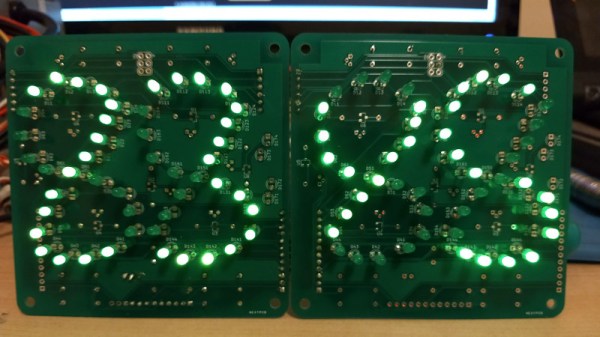
There have been many attempts at electronic numerical display technology over the decades since the first incandescent bulb or neon tube flickered into life at the command of a primordial computer, but the lowest common denominator has remained the humble seven segments. Here it might end, but for [Ken Yap] who has taken inspiration from a 1960s Sharp calculator to re-create a numerical display with only six segments.

This seemingly impossible feat is achieved by having six curved segments arranged as a figure-eight, which can render all the digits after a fashion, but which soon reveals why the extra segment made an appearance. The numbers that are made up of curves look good enough, but the straight lines in the 1, 4, and 7, are compromised by the diagonal, and the zero is curiously small at half the height.  You can read the digits, but it takes getting used to.

What made sense to reduce the complexity of 1960s electronics is only a fascinating curiosity in 2020, but we maybe won’t see these displays appearing too often. You can take a look at it in the video below the break, and if you’re curious about the Sharp calculator which inspired it then you can take a look at its page in the Vintage Calculator Museum.

Continue reading “Where We’re Calculating, We Don’t Need No Seven Segments!”
Climbing Everest One Hill At A Time – And Keeping Track Of It

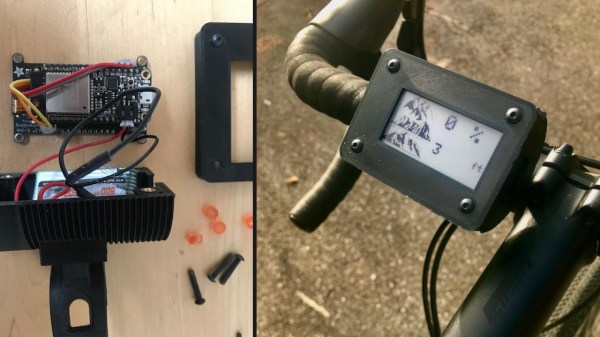
The internet is full of self-proclaimed challenges, ranging from some absolutely pointless fads to well-intended tasks with an actual purpose. In times of TikTok, the latter is of course becoming rarer, as a quick, effortless jump on the bandwagon is just easier for raising your internet points. Cyclists on the other hand love a good challenge where they compete with one another online, testing their skills and gamifying their favorite activity along the way. One option for that is Everesting, where you pick a hill of your choice, and within a single session you ride it up and down as many times as it takes until you accumulated the height of Mount Everest on it. Intrigued by the idea, but not so much its competitive aspect, [rabbitcreek] became curious how long it would take him to reach that goal with his own casual bicycle usage, so he built a bicycle computer to measure and keep track of it.

While the total distance and time factors into the actual challenge, [rabbitcreek]’s primary interest was the accumulated height, so the device’s main component is a BMP388 barometric pressure sensor attached to a battery-powered ESP32. An e-paper display shows the total height and completed percentage, along with some random Everest-related pictures. Everything is neatly packed together in a 3D-printed case that can be mounted on the bicycle’s handlebar, and the STL files are available along with the source code in his write-up.

Of course, if you’re actually interested in the challenge itself, you probably have an assortment of sports tracking equipment anyway, but this is a nice addition to keep track as you go, and has a lower risk of ransomware attacks. And in case [rabbitcreek] sounds like a familiar name to you, he’s indeed become a Hackaday regular with his environmental hacks like the tide clock, a handheld particle sniffer, or logging temperatures in the Alaskan wilderness.

Polymer Networks Make Better 3D Prints

Biological machines such as human and animal bodies are quite incredible. Your body seamlessly incorporates materials as different as muscle, bone, and tendons into an integrated whole. Now Texas A&M researchers think they can imitate nature using polymer networks that have a tunable stiffness. As a bonus, similar to biological devices, the material spontaneously self-heals.

The trick relies on the Diels-Alder reaction which is a cycloaddition reaction of a conjugated diene to an alkene. Diels-Alder-based polymers or DAPs will bond together even when they have different physical characteristics and they undergo a reversible reaction to heat which offers shape-memory and healing capability.

Continue reading “Polymer Networks Make Better 3D Prints”

Attempting To Generate Photorealistic Video With Neural Networks

Over the past decade, we’ve seen great strides made in the area of AI and neural networks. When trained appropriately, they can be coaxed into generating impressive output, whether it be in text, images, or simply in classifying objects. There’s also much fun to be had in pushing them outside their prescribed operating region, as [Jon Warlick] attempted recently.

[Jon]’s work began using NVIDIA’s GauGAN tool. It’s capable of generating pseudo-photorealistic images of landscapes from segmentation maps, where different colors of a 2D image represent things such as trees, dirt, or mountains, or water. After spending much time toying with the software, [Jon] decided to see if it could be pressed into service to generate video instead.

The GauGAN tool is only capable of taking in a single segmentation map, and outputting a single image, so [Jon] had to get creative. Experiments were undertaken wherein a video was generated and exported as individual frames, with these frames fed to GauGAN as individual segmentation maps. The output frames from GauGAN were then reassembled into a video again.

The results are somewhat psychedelic, as one would expect. GauGAN’s single image workflow means there is only coincidental relevance between consecutive frames, creating a wild, shifting visage. While it’s not a technique we expect to see used for serious purposes anytime soon, it’s a great experiment at seeing how far the technology can be pushed. It’s not the first time we’ve seen such technology used to create full motion video, either. Video after the break.

Continue reading “Attempting To Generate Photorealistic Video With Neural Networks”

Robot Travels The World

Around the World in 80 Days may have been an impressive feat of international travel in a world before widespread air transit. In modern times though, it’s not even necessary to leave your home in order to travel around the world. To that end, [Norbert] is attempting to accomplish this journey using a robot that will do the traveling for him as part of this year’s Virtual Maker Faire.

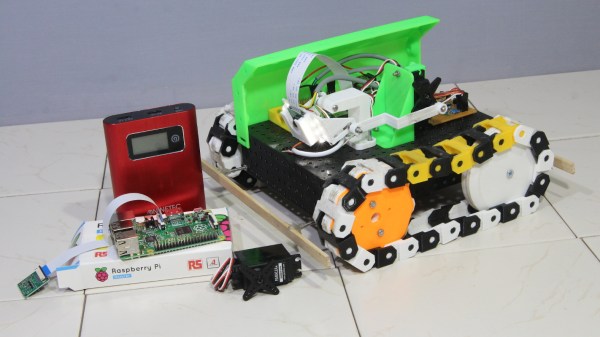
The robot is called the World Tour Robot, and the idea for it is to be small enough to ship to each new location around the world and be simple enough to be repaired easily. It is driven by two servo motors and controlled by a Raspberry Pi which also handles a small camera. Once at its location, it can connect to the internet and then be able to be controlled through a web interface. Locations are selected by application, and the robot is either handed off to the next person in the chain or put back in a box to be shipped.

The robot hasn’t left for its maiden voyage just yet but [Norbert] plans to get it started soon. Hopefully there are enough interesting places for this robot to explore on its trip around the world, although it’s probably best to avoid Philadelphia as it is known to be unfriendly to robots.

SMD Breadboard Adaptors Skip Schematic, Goes Straight To PCB

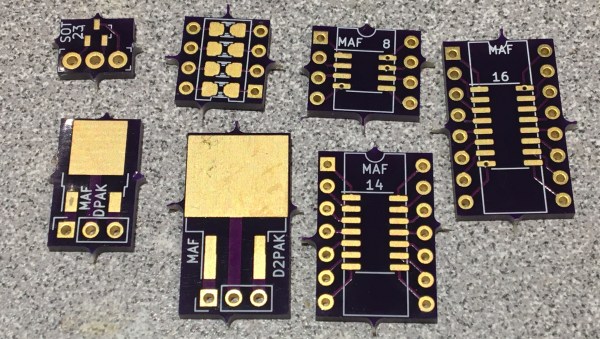
If you need to add one or two SMT chips to your breadboarded prototype, [Travis Hein] has you covered. He designed a set of small SMD adaptor boards for various SOIC, SOT23, and DPAC patterns using KiCad.  He has released them as open source, so you can feel free to use them or modify them as needed.

Normally we don’t see people bypassing the schematics when designing a PCB. But we can agree that [Travis] has found a situation where going direct to PCB makes more sense. He just plops down the package in Pcbnew, adds some pin headers and wires everything up directly on the PCB. (But don’t worry, some of you may remember [Travis] from his earlier SSR mains switching project, which demonstrates that he can indeed draw proper schematics.) We know there are more people out there who prefer to go straight to PCB layout… [mikeselectricstuff] comes to mind. If you could yourself among this tribe, let use know your reasoning in the comments below.

We wrote about a similar universal breakout boards for SMD parts back in 2016, which is a single breakout board for two- and three-pin jelly-bean components. If you paired some of those boards with [Travis]’s breakout boards, it would make a great combination to keep in your prototyping gadgets bin. Consider this project the next time your favorite PCB shop has a sale.

Spare Parts Express

I’ve got spare parts, and I cannot lie.

This week I’m sending out two care packages to friends and coworkers because I’ve got too many hackables on hand, and not enough time to hack them all. One is a funky keyboard, and the other is an FPGA dev board, but that’s not the point. The point is that the world is too interesting, and many of us have more projects piled up in the to-do box, with associated gear, than we’ll ever have time to complete.

Back in the before-times, we would meet up, talk about our ongoing hacks, and invariably someone would say “oh you need an X, I’ve got half a box of them” and send you one. Or maybe you’d be the one with the extra widgets on hand. I know I’ve happily been in both positions.

Either way, it’s a win for the giver, who gets to take a widget off the widget pile, for the receiver, who doesn’t have to go to the widget store, and for the environment, which has to produce fewer widgets. (My apologies to the widget manufacturers and middlemen.)

This reminded me of Lenore Edman and Windell Oskay’s Great Internet Migratory Box Of Electronics Junk back in the late aughts. Trolling through the wiki was like a trip down memory lane. This box visited my old hackerspace, and then ended up with Bunnie Huang. Good times, good people, good hacker junk! And then there’s our own Brian Benchoff’s Travelling Hacker Box and spinoffs.

These are great and fun projects, but they all end up foundering in one respect: to make sense, the value of goods taken and received has to exceed the cost of the postage, and if you’re only interested in a few things in any given box, that’s a lot of dead weight adding to the shipping cost.

So I was trying to brainstorm a better solution. Some kind of centralized pinboard, where the “have too many h-bridge drivers” folks can hook up with the “need an h-bridge” people? Or is this ad-hoc social network that we already have working out well enough?

What do you think? How can we get the goods to those who want to work on them?