A Replacement PCB For The Echo Dot

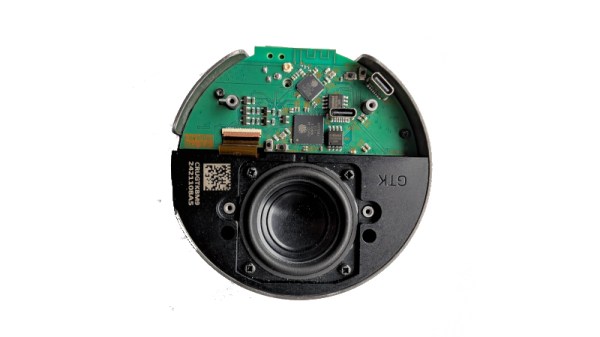
The Amazon Echo and other voice-controlled home assistants provide so much promise of a Jetsons style future of machines at your service. They would be a must-have accessory, were it not that they rely on the data centres of a large corporation that does not necessarily have your best interests at heart. But what if you like the Echo, but not the cloud? If you’re [ale1800], you take a 3rd generation Echo Dot, gut it, and put your own PCB inside to offer a local service.

The device keeps the Dot interface and microphone array, and connects to a Home Assistant server. As you’d imagine it needs a more powerful computer at its heart than a run-of-the-mill microcontroller, so it  uses an ESP32-P4 application processor, with the usual ESP32-S3 companion for connectivity. We’ve been following P4 projects as they gather steam, and it’s interesting to see one that’s not using a screen-based interface. There’s a YouTube video below the break, so you can see it in action.

We like this device, on many levels. In using the P4 it’s pushing forward with the next generation of microcontrollers, and in providing a local voice assistant it’s freeing its users from the cloud. What’s not to like!

Continue reading “A Replacement PCB For The Echo Dot” →

A white, 3D-printed robot hand is shown making a gesture with its index finger, pinkie finger, and thumb extended, and the others curled.

Building A Robotic Hand On A Budget

For all the recent advances in robot control enabled by machine learning, there are still a few problems which remain stubbornly difficult: locomotion, for example, or whole-body balance for humanoids. Dexterity, in particular, has emerged as a particularly hard problem, requiring both software and hardware sophistication; hardware capable of useful fine motor movement is often quite expensive. [Mahdi]’s been working on that problem, though, with an eighteen-degree-of-freedom robot hand that costs less than $300 in parts.

Although the hand is the main point of the project, it’s really a full forearm. The skeleton is 3D printed and driven by servo motors; like a human hand, the motors are located mostly in the forearm and use tendons to actuate the joints. Unlike most servo-driven robot hands, it uses thin steel rope instead of synthetic fiber cables, which eliminates the need to tie small knots — the tendon can simply be tensioned and crimped in place.

To reduce friction, each tendon runs through a PTFE tube. Wherever a tendon would have to go past a joint, it passes through the joint’s center of rotation, which keeps the length of the tendon’s path from changing as the joint bends. Each finger on the hand can move side-to-side and flex two joints independently.

The base of the arm can also rotate on a servo motor, which made powering the servo motors a challenge: the servos draw too much current for small slip-rings, and larger slip-rings were too expensive. Since the arm didn’t need to rotate continuously, though, he instead used a coil of flat ribbon cable which winds in or our as the joint rotates, with a printed cable guide to keep it from kinking; not only is this much cheaper than a slip ring, it’s also more compact.

We’ve seen a few robot hands take the same tendon-based approach before, and the more realistic ones replace the servo motors with artificial muscles. Some have even 3D-printed tendons and ligaments.

Continue reading “Building A Robotic Hand On A Budget” →

Capturing And Mineralizing Atmospheric Carbon Dioxide

Although the various panicked noises about there being ‘too much’ CO2 in the atmosphere might make one think that we’re pretty much breathing in pure CO2 at this point, Earth’s atmosphere is thankfully still roughly 78% nitrogen and 21% oxygen, with even argon crowding out carbon dioxide. That said, even at a mere 400 ppm it’s already a problem, so capturing it seems like a good idea. In a recent video by [Hyperspace Pirate] we thus look at turning this gas into a more solid form.

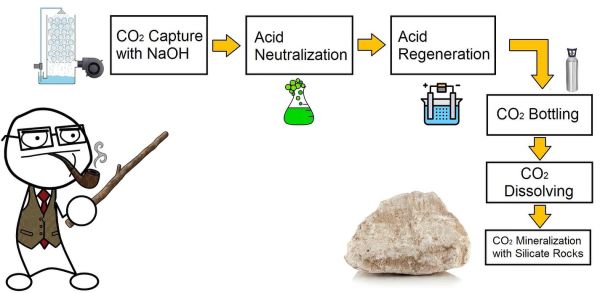
Unlike common calcium-based methods the demonstrated method is based around sodium hydroxide as the capturing liquid. This produces sodium carbonate and from there sodium bicarbonate, though these are not the final forms yet. Next the captured CO2 has to be released for the actual sequestering step, which uses sulfuric acid. This itself is regenerated with a cation exchange membrane-based cell by [Rowow] which we have covered before.

By mineralizing the carbon dioxide it should end up in a stable form that will last the ages. Here crushed wollastonite is used to finally mineralize the gas, with it being fed in at high pressure and temperature to speed up the process.  Ultimately this experiment removed 4.3 grams of carbon dioxide from the atmosphere, corresponding to about 2 liters.

Direct air capture of carbon dioxide makes little sense at this point, as the calculations in the video also show by scaling up this experiment. Even when you talk about carbon capture and storage/sequestration (CCS) directly at the source of the air pollution the economics are iffy, albeit it significantly more realistic.

Continue reading “Capturing And Mineralizing Atmospheric Carbon Dioxide” →

Thermite Powered Instant Phone Charger

Thermite is an amazing material, using mostly easily obtainable ingredients like aluminium and iron(III) oxide in a redox reaction to create a rather spectacular amount of thermal energy in very little time. In addition to its welcome use in e.g. welding railroad tracks, thermite has also seen use by the folk over at [The Thought Emporium] for less conventional uses like heating up hotdogs and more recently charging a cellphone.
The rough idea is basically inspired by the radioisotope generators that power for example all the rovers currently scurrying about on the surface of Mars, not to mention the venerable Voyager 1 and 2 spacecraft on their journey through Deep Space.

Of course, the nice thing about plutonium or similar isotopes in an RTG is that they release their energy in a rather slow and controlled fashion, whereas thermite tends to be slightly more violent and of a significantly shorter duration. In short, much like how using the immense power in a lightning strike is highly impractical, is there any way to make using thermite’s redox reaction for electricity production at all practical?

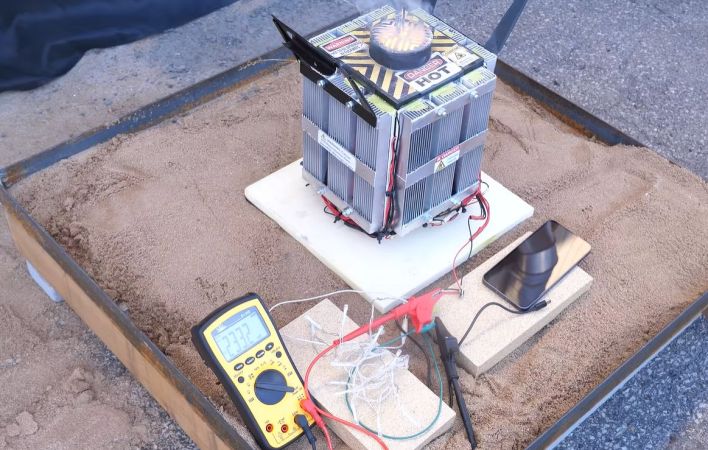
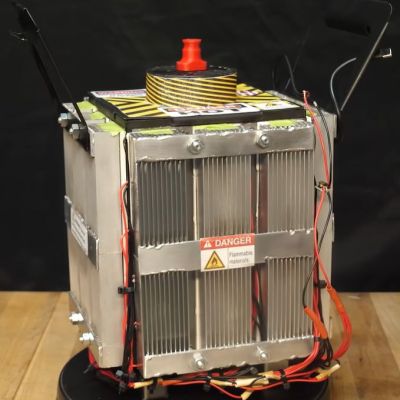
The core of this thermite generator uses a similar thermoelectric cooling (TEC) plate, also known as a Peltier element. After spending most of the video discussing why RTGs are far superior, 300 grams of thermite is loaded into the chamber of this thermite generator. It then took ten minutes for enough heat to build up, and produce maybe a Watt of power. Although they managed to have a slow enough thermite reaction to give the TECs some time to churn out some power, ultimately its probably the most flashy and least productive way to charge up your phone.

Continue reading “Thermite Powered Instant Phone Charger” →

ESP32 Drives MDA Display For Wireless Terminal

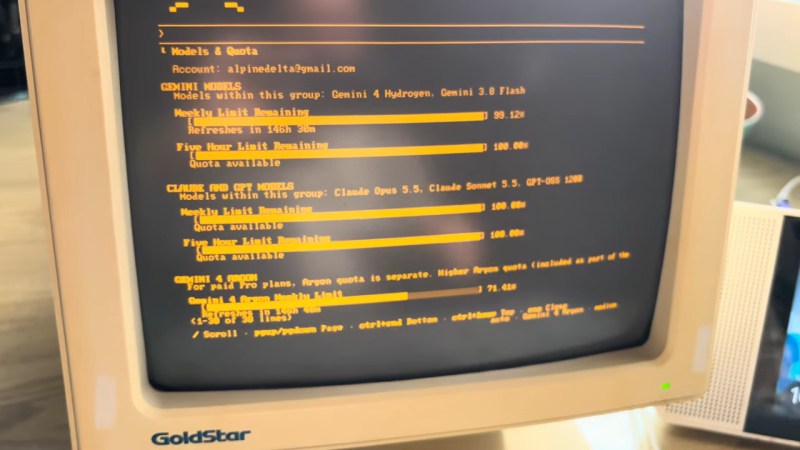
Don’t you miss the days where you had to point a particle accelerator at your face for a full shift? Well, maybe not when we think of it that way, but we still love the amber glow of the Monochrome Display Adapter (MDA) monitor [Chad Boughton] has hooked up to an ESP32 wireless terminal.

The particular ESP32 dev board he’s using comes with PS/2 input and VGA output, but of course VGA is not compatible with the TLL signal the old monochrome monitors are looking for, so he’s had to do a little bodge work– though aside from the one wire, this is evidently a software project. It took a bit of trial-and-error with the oscilloscope to get the timings right, but now that he has them he’s willing to share. [Chad] built that into a fork of FabGL’s terminal he has up on GitHub.

What he’s displaying on the terminal is equally fun, as he’s got a lovely command-line interface styled to look like IBM OfficeVision running on his server, complete with word processor and Lotus 1-2-3 spreadsheet editor– though it can also control the Plex server that carries [Chad]’s tunes. That’s also up on GitHub for anyone who wants it.

If you prefer green, check out the last CRT/ESP32 combo project we featured. For those of you with the opposite problem– a TLL output and no accompanying screen– there’s a project for that, too. 

Thanks to [Chad] for the tip!

Continue reading “ESP32 Drives MDA Display For Wireless Terminal” →

Automation For The Swimming Pool

Swimming pools demand constant maintenance if they are to avoid becoming disgusting pools of fetid, bacterial soup. [ingTacchelli] has been working on an automation system for this very purpose.

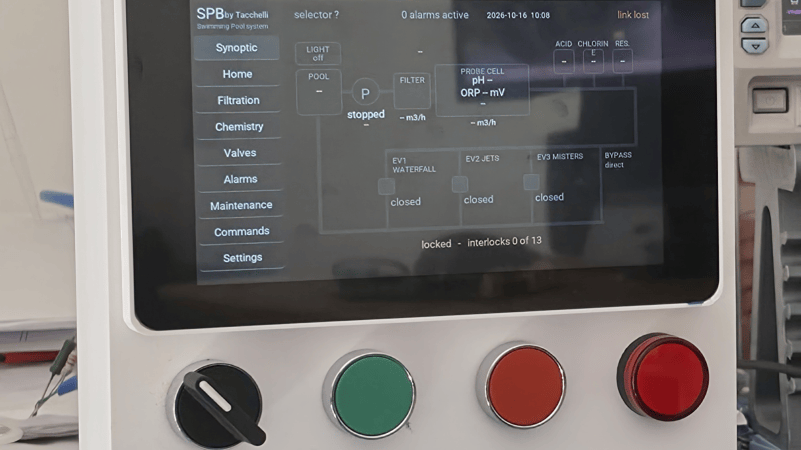
Swimming Pool System Open (SPSO) is, as the name suggests, an open-source design for a swimming pool automation controller. It’s intended to be simple, low-cost, and easy to understand. It uses a custom board running an ESP32-S3 microcontroller to measure pH and chlorine probes to determine the state of the water, and it also monitors temperature, filter pressure, flow, and tank levels. Dosing and filtration pumps are then controlled to deliver the proper chemicals and filter the water when needed, with careful attention to safety to avoid dangerous conditions. The interface is via a 7″ Waveshare touchscreen, and the whole system can also be hooked up to Home Assistant if so desired. Files are on GitHub for those eager to dive in the deep end.

If you’re sick of manually sampling your pool water and applying the necessary chemicals, this could be a system that appeals to you. We’ve featured similar projects before, too. If you’re working on similar projects to maintain your pool, garden, fish tank, or fancy Bond-esque shark trap, don’t hesitate to notify the tipsline. We might tell the authorities about the shark thing if you’re foolish enough to do so, though.

LiDAR Glasses For The Visually Impaired

The human brain has a fairly remarkable ability to take any sensory input and convert it into another type. Most notably, those with vision impairments can use systems that produce sound from what they see in the environment, with the brain learning to process this information visually after some time. Touch is another sense that can be remapped to vision, and [DebackTech] has come up with this system which uses a series of vibration motors to assist the visually impaired.

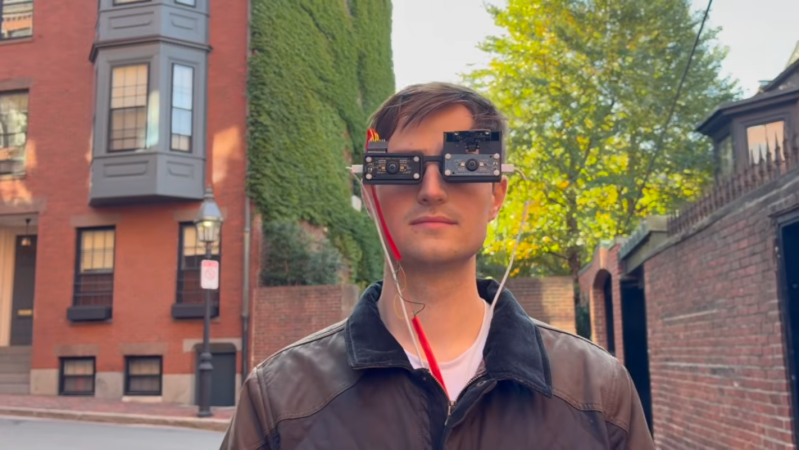
The brain’s ability to transfer information from one system to another is known as cross-modal plasticity. This system specifically uses a pair of glasses that have LiDAR built in. The sensors continually scan the environment, providing a computer with distance and direction information. The computer processes this and outputs its findings immediately to a shirt with an array of vibration motors sewn into it. With practice, a user can learn to identify obstacles based on the vibration of these motors.

As far as actually usability goes, [DebackTech] was able to use them to walk around, ride an electric scooter, and play catch with a large, slow-moving ball. The prototype system is a little bit bulky for now but in a place like Boston with so many universities this presumably wouldn’t draw that much attention, and it could also be streamlined in future versions.

There are some other interesting methods that can be used to help those with visual disabilities, sometimes without using any technology at all.

Continue reading “LiDAR Glasses For The Visually Impaired” →