Counter-Strike Gets The RGB LED Treatment

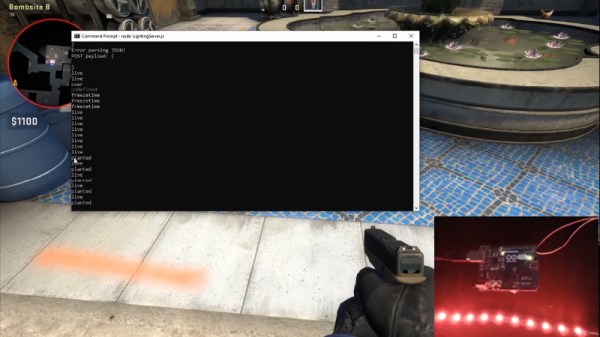
Inspired by the over-the-top stage lighting and pyrotechnics used during e-sport events, [Hans Peter] set out to develop a scaled-down version (minus the flames) for his personal Counter-Strike: Global Offensive sessions. It might seem like pulling something like this off would involve hacking the game engine, but as it turns out, Valve was kind enough to implement a game state API that made it relatively easy.

According to the documentation, the CS:GO client can be configured to send out state information to a HTTP server at regular intervals. It even provided example code for implementing a simple state server in Node.js, which [Hans] adapted for this project by adding some conditional statements that analyze the status of the current game.

These functions fire off serial commands to the attached Arduino, which in turn controls the WS2812B LEDs. The Arduino code takes the information provided by the HTTP server and breaks that down into various lighting routines for different conditions such as wins and losses. But things really kick into gear when a bomb is active.

[Hans] wanted to synchronize the flashing LEDs with the beeping sound the bomb makes in the game, but the API doesn’t provide granular enough data. So he recorded the audio of the bomb arming sequence, used Audacity to precisely time the beeps, and implemented the sequence in his Arduino code. In the video after the break you can see that the synchronization isn’t perfect, but it’s certainly close enough to get the point across in the heat of battle.

With the special place that Counter-Strike occupies in the hearts of hackers and gamers alike, it’s little surprise people are still finding unique ways to experience the game.

Continue reading “Counter-Strike Gets The RGB LED Treatment”
The Art Of USB Dongle Repair

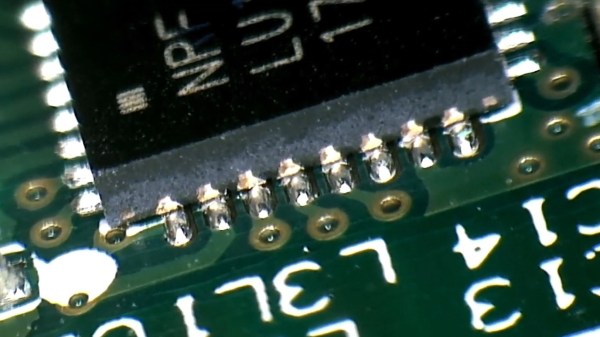
Faced with a broken USB dongle for our wireless devices, most of us would likely bin the part and order a replacement, after all the diminutive size of those things probably means hard to impossible repairability, right? Well, [The Equalizor] took it as a challenge and used the opportunity to practice his microscopic soldering skills just for funsies.

The wireless adapter in question, which came from one of his clients who accidentally bent it while it was plugged into a laptop, refused to be recognized by a computer under any circumstances. After sliding out the metal casing for the USB plug and snapping off the plastic housing, [The Equalizor] discovered that the slightly bent exterior hid a deeply cracked PCB. Then, with an inspection of the severed traces and lifted components, it was simply a matter of reflowing solder a few times to try to make the board whole again. Once the dongle was confirmed working, a new 3D shell was printed for it, replacing the original which had to be broken off.

It might not seem extraordinary to some people, but this video is a good example to show that repairs to delicate electronics in such a small scale are feasible, and can serve to reduce the amount of electronic waste we constantly dump out. Just because some electronics seem dauntingly elaborate or beyond salvaging, it doesn’t always mean there isn’t light at the end of the tunnel. You can see the work performed on this tiny dongle after the break.

Continue reading “The Art Of USB Dongle Repair”

Password Keeper Uses Off-The-Shelf Formfactor

With every website these days demanding the creation of an account, it can become difficult to remember so many logins. Each password should ideally be unique, lest a leak from your fantasy football game cost you thousands in stolen bitcoins. To help, [vcch] developed a password vault, using an interesting off-the-shelf platform.

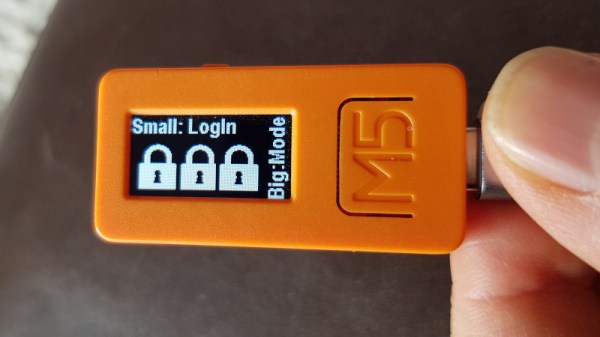
The platform in question is the M5stickC, which packs an ESP32, color LCD, and battery into an attractive orange enclosure. It’s even got USB-C, making it a tool with an eye on the future. It serves as a quick way to get a basic IOT project up and running, without having to fuss about designing your own enclosure or basic power supply hardware.

On this platform, [vcch] created a tool to make keeping track of passwords easy. The PassStrong, as it’s called, can store a huge number of passwords, and communicates with the host PC over Bluetooth. The interface makes good use of the LCD, displaying the current mode and function of each button on the device for the user. It’s capable of working in both QWERTY and AZERTY environments, which should appeal to European users.

The M5StickC is a perfect choice in this regard, packing enough buttons and the required Bluetooth hardware to get the job done. No need to spend any time integrating modules – simply open the box and get to coding. We expect to see more developments in this space in future, and look forward to the efficiency gains this will bring to all kinds of projects!

Solid State Relay Simulation, Explained

[SaltyPuglord] needed a solid state relay for a project. We’d have just bought one, but he decided to design his own in LTSpice. Along the way he made the video below, which is pretty informative and a good example of a non-trivial design in LTSpice.

MOSFETs have made designs like this a lot easier, to the extent that it should be as easy as putting a pair of beefy fets in-line with the AC source and load. However, that has a few ramifications that [Salty] covers in the video.

The biggest concern comes in isolating the DC supply from ground. He used a transformer which is tricky to simulate in LTSpice. Beyond that the design of the power supply is quite simple, and as he mentions in the video, you don’t really need this complex of a regulator just to feed the gates of the MOSFETs.

Continue reading “Solid State Relay Simulation, Explained”

The CarolinaCon 16 Badge Slithers Into Life

It’s something of an unwritten rule at this point that you can’t hold a hacking conference without providing a badge with at least a few LEDs on it. Not only can they be a great way to learn electronics for the attendees that tinker with them, but they’re a keepsake to commemorate the event. As a perfect example, [Matt Agius] recently wrote in to tell us about the badge he’s made for the upcoming CarolinaCon 16.

As [Matt] explains, the idea with this badge was to make it as easy as possible for attendees to assemble. In the final version there are only going to be three components that need to be soldered, so even if they’ve never touched SMD components before, they should still be able to get their badge lit up.

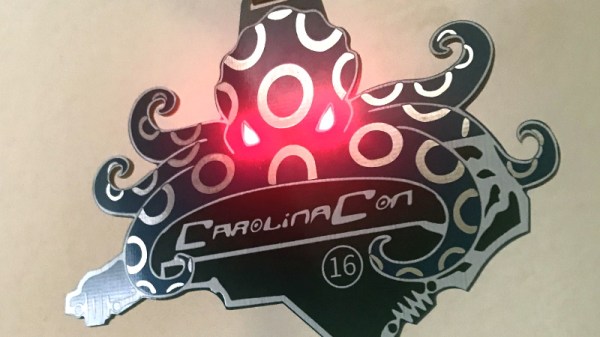
The badge largely makes up for its simplistic electronics with some fantastic board art on the flip side. The two red LEDs illuminate the eyes of a rather sinister looking octopus that’s ensnaring the unsuspecting state of North Carolina in its tentacled grip. The art was originally done by [Katie Dorn], with [Matt] spearheading its conversion into something that could be sent out for PCB fabrication.

Anyone looking to add this latest entry to their growing collection of badges will need to attend CarolinaCon on April 10th and 11th, where you’ll be able to catch a talk [Matt] is giving on the subject called “How to design Printed Circuit Boards for Hacking and for Art”.

Lil’ ESP32 Bot Does Remote Surveillance, And It’s Easy

Digital cameras have been around for a long time, as have small remote control robotics platforms. However, combining the two has really only come into its own in the last decade or so, as more bandwidth has become available to the home tinkerer. This ESP32-CAM surveillance bot is a great example of what was once hard becoming trivially easy.

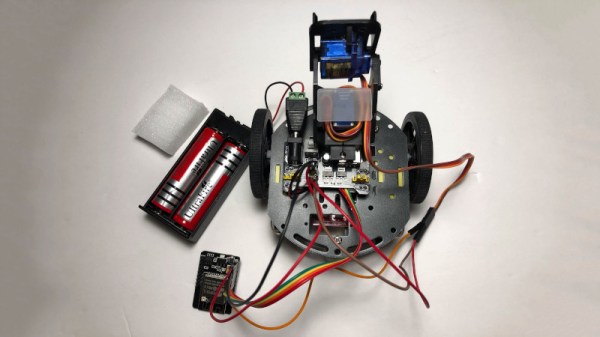
It’s a case of standing on the shoulders of giants. The ESP32-CAM is a device that allows one to stream live video images over a network using existing example code. In this case, it’s combined with an L298N DC motor driver which allows the Adafruit robot platform to be steered like a tank via its two wheels. A pair of SG90 servos then serve as a pan/tilt mechanism to further improve the robot’s field of view.

If you aimed to attempt this back in 2010, you’d have spent six months figuring out how to get a microcontroller to talk to a small camera module. Only then could you consider solving the multitude of other problems presented by getting the video feed off the bot to somewhere useful. These days, you can order a bunch of parts online and have it up and running in a couple hours. This project from 2013 serves as an example of how much things have changed in the intervening years. Video after the break.

Continue reading “Lil’ ESP32 Bot Does Remote Surveillance, And It’s Easy”

Machine Inside Of A Chip: How Sprite_TM Built The FPGA Game Boy Badge

Kids of the 1990’s would call you a liar if you told them that within thirty years you’d go to a conference and be handed a Super Nintendo Entertainment System to wear around your neck. But that’s what happened with the badge Jeroen Domburg, aka [Sprite_TM], designed for the 2019 Hackaday Superconference. It’s built in the Game Boy form factor, complete with a cartridge slot, beautiful screen, and the familiar button layout. But there’s so much more here, like the HDMI port on the bottom and the ability to completely reconfigure the device by dropping a binary file onto it over USB.

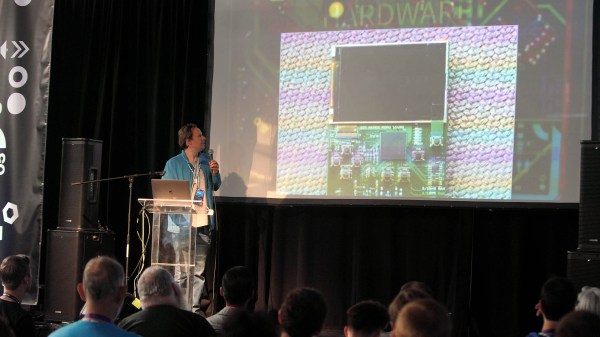
Of course what makes this possible is the FPGA at the heart of the design. The story of how the badge was developed is shared in great detail during Sprite’s Supercon talk. The timeline, the hardware choices, and the oopses along the way make for a great story. But what you really don’t want to miss is how he built the machine inside of the FPGA — the collection of Verilog code known as “gateware” that brings together the System-on-a-Chip (SoC). From his delight at being able to spawn more processor cores by changing a single variable, to the fascinating SNES-inspired graphics subsystem, the inside story shared below is even more interesting than the physical device itself.

Continue reading “Machine Inside Of A Chip: How Sprite_TM Built The FPGA Game Boy Badge”