Old Cisco WAN Card Turned FPGA Playground

Many of us think of FPGAs as some new cutting edge technology, but the fact of the matter is that they’ve been around for quite some time. They’ve just traditionally been used in hardware that’s too expensive for us lowly hackers. A case in point is the Cisco HWIC-3G-CDMA WAN card. A decade ago these would have been part of a router valued in the tens of thousands of dollars, but today they can be had for less than $10 USD on eBay. At that price, [Tom Verbeure] thought it would be worth finding out if they could be repurposed as generic FPGA experimentation devices.

So as not to keep you in suspense, the short answer is a resounding yes. In the end, all [Tom] had to do was figure out what voltages the HWIC-3G-CDMA was expecting on the edge connector, and solder a 2×5 connector onto the helpfully labeled JTAG header. Once powered up and connected to the computer, Intel’s Quartus Programmer software immediately picked up the board’s Cyclone II EP2C35F484C8 chip. The blinking LEDs seen in the video after the break serve as proof that these bargain bin gadgets are ripe for hacking.

Unfortunately, there’s a catch. After studying the rest of the components on the board, [Tom] eventually came to the conclusion that the HWIC-3G-CDMA has no means of actually storing the FPGA’s bitstream. Presumably it was provided by the router itself during startup. If you just want to keep the board tethered to your computer for experimenting, that’s not really a big deal. But if you want to use it in some kind of project, you’ll need to include a microcontroller capable of pushing the roughly 1 MB bitstream into the FPGA to kick things off.

It might not be as easy to get up and running as the 2019 Hackaday Superconference badge, but it’s certainly a lot easier to get your hands on.

Continue reading “Old Cisco WAN Card Turned FPGA Playground”
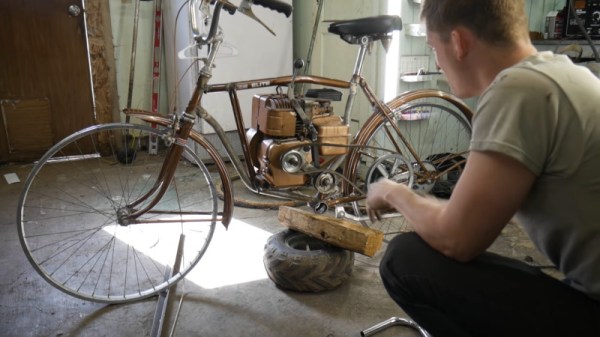
Vintage Bike Gets Briggs And Stratton Power

eBay made the process of motorizing a bicycle popular, with cheap engines from China combined with a handful of parts to lace everything together. If your tastes are a little more vintage however, [Oliver]’s build might be more your speed.

Starting with a real Briggs and Stratton liberated from an old rotary tiller, this engine has legitimate vintage credentials. Looking resplendent in brown, it’s paired with a bike in a similar shade from yesteryear. Drive from the engine is transferred by belt to a jackshaft, which then sends power through a chain to the rear wheel. The belt tensioner serves as a rudimentary clutch, allowing the engine to be disconnected from the drivetrain when disengaged.

The retro components, combined with an appropriate color scheme, make this a wonderful cruiser that oozes style. While it’s probably not suited for downtown commuting due to its lack of a real clutch and noise, it would make a great ride for taking in some country roads on a sunny day. We’ve seen similarly styled e-bikes, too. Video after the break.

Continue reading “Vintage Bike Gets Briggs And Stratton Power”

Open Source Kitchen Helps You Watch What You Eat

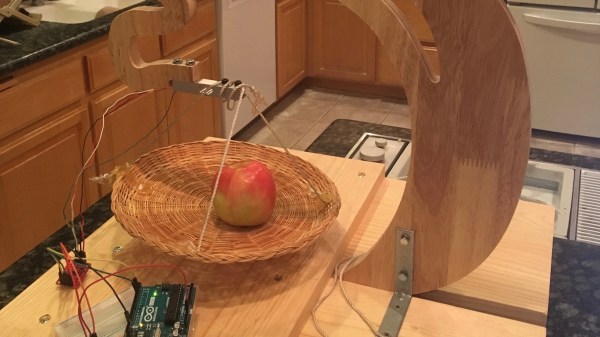
Every appliance business wants to be the one that invents the patented, license-able, and profitable standard that all the other companies have to use. Open Source Kitchen wants to beat them to it. 

Every beginning standard needs a test case, and OSK’s is a simple one. A bowl that tracks what you eat. While a simple concept, the way in which the data is shared, tracked, logged, and communicated is the real goal.

The current demo uses a Nvidia Jetson Nano as its processing center. This $100 US board packs a bit of a punch in its weight class. It processes the video from a camera held above the bowl of fruit, suspended by a scale in a squirrel shaped hangar, determining the calories in and calories out.

It’s an interesting idea. One wonders how the IoT boom might have played out if there had been a widespread standard ready to go before people started walling their gardens.

Texas Tesla Tower Titillates

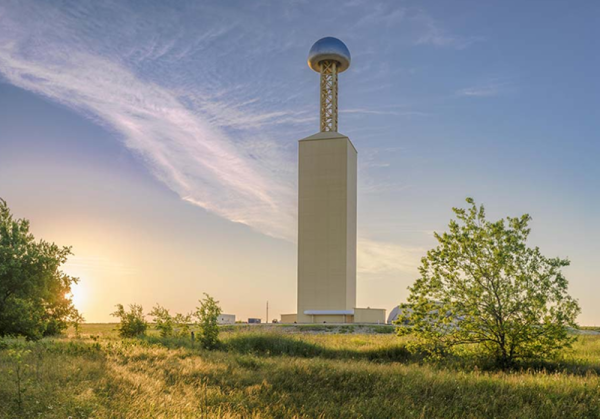
One of the nice things about a road trip is you often get to see something that really surprises you. A recent trip through Texas may have resulted in my second most surprising sighting. There’s a strange tower that looks oddly like a Tesla tower in the middle of rural Texas, right off the main interstate. What is it? Although Google did answer the question — sort of — I’m still not sure how legitimate its stated purpose is.

First Sighting

I was driving between Wimberly and Frisco — two towns that aren’t exactly household names outside of Texas. Near Milford, there’s a very tall structure that looks like a giant mechanical mushroom on top of a grain silo. If the mushroom were inverted or pointing towards the horizon, it would be easy to imagine it was some very odd antenna. This dish, however, is pointed right down its own odd-shaped mast. The top of the thing sure looks like the top of a Van de Graf generator.

Continue reading “Texas Tesla Tower Titillates”

Fast Fresnel Hack Embiggens The Smallest Of Heads

Aside from frightening small children, we have absolutely no idea why anyone would need a face-magnifying headpiece. But the video below gives us a chuckle every time we see it, and we figure a good laugh that incorporates a quick optics hack is worth a look.

When he’s not playing geek in a box, [Curious Marc]’s videos usually have more of a retrocomputing theme, like his recent conversion of a vintage terminal to a character set from a made-up language, or helping to revive an Apollo Guidance Computer. Given gems like those, we were surprised to learn that [Marc]’s background is physics – optics, to be precise – and that he studied at École Polytechnique, the same school famed physicist Augustin-Jean Fresnel attended. Which fits right into this build since it features one of those large, plastic Fresnel lenses. After a fascinating detour into the history of Fresnel’s namesake lens, [Marc] proceeds with the build.

It’s simplicity itself – a box big enough to wear on the head with one end replaced by the Fresnel lens. A strip of LEDs – warm white, please, lest the wearer takes on a deathly pall – lines the edge of the box just behind the lens. If you want to get fancy, maybe attaching a hard-hat suspension piece would make it more wearable, but even as is it’s just a hoot to see someone with a magnified and distorted head walking around. One probably should be careful not to look at the sun while wearing this, however, for reasons that become apparent beginning at the 3:24 mark of the video.

Thanks to [Marc] for perhaps the oddest YouTube face-reveal yet, and for a great idea for a quick cosplay hack.

Continue reading “Fast Fresnel Hack Embiggens The Smallest Of Heads”

Brussels Looks Towards Banning Fossil Fuel Transportation As Soon As 2035

Many cities around the world routinely struggle with smog. Apart from being unsightly, heavy air pollution has serious negative health effects, both in the short term and with regards to long-term life expectancy. Over the years, governments have tried to tackle the problem with varied tactics around the world.

When talking about smog, Brussels is not one of the cities that comes first to mind. Regardless, the local government has developed its new climate plan that seeks to abolish fossil fuel vehicles from its streets by 2035. The scheme has a variety of measures that will be staggered over the coming years. It’s part of a broadening trend in transportation, and something we’ll likely see more of around the world in coming years.

What’s The Go?

Brussels is in the process of reducing congestion by converting former roads into pedestrian-only spaces. REUTERS/Eric Vidal

Under the new plan, diesel vehicles will be banned from the city’s Low Emission Zone, or LEZ, by 2030. This will further extend to gasoline vehicles in 2035. Furthermore, special categories of higher polluting vehicles will have bans enforced even earlier. Motorcycles had previously been exempt from the LEZ, but moving forward, the most polluting models will be locked out of the city centre as soon as 2022. The aim is to reduce emissions, with a goal of cutting CO2 output by 40 percent by 2030, and becoming carbon neutral by 2050. The city is also exploring the concept of a Zero Emission Zone, or ZEZ, expanding upon earlier efforts which transformed the Boulevard Anspach from a heavily-trafficked road into a pedestrian-only plaza. Continue reading “Brussels Looks Towards Banning Fossil Fuel Transportation As Soon As 2035”

Fail Of The Week: The 3D Printer Nozzle Wipe That Won’t

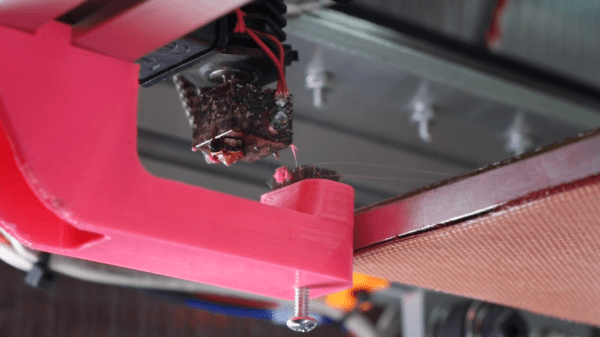
Some of you will be familiar with the idea of using a brush as a nozzle wipe on a 3D printer. The idea is that passing the hot end over the brush cleans any stray plastic from the nozzle, ensuring that those plastic bits don’t end up in unwelcome places. [Mark Rehorst] attempted to implement a nozzle brush system in his own printer, but hasn’t so far been successful.

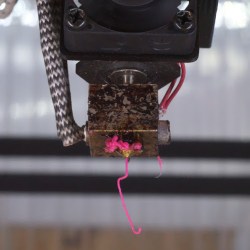
One of the things [Mark] makes is 3D printed lamp shades and this led to his experiments in setting up an automatic nozzle cleaner. Despite best efforts, the hot ends of 3D printers can occasionally accumulate bits of molten plastic which can sometimes end up deposited on the print. Because the lamp shades are so thin and so big, having a charred blob end up on the print is pretty unwelcome. Having the nozzle automatically wiped clean would be a very handy feature, but is proving to be a troublesome one.

[Mark] based his design on a small, dense wire brush used for cleaning the print nozzle of a Stratasys printer. Sadly, he found no combination of motion or brush height that got the nozzle reliably clean every time. Sometimes a blob would be dislodged, but the hot end would pick it back up again on subsequent passes. You can see it in slow motion from a variety of angles in the video below.

Continue reading “Fail Of The Week: The 3D Printer Nozzle Wipe That Won’t”