Tiny Woodshop Is Packed With Space-Saving Hacks

Fair warning: once you’ve watched [Stephen]’s tiny workshop tour, you will officially be out of excuses for why you need to expand your workshop. And, once you see his storage and organization hacks, you’ll be shamed into replicating some in whatever space you call home.

[Stephen]’s woodshop is a cozy 6′ x 8′ (1.8 m x 2.4 m) garden shed. The front wall is almost entirely occupied by the door and a window, reducing the amount of wall space available but providing ample natural light and keeping the small space from inducing claustrophobia. Absolutely every square inch of the remaining space is optimized and organized. [Stephen] wisely eschews bulky cabinets in favor of hanging tool racks, all mounted flexibly to the wall on French cleats. Everything has a place, and since every hand tool is literally within arm’s reach, it stays stored until it’s needed and goes right back when it’s done. The shop boasts way more than hand tools, though; a lathe, drill press, thickness planer, sander, air compressor, scroll saw, band saw, and even a table saw all fit in there. There’s even dust collection courtesy of “The Beast”, [Stephen]’s DIY dust extractor.

No matter whether you work in wood, metal, or silicon, we could all learn some lessons from [Stephen]’s shop. It’s a model of efficiency and organization, and while he’s not likely to build a full-size [Queen Anne] dresser in there, it’s clear from his blog that he gets a lot done with it. Too bad we missed this one the last time we did a roundup of tiny shops.

Continue reading “Tiny Woodshop Is Packed With Space-Saving Hacks”
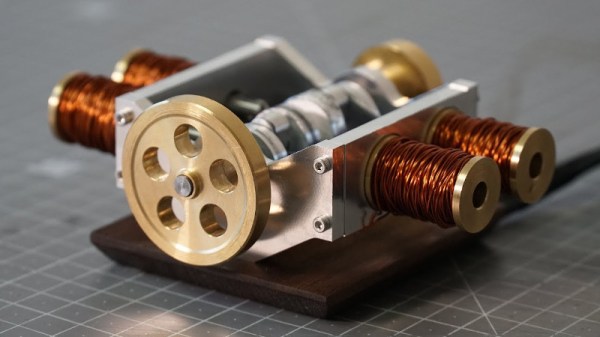
Stunning 4-Cylinder Solenoid Motor Should Be A Hit With Subaru Fans

As far as electric propulsion is concerned, the vast majority of applications make use of some kind of rotational motor. Be it induction, universal, brushed or brushless, these are the most efficient ways we have to do mechanical work with electricity. There are other, arcane methods, though – ones which [Maker B] explores with this 4-cylinder solenoid engine.

The principle of the solenoid engine is simple. Cylinders are wound with coils to act as solenoids, with the piston acting as the armature. When the solenoid is energised, it pulls the piston into the cylinder. The solenoid is then de-energised, and the piston can return to its initial position. The piston is coupled to a crankshaft via a connecting rod, and a flywheel is used to help the motor run continually. These are also known as reciprocating electric motors.

[Maker B]’s build is a 4-cylinder design in a boxer configuration. Produced with basic hand-operated machine tools, the build process is one to watch. Aluminium and brass are carefully crafted into the various components of the motor, and parts are delicately assembled with small fasteners and plenty of retaining compound. Solenoid timing is via a series of microswitches, installed neatly in the base of the motor and actuated by the crankshaft.

While solenoid motors are inefficient, they’re quite something to watch in action. This one is no exception, with the motor spinning up to 1100 rpm when running at 7.2 volts. We’d love to see some data on the power output and efficiency too. It’s possible to build solenoid motors in different configurations, too – this radial build is particularly fun. Video after the break.

Continue reading “Stunning 4-Cylinder Solenoid Motor Should Be A Hit With Subaru Fans”

Smart Thermometer Probes First, Asks Questions Later

As flu season encroaches upon the northern hemisphere, doctor’s offices and walk-in clinics will be filled to capacity with phlegm-y people asking themselves that age-old question: is it the flu, or just a little cold? If only they all had smart thermometers at home that can tell the difference.

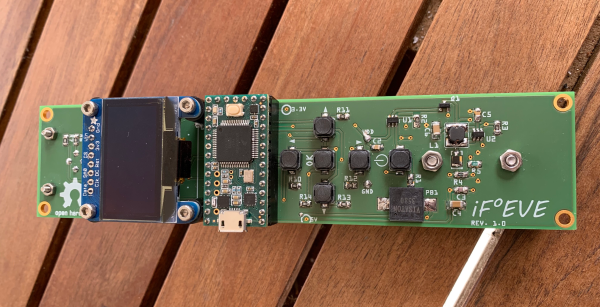
Typically, a fever under 101°F (38.5°C) in adults and 100.4°F (38°C) in children is considered low-grade, and thus is probably not the flu. But who can remember these things in times of suffering? [M. Bindhammer]’s iF°EVE is meant to be a lifesaving medical device that eliminates the guesswork. It takes readings via 3D printed ear probe mounted on the back, and then asks a series of yes/no questions like do you have chills, fatigue, cough, sore throat, etc. Then the Teensy 3.2 uses naive Bayes classification to give the probability of influenza vs. cold. The infrared thermometer [M.] chose has an accuracy of 0.02°C, so it should be a fairly reliable indicator.

Final determinations should of course be left up to a throat swab at the doctor’s office. But widespread use of this smart thermometer could be the first step toward fewer influenza deaths, and would probably boost the ratio of doctors to patients.

Tool Rolls, The Fabric Design Challenge That Can Tidy Up Any Workshop

You’ve designed PCBs. You’ve cut, drilled, Dremeled, and blow-torched various objects into project enclosurehood. You’ve dreamed up some object in three dimensions and marveled as the machine stacked up strings of hot plastic, making that object come to life one line of g-code at a time. But have you ever felt the near-limitless freedom of designing in fabric?

I don’t have to tell you how satisfying it is to make something with your hands, especially something that will get a lot of use. When it comes to that sweet cross between satisfaction and utility, fabric is as rewarding as any other medium. You might think that designing in fabric is difficult, but let’s just say that it is not intuitive. Fabric is just like anything else — mysterious until you start learning about it. The ability to design and implement in fabric won’t solve all your problems, but it sure is a useful tool for the box.

WoF? Fat quarter? How much is a yard of fabric, anyway?

To prove it, I’m going to take you through the process of designing something in fabric. More specifically, a tool roll. These two words may conjure images of worn, oily leather or canvas, rolled out under the open hood of a car. But the tool roll is a broad, useful concept that easily and efficiently bundles up anything from socket wrenches to BBQ utensils and from soldering irons to knitting needles. Tool rolls are the best in flexible, space-saving storage — especially when custom-designed for your need.

In this case, the tools will be pens, notebooks, and index cards. You know, writer stuff. But the same can just as easily organize your oscilloscope probes. It’s usefully and a great first foray into building things with fabric if this is your first time.

Continue reading “Tool Rolls, The Fabric Design Challenge That Can Tidy Up Any Workshop”

Superbly Synchronized Servos Swaying Softly

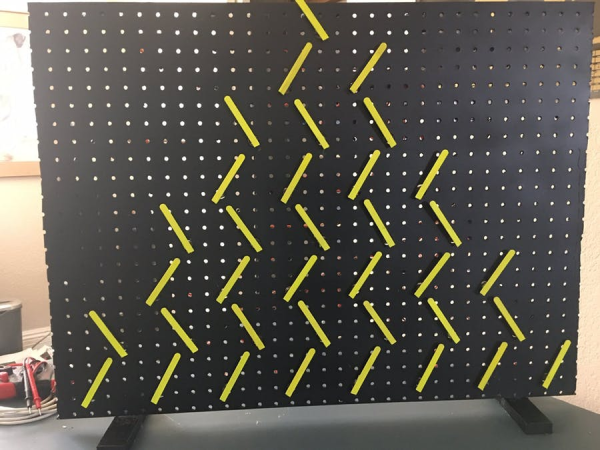
LEDs and blinky projects are great, and will likely never fade from our favor. But would you look at this sweeping beauty? This mesmerizing display is made from 36 micro servos with partial Popsicle sticks pasted on the arms. After seeing a huge display with 450 servos at an art museum, [Doug Domke] was inspired to make a scaled-down version.

What [Doug] didn’t scale down is the delightful visuals that simple servo motion can produce. The code produces a three-minute looping show that gets progressively more awesome, and you can stare at that after the break. Behind the pegboard, a single, hardworking Arduino Uno controls three 16-channel PWM controllers that sweep the servos. We like to imagine things other than Popsicle sticks swirling around, like little paper pinwheels, or maybe optical illusion wheels for people with strong stomachs.

You won’t see these in the video, but there are five ultrasonic sensors mounted face-up on the back of the pegboard. [Doug] has optional code built in to allow the servo sticks to follow hand movement. We hope he’ll upload a demo of that feature soon.

Servos can be hypnotic as well as helpful, as we saw in this 114-servo word clock.

Continue reading “Superbly Synchronized Servos Swaying Softly”

What’s In A Name? Tales Of Python, Perl, And The GIMP

In the older days of open source software, major projects tended to have their Benevolent Dictators For Life who made all the final decisions, and some mature projects still operate that way. Guido van Rossum famously called his language “Python” because he liked the British comics of the same name. That’s the sort of thing that only a single developer can get away with.

However, in these modern times of GitHub, GitLab, and other collaboration platforms, community-driven decision making has become a more and more common phenomenon, shifting software development towards democracy. People begin to think of themselves as “Python programmers” or “GIMP users” and the name of the project fuses irrevocably with their identity.

What happens when software projects fork, develop apart, or otherwise change significantly? Obviously, to prevent confusion, they get a new name, and all of those “Perl Monks” need to become “Raku Monks”.  Needless to say, what should be a trivial detail — what we’ve all decided to call this pile of ones and zeros or language constructs — can become a big deal. Don’t believe us? Here are the stories of renaming Python, Perl, and the GIMP.

Continue reading “What’s In A Name? Tales Of Python, Perl, And The GIMP”

Arduino, Accelerometer, And TensorFlow Make You A Real-World Street Fighter

A question: if you’re controlling the classic video game Street Fighter with gestures, aren’t you just, you know, street fighting?

That’s a question [Charlie Gerard] is going to have to tackle should her AI gesture-recognition controller experiments take off. [Charlie] put together the game controller to learn more about the dark arts of machine learning in a fun and engaging way.

The controller consists of a battery-powered Arduino MKR1000 with WiFi and an MPU6050 accelerometer. Held in the hand, the controller streams accelerometer data to an external PC, capturing the characteristics of the motion. [Charlie] trained three different moves – a punch, an uppercut, and the dreaded Hadouken – and captured hundreds of examples of each. The raw data was massaged, converted to Tensors, and used to train a model for the three moves. Initial tests seem to work well. [Charlie] also made an online version that captures motion from your smartphone. The demo is explained in the video below; sadly, we couldn’t get more than three Hadoukens in before crashing it.

With most machine learning project seeming to concentrate on telling cats from dogs, this is a refreshing change. We’re seeing lots of offbeat machine learning projects these days, from cryptocurrency wallet attacks to a semi-creepy workout-monitoring gym camera.

Continue reading “Arduino, Accelerometer, And TensorFlow Make You A Real-World Street Fighter”