Put The 3D Printer To Sleep So You Can Rest Easy

At this point you’ve probably already heard the news: cheap Chinese 3D printers sometimes catch fire. Now we can’t say we’re shocked to find out that absolute bottom of the barrel gear wasn’t designed to the highest standards (gotta cut those corners someplace), but that doesn’t change the fact that there are thousands of hackers and makers out there who are in possession of one of these suspect machines. Just tossing them to the curb is hardly the hacker way, so we’ve got to find ways to make the best of the hand dealt to us.
After sleeping with one eye (and maybe one nostril) open during some overnight prints, Hackaday.io user [TheGrim] wanted a way to make sure his Alunar Anet A6 didn’t stay powered on any longer than necessary. So he came up with a way of using the printer’s own endstop switch to detect if the print has completed, and cut the power.

The idea is simple, but of course the real trick is in the implementation. By adding a “Home” command to his ending G-Code in Cura, [TheGrim] reasoned he could use the Y endstop switch to determine if the print had completed. It was just a matter of reading the state of the switch and acting on it.

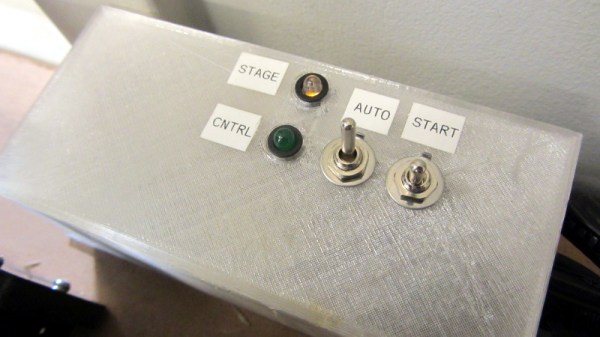
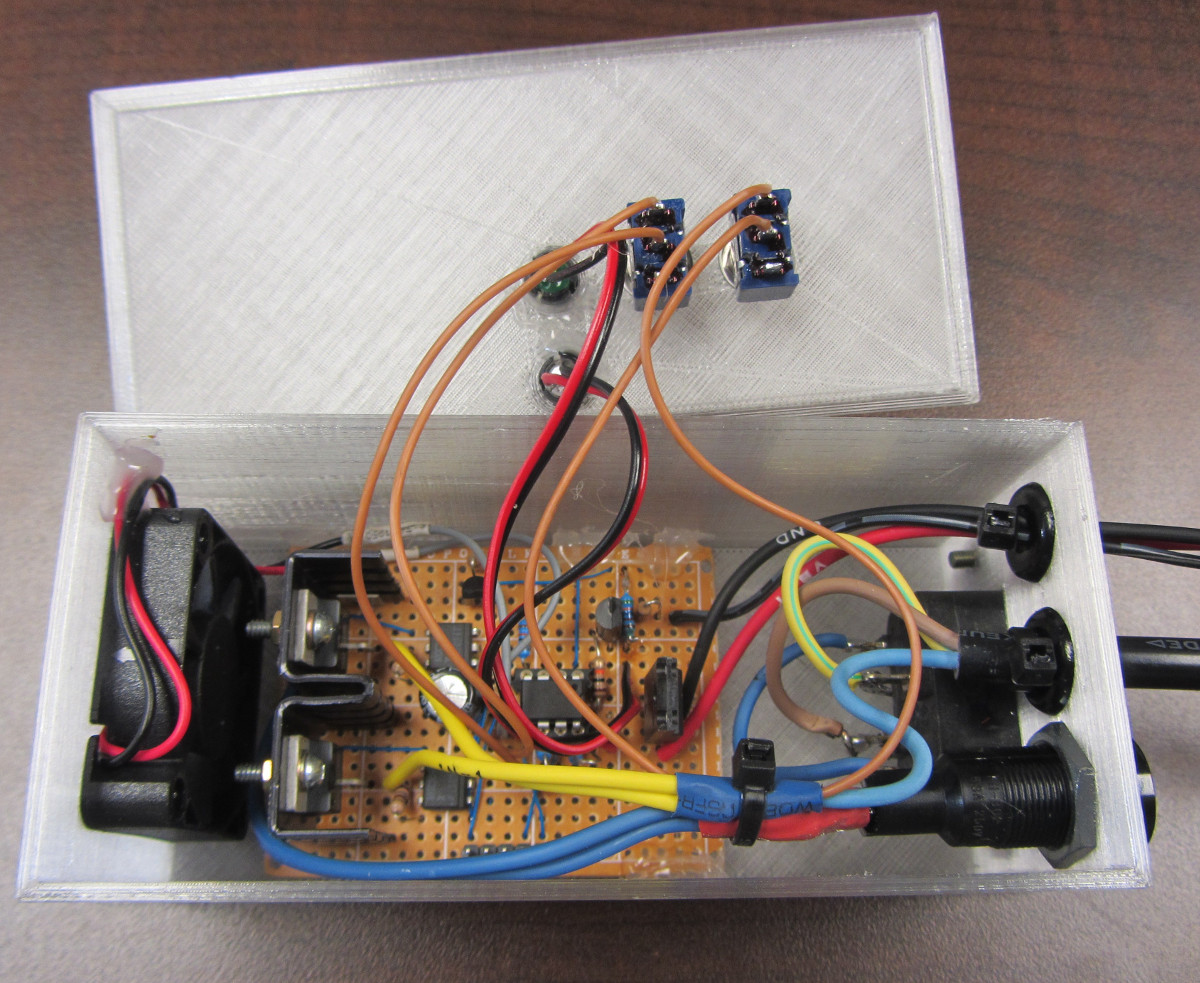
In the most basic implementation, the switch could be used to control a relay on the AC side of the power supply. But [TheGrim] doesn’t trust relays, and he wanted to pack in a couple “smart” features so he ended up using a PIC microcontroller and two 12 amp TRIACs. There’s also a couple of LEDs and toggle switches to serve as the user interface, allowing you to enable and disable the automatic shutdown and get status information about the system.

Will cutting the juice to the PSU prevent another terrible fire? It’s debatable. But it certainly can’t hurt, and if it makes [TheGrim] feel more confident about running his machine, then so be it. We’d still advise anyone with a 3D printer at home to brush up on their fire safety knowledge.

Tiny $25 Spectrometer Aims To Identify Materials With Ease

Reflectance spectrometers work on a simple principle: different things reflect different wavelengths in different amounts, and because similar materials do this similarly, the measurements can be used as a kind of fingerprint or signature. By measuring how much of which wavelengths get absorbed or reflected by a thing and comparing to other signatures, it’s possible to identify what that thing is made of. This process depends heavily on how accurately measurements can be made, so the sensors are an important part.

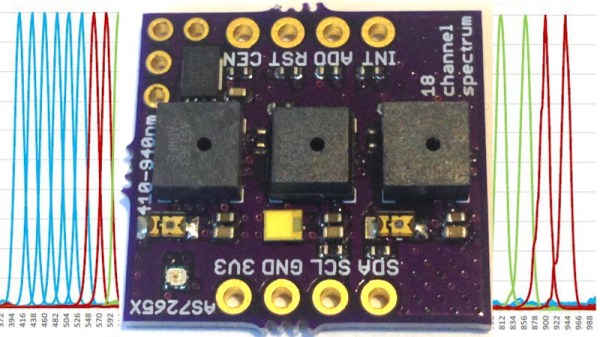
[Kris Winer] aims to make this happen with the Compact, $25 Spectrometer entry for The 2018 Hackaday Prize. The project takes advantage of smaller and smarter spectral sensors to fit the essential bits onto a PCB that’s less than an inch square. If the sensors do the job as expected then that’s a big part of the functionality of a reflectance spectrometer contained in a PCB less than an inch square and under $25; definitely a feat we’re happy to see.

Spanning The Tree : Dr Radia Perlman & Untangling Networks

As computer networks get bigger, it becomes increasingly hard to keep track of the flow of data over this network. How do you route data, making sure that the data is spread to all parts of the network? You use an algorithm called the spanning tree protocol — just one of the contributions to computer science of a remarkable engineer, Dr. Radia Perlman. But before she created this fundamental Internet protocol, she also worked on LOGO, the first programming language for children, creating a dialect for toddlers.

Continue reading “Spanning The Tree : Dr Radia Perlman & Untangling Networks”

Badge Bling And More At LayerOne 2018

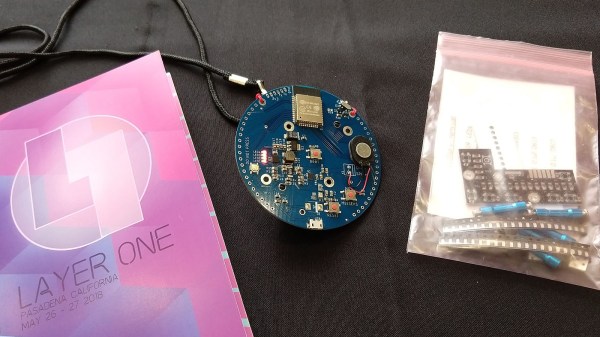
The security conference LayerOne 2018 took place this past weekend in Pasadena, California. A schedule conflict meant most of our crew was at Hackaday Belgrade but I went to LayerOne to check it out as a first-time attendee. It was a weekend full of deciphering an enigmatic badge, hands-on learning about physical security, admiring impressive demos, and building a crappy robot.

Continue reading “Badge Bling And More At LayerOne 2018”

Smart Plugs Don’t Save You Energy, But Don’t Consume Much Either

Amazon Alexa, Google Home, and just about every electronic device manufacturer are jumping on the bandwagon of connected devices. They promise us the ability to turn on our toaster from another room, unlock our doors just by shouting at them from outside, and change the channel on our TV through perfectly enunciating a sentence instead of mashing the buttons on our remotes like chumps. And yet, despite all this new-fangled finger-less control, there is an unanswered question: does this technology save us energy in the long run?

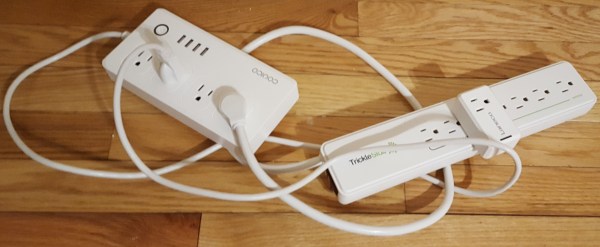
For years we’ve been hearing about vampire power and all the devices in our home that sit in standby, waiting for their masters to turn them on, quietly burning power to listen for that signal to wake. Fortunately the One Watt Initiative and general awareness and design for energy savings has cut out a lot of this phantom load. So how does the smart home, which essentially adds a bunch of connected vampires to our base load, end up saving money in the long run? And is it better than other alternatives or just good habits? I put these questions to the test with today’s smart power strips and controllable outlets.

Continue reading “Smart Plugs Don’t Save You Energy, But Don’t Consume Much Either”

Hacking A Fitness Tracker

When [rbaron] started a new job, he got a goodie bag. The contents included a cheap fitness tracker bracelet that used Bluetooth LE. Since this is Hackaday, you can probably guess what happened next: hacking ensued.

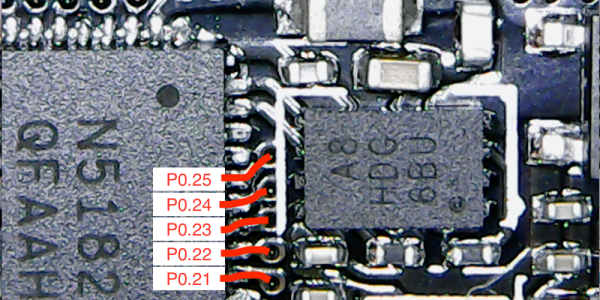
For something cheap enough to give away, [rbaron] claims it cost $10, the device has quite a bit in it. In the very tiny package, there is an OLED display, a battery, a vibration motor, and a Nordic 32-bit ARM with BLE. The FCC ID was key to identifying the device. Opening the case, which was glued down, was pretty difficult, but doable with a hair dryer and a knife.

Continue reading “Hacking A Fitness Tracker”

This Mostly 3D-Printed Discone Antenna Is Ready For Broadband Duty

For hams and other radio enthusiasts, the best part of the hobby is often designing antennas. Part black magic, part hard science, and part engineering, antenna design is an art. And while the expression of that art often ends up boiling down to pieces of wire cut to the correct length, some antennas have a little more going on in the aesthetics department.

Take the discone antenna, for example. Originally designed as a broadband antenna to sprout from aircraft fuselages, the discone has found a niche with public service radio listeners. But with a disk stuck to the top of a cone, the antennas have been a little hard to homebrew, at least until [ByTechLab] released this mostly 3D-printed discone. A quick look at the finished product, resembling a sweater drying rack more than a disc on top of a cone, reveals that the two shapes can be approximated by individual elements instead of solid surfaces. This is the way most practical discones are built, and [ByTechLab]’s Thingiverse page has the files needed to print the parts needed to properly orient the elements, which are just 6-mm aluminum rods. The printed hub pieces sandwich a copper plate to tie the elements together electrically while providing a feedpoint for the antenna as well as a sturdy place to mount it outdoors. This differs quite a bit from the last 3D-printed discone we featured, which used the solid geometry and was geared more for indoor use.

Interested in other antenna designs? Who can blame you? Check out the theory behind the Yagi-Uda beam antenna, or how to turn junk into a WiFi dish antenna.

[via RTL-SDR.com]