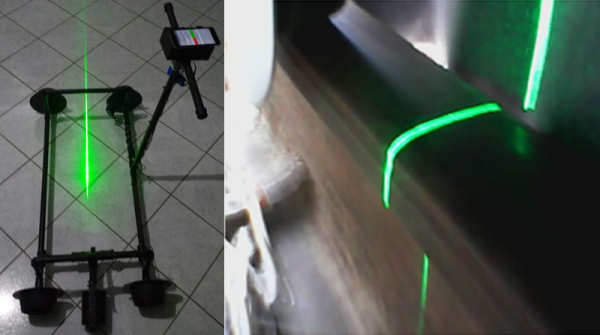
[Calango] is a railway technician, and for a school final project created the Rail Wear Surveillance Trolley (RWST) which is a delightfully designed device made mainly from PVC conduit with one job: travel down a segment of train track while shining a green laser onto the rail, and capture camera images. The trolley holds both the laser and the camera at just the right angles for the camera to capture a profile of the rail’s curved surface. The images are sent via Bluetooth to a smartphone for later analysis. Rail wear can be judged by checking how well the profile of the rail conforms to the ideal profile of an unworn segment. The trolley is manually pushed by an operator, but [Calango] says that ideally, it would be self-propelled and able to inspect a length of the track then return on its own.
The project was made on a tight budget, which led to some clever solutions like using a rotary encoder attached to a wheel as a makeshift distance sensor. If things get desperate enough, it’s even possible to roll your own rotary encoder with a 3D printer and two microswitches.
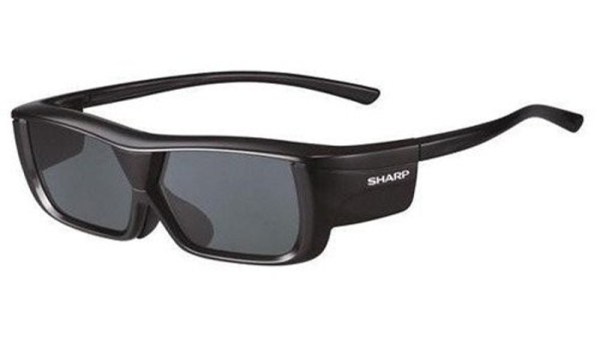
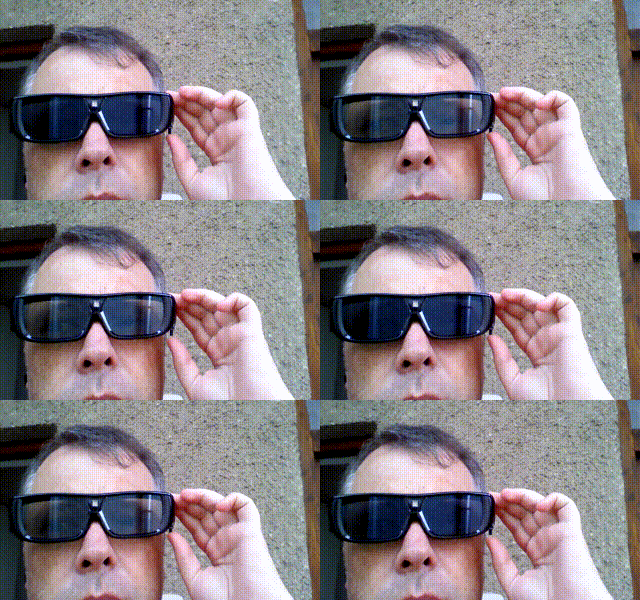 Of course, once everyone had seen the film with the blue aliens and tried a few other titles on their new toy, they grew tired of headaches, nausea, and half-brightness. The glasses gathered dust, and the fancy 3D telly never ventured beyond two dimensions again. Except for [Bobricius’s] glasses, that is, for he’s levered out the 3D driver electronics and replaced them with a tiny SOIC-8 solar cell. Light hits the cell, the LCD gets a charge and darkens, no light and they remain transparent. Similar to welding goggles — though they usually use a battery. It’s unclear whether they can get a little too dark on a really bright day and whether they are something akin to