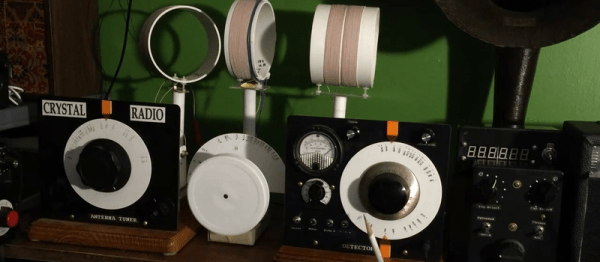
When you think of a crystal radio, you probably think of something simple maybe built out of household scraps. Not if you are [Chris Wendling]. He recently posted a video (see below) of his high-performance crystal set. He doesn’t take any shortcuts: he has several hundred feet of antenna wire, and uses a cold-water pipe ground system. With no amplifier, a strong signal input is crucial.
The radio has four subsystems: an antenna tuner, a bandpass filter, a detector, and a powered audio output system. He also has a truly enormous system of speakers on the ceiling–this isn’t the crystal radio you made in the boy scouts.
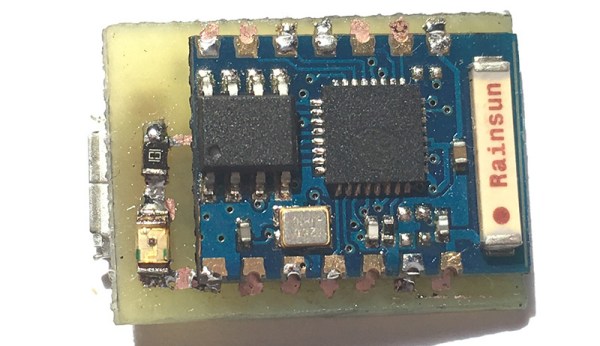
Good grief, this smartphone-to-TV remote really drives home how simple hardware projects have become in the last decade. We’re talking about a voltage regulator, IR LED, and ESP8266 to add TV control on your home network. The hardware part of the hack is a homemade two sided board that mates an ESP with a micro-USB port, a voltage regulator to step down fom 5 to 3.3 v, and an IR LED for transmitting TV codes.
Let’s sit back and recount our good fortunes that make this possible. USB is a standard and now is found on the back of most televisions — power source solved. Cheap WiFi-enabled microcontroller — check. Ubiquitous smartphones and established protocols to communicate with other devices on the network — absolutely. It’s an incredible time to be a hacker.
Television infrared remote codes are fairly well documented and easy to sniff using tools like Arduino — in fact the ESP IR firmware for this is built on [Ken Shirriff’s] Arduino IR library. The rest of the sketch makes it a barebones device on the LAN, waiting for a connection that sends “tvon” or “tvoff”. In this case it’s a Raspberry Pi acting as the Homekit server, but any number of protocols could be used for the same (MQTT anyone?).
Drones are adding functionality to our everyday lives, and automation is here to help humanity whether we’re ready for it or not. In a clever combination of the two, [Richard Hardiman] of RanMarine has developed small drone-boats that scoop up garbage from the ocean — he calls them ‘Waste Sharks.’
The two models — slim and fatboy — aim to collect up to 1,100 pounds of garbage apiece in the ‘mouths’ just below the water’s surface. The Waste Sharks are still restricted to remote control and are only autonomous when traveling between waypoints, but one can see how this technology could evolve into the “Wall-E of water.”
The front of the Soviet jet train on a monument in Tver, Russia. By Eskimozzz [PD], via Wikimedia Commons.It started with one of those odd links that pop up from time to time on Hacker News: “The strange and now sadly abandoned Soviet Jet Train from the 1970s“. Pictures of a dilapidated railcar with a pair of jet engines in nacelles above its cab, forlorn in a rusty siding in the Russian winter. Reading a little further on the subject revealed a forgotten facet of the rivalry between Russians and Americans at the height of the Cold War, and became an engrossing trawl through Wikipedia entries, rail enthusiast websites, and YouTube videos.
Close your eyes and think of an electric wheelchair. What do you see? Is it sleek, futuristic, and elegant… worthy of the moniker: iChair? No, no it is not. It’s a boxy tank-like thing with grey knobbed wheels that is powered with lead-acid batteries. Why is that?
Obviously there are alternatives. Just yesterday I came across UPnRIDE (that name is sore on the eyes but speak it aloud and you’ll get it). It’s an electric wheelchair that converts into a standing position. And it looks comparatively sleek and modern. And it’s not the first time I’ve seen the idea before. One of my favorite articles over the years is still our coverage of Tek RMD, a similar standing robotic wheelchair design. So why is it I don’t see these in the wild? Why is it I only remember seeing the concept twice in four years?
Many of us have had a radio controlled car at some time in our youth, though it’s probable that none all of us entirely mastered it. There are memories of spectacular crashes, and if we were really unlucky, further boosts to Mr. Tamiya’s bank balance as fresh parts had to be fitted.
[Paul Yan] was watching his young son with a radio controlled toy, and was struck by how the two-joystick control layout is not necessarily as intuitive as it could be. By contrast when faced with a console game with first-person view and a steering wheel the boy had no problem dropping straight into play. This observation led him to investigate bringing a console steering wheel to an RC car, and the result is a rather impressive FPV immersive driving experience.
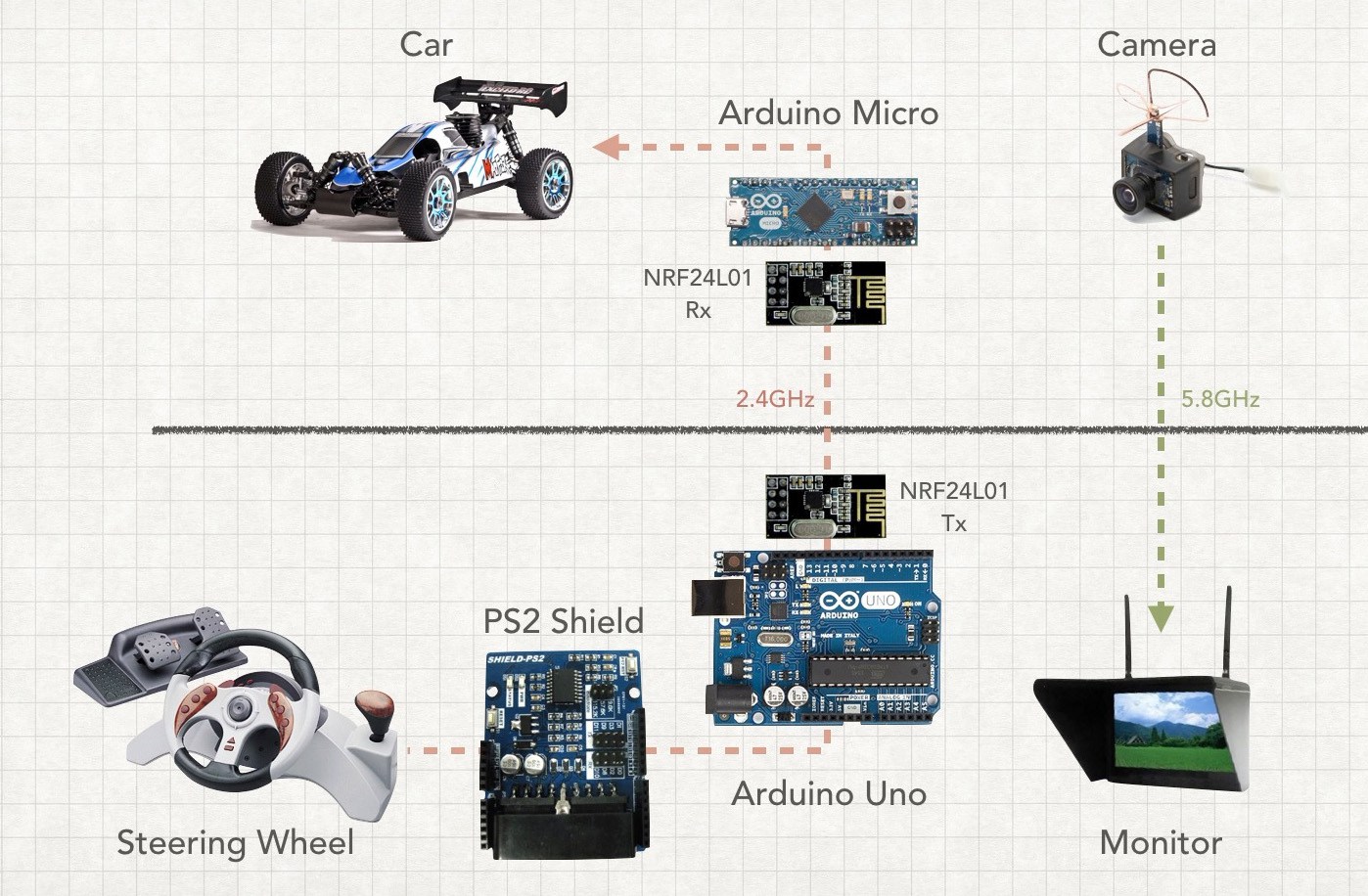
Paul’s FPV car, explained.
His build took a PS2 steering wheel peripheral with pedals and mated it to an Arduino Uno via a PS2 shield. The Uno talks to a Nordic NRF24L01 RF module, which communicates with another NRF24L01 on the car. This in turn talks to a car-mounted Arduino Micro, which controls the car servos and speed controller.
FPV video is provided by a miniature camera and transmitter from the world of multirotor flying which is mounted on the car and transmits its pictures over 5GHz to a set of monitor goggles. Sadly he does not appear to have posted any of the software involved, though we doubt there is anything too challenging should you wish to try it for yourselves.
The video below shows the car in action, complete with an over-enthusiastic acceleration and crash from his young son. He tells us it’s a similar experience to playing a racing kart game in the real world, and having seen the video we wish we could have a go.
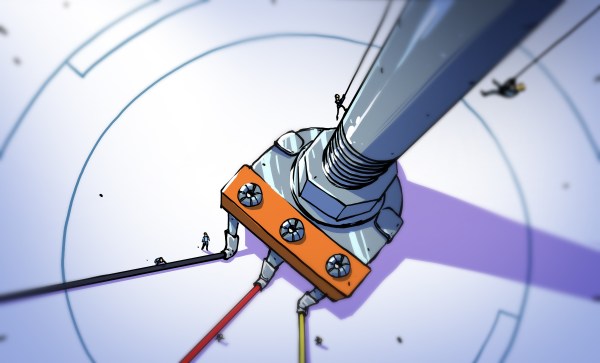
Adjusting the volume dial on a sound system, sensing your finger position on a touch screen, and knowing when someone’s in the car are just a few examples of where you encounter variable resistors in everyday life. The ability to change resistance means the ability to interact, and that’s why variable resistance devices are found in so many things.
The principles are the same, but there are so many ways to split a volt. Let’s take a look at what goes into rotary pots, rheostats, membrane potentiometers, resistive touchscreens, force sensitive resistors, as well as flex and stretch sensors.



![The front of the Soviet jet train on a monument in Tver, Russia. By Eskimozzz [PD], via Wikimedia Commons.](https://hackaday.com/wp-content/uploads/2016/09/576px-d181d182d0b5d0bbd0b0.jpg)