Tiny House Forecasts Weather

Before the information age, it wasn’t quite as easy to glean information about the weather. Sure, there were thermometers and barometers and rhymes about the sky, but if you lived in or near Germany back then you might have also had access to something called a “weather house” which could help predict rain. [Moritz] aka [Thinksilicon] found one of these antequated devices laying around, and went about modernizing it. (Google Translate from German)

A traditional weather house is essentially a hygrometer housed in an intricate piece of artwork. Two figures, typically a man and woman, are balanced on a platform that is suspended in the middle by a small section of horsehair. When the humidity is low, the hair tightens up and turns the platform one way, and when humidity is high — suggesting rain is coming — it turns the other way. When the man comes out of the house, it predicts rainfall.

To get the weather house upgraded, [Moritz] outfitted the front with an OLED display which replaced the traditional thermometer. Instead of using horsehair to spin the figures he installed a small servo on the platform. The entire house is controlled by an ESP8266 which pulls data from the Open Weather API and spins the figures based on the information it receives.

Much like unique clocks, we enjoy interesting weather indicating/forecasting builds. This one’s right up there with using squirrels to predict the weather, or having a small weather-recreation right on your bookshelf.
Desuiciding Capcom Arcade Boards

Capcom’s CPS2 – or CP System II – was the early to mid-90s arcade hardware famous for Super Street Fighter II, Alien vs. Predator, and a few of the Marvel and Capcom crossover arcade games. As you would expect, these boards have become collectors items. Unfortunately for future generations, Capcom took some short-sighted security measures to prevent copying the games, and the boards have been failing over the last two decades.

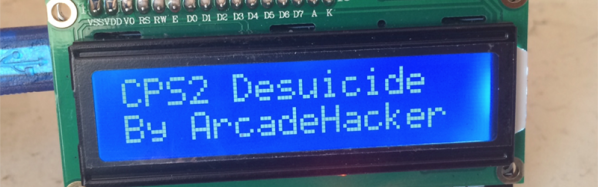
After months of work, [ArcadeHacker] and several other arcade enthusiasts have reverse engineered the security protocol and devised a method of de-suiciding these arcade boards, allowing for the preservation of this hardware and these games. The code that does the trick is up on GitHub.

Last year, [ArcadeHacker] reverse engineered the on-chip security for Capcom’s Kabuki processor, the CPU used in some of Capcom’s earlier arcade boards. It used a similar protection scheme. In the Kabuki hardware, the on-chip ROM was interspersed with a few XOR gates on the processor’s bus. With a security key kept in battery-backed memory, this was enough to keep the code for the game secret, albeit at the cost of preventing historical preservation.

Over the next few weeks, [ArcadeHacker] will post more detailed information about the copy protection scheme of the CPS2 board, but the proof-of-concept works right now. It’s now possible to revive a CPS2 board that has killed itself due to a dead battery, and the hardware is as simple as an Arduino and a few test clips. You can check out a video of the exploit in action below.

Continue reading “Desuiciding Capcom Arcade Boards”

The Surprising Story Of The First Microprocessors

If you maintain an interest in vintage computers, you may well know something of the early history of the microprocessor, how Intel’s 4-bit 4004, intended for a desktop calculator, was the first to be developed, and the follow-up 8008 was the first 8-bit device. We tend to like simple stories when it comes to history, and inventions like this are always conveniently packaged for posterity as one-off events.

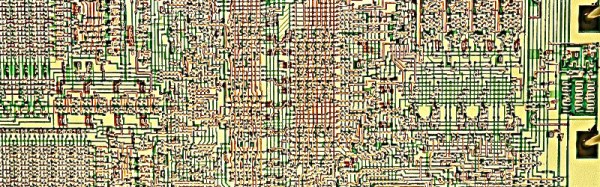
In fact the story of the development of the first microprocessors is a much more convoluted one than it might appear, with several different companies concurrently at the forefront of developments. A fascinating recent IEEE Spectrum piece from [Ken Shirriff] investigates this period in microprocessor design, and presents the surprising conclusion that Texas Instruments may deserve the crown of having created the first 8-bit device, dislodging the 8008 from its pedestal. Continue reading “The Surprising Story Of The First Microprocessors”

3D Printering: Aramid And Carbon Fiber Infused ABS

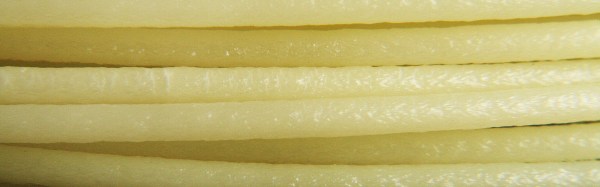
Last week, we had a look at a carbon-infused PETG filament. This week, I’d like to show you two composites based on a more common thermoplastic in 3D printing: ABS. Among a whole lot of other engineering plastics, the french company Nanovia manufactures Kevlar-like aramid-fiber-infused and carbon-fiber-infused ABS 3D printing filaments. These materials promise tougher parts with less warping while being just as easy to print as regular ABS. Let’s check them out!

Continue reading “3D Printering: Aramid And Carbon Fiber Infused ABS”

Custom Gaming Keypad Developed With PSoC And Fusion 360

There was a time when building something yourself probably meant it didn’t look very much like a commercial product. That’s not always a bad thing. We’ve seen many custom builds that are nearly works of art. We’ve also seen plenty of builds that are–ahem–let’s say were “hacker chic”.

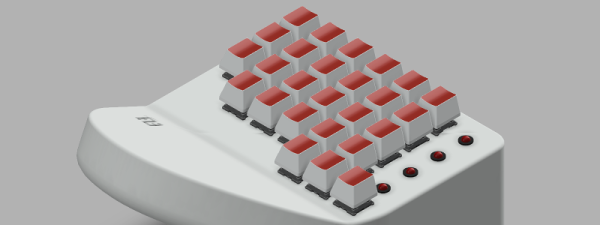
[AlexanderBrevig] decided to take on a project using a PSoC development board he picked up. In particular, he wanted to build a custom game keypad. He prototyped a number of switches with the board and got the firmware working so that the device looks like a USB HID keyboard.

Continue reading “Custom Gaming Keypad Developed With PSoC And Fusion 360”

ESP32 Hands-On: Awesome Promise

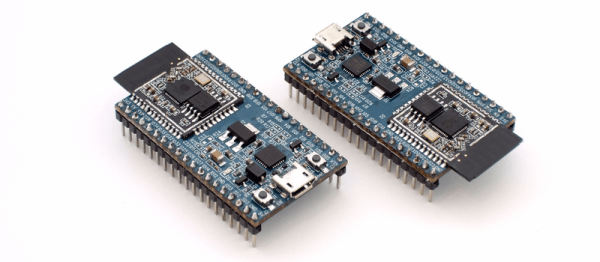
The ESP32 is looking like an amazing chip, not the least for its price point. It combines WiFi and Bluetooth wireless capabilities with two CPU cores and a decent hardware peripheral set. There were modules in the wild for just under seven US dollars before they sold out, and they’re not going to get more expensive over time. Given the crazy success that Espressif had with the ESP8266, expectations are high.

And although they were just formally released ten days ago, we’ve had a couple in our hands for just about that long. It’s good to know hackers in high places — Hackaday Superfriend [Sprite_tm] works at Espressif and managed to get us a few modules, and has been great about answering our questions.

We’ve read all of the public documentation that’s out there, and spent a week writing our own “hello world” examples to confirm that things are working as they should, and root out the bugs wherever things aren’t. There’s a lot to love about these chips, but there are also many unknowns on the firmware front which is changing day-to-day. Read on for the full review.

Continue reading “ESP32 Hands-On: Awesome Promise”

Open Hardware RC Radios

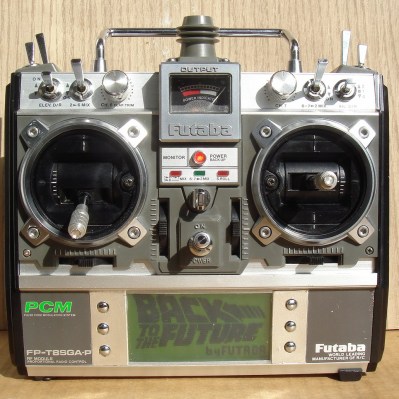
A decade ago, RC transmitters were clunky, expensive and PCM. A decade before that, everything was analog. Now, RC transmitters are completely digital, allowing for hundreds of aircraft to take to the sky. They’re also cheap, thanks to engineers in China. Now, they’re open hardware, too.

An old Futaba radio outfitted with AR Uni electronics. Image source: vikar

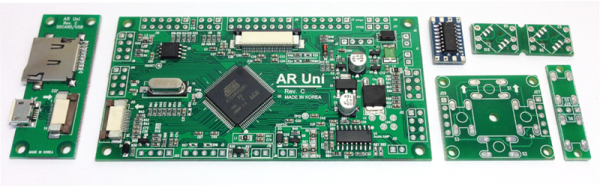
An exceptionally long thread over on the RCGroups forums has been going on for a few months, extolling the virtues of the ‘AR Uni’ board that turns old transmitters into full featured digital radios. This board runs everything, from two analog sticks, a directional keyboard, pots galore, switches everywhere, and a fancy LCD that makes programming easy. The joys of Open Hardware, brought to RC geeks. It’s a thing of beauty. Continue reading “Open Hardware RC Radios”