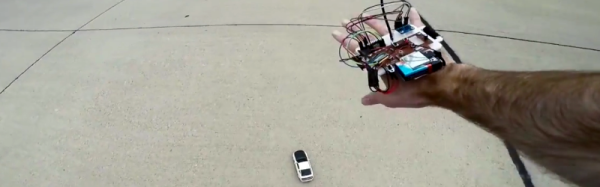
Does your RC car’s crude, push-button controller make you feel like you’re mashing tv remote buttons like a caveman? We think so too, but [Noel] has actually done the heavy-lifting to fix just that. He’s revamped his kids’ rc controller for gesture control. Now their rc car can be guided by the crisp, intuitive control of one’s wrist movements.
To tackle this project, [Noel] has integrated a gyroscope and accelerometer, an Arduino, and the existing remote. Data from the gyroscope-and-accelerometer limits are mapped to the buttons through an Arduino, which parses the raw data and triggers the controller’s switches, now wired directly to the Arduino and pulled up with resistors. In his overview video, [Noel] tells us that he’s binarized the gyroscope-and-accel data to trigger at certain limits, a choice that adequately suits the controller’s original push-button controls. Finally, the entire setup is cleanly strapped to a 3D-printed case. Not bad, for a grand total of $20 and a quick trip to Target.
[Noel]’s custom wrist-controller takes its place on the shelf of many other unique controllers, and his demo is a great example of using existing open hardware to tailor our toys to more personal tastes. After all, the hardware shopping list is just a breakout board, an Arduino, and a few jumper wires. When the next zombie apocalypse hits, we can easily see some practical components like these making their way into our suitcase. At the very least, we’ll be able to build a few wrist controllers and dispatch some toy cars to greet the undead.
Continue reading “Budget Wrist-Controlled RC Car Is A Nice Touch”

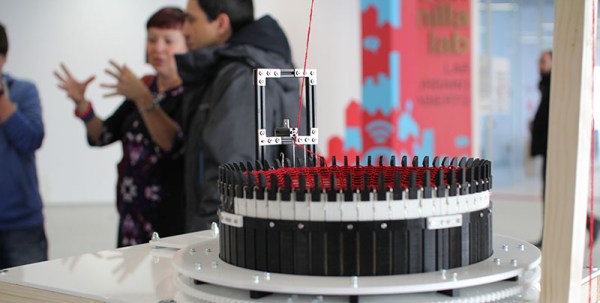
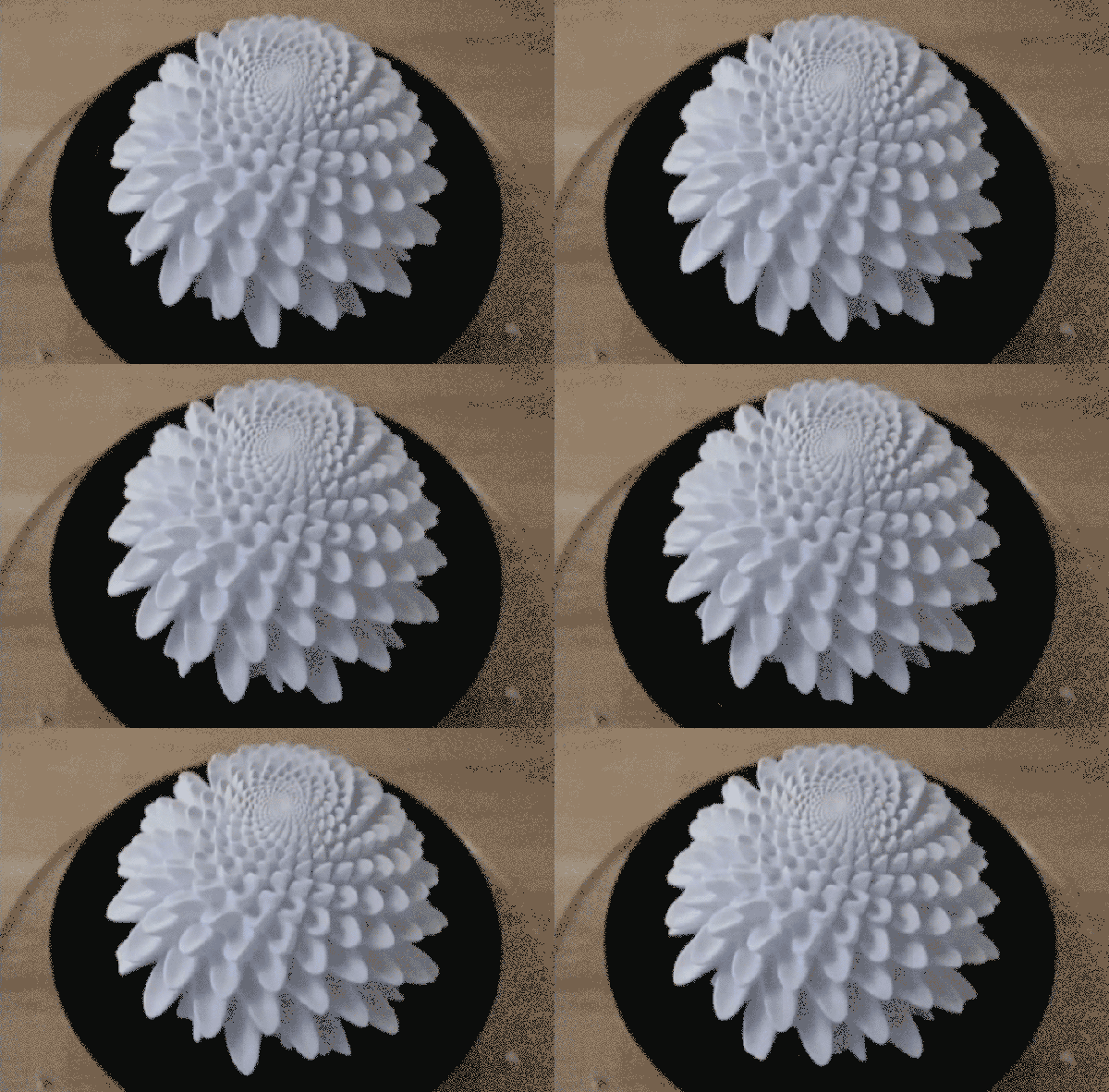
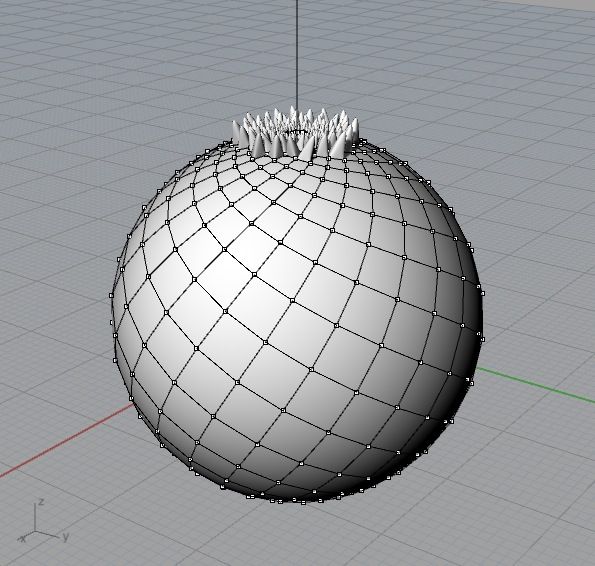 [John] modeled several 3D sculptures in Rhino containing similar geometric properties to those found in pinecones and palm tree fronds. As the segments grow from those objects in nature, they do so in approximately 137.5 degree intervals. This spacing produces a particular spiral appearance which [John] was aiming to recreate. To do so, he used a Python script which calculated a web of quads stretched over the surface of a sphere. From each of the divisions, stalk-like protrusions extend from the top center outward. Once these figures were 3D printed, they were mounted one at a time to the center of a spinning base and set to rotate at 550 RPM. A camera then films the shape as it’s in motion at a 1/2000 sec frame rate which captures stills of the object in just the right set of positions to produce the illusion that the tendrils are blooming from the top and pouring down the sides. The same effect could also be achieved with a strobe light instead of a camera.