BAMF2010: Look Sir, Droids!

Ask any engineer what originally sparked their interest in technology, and almost universally the response will be a Hollywood film or TV robot — Star Wars’ R2-D2, the B9 robot from Lost in Space, or Short Circuit’s Johnny 5, to name a few. Engineers need a creative outlet too, and some pay homage to their inspirations by building elaborate reproductions. At this year’s Maker Faire, droid-builders had their own corner in the center hall, their work ranging from humble craft materials to ’bots surpassing their film counterparts in detail and workmanship.

Continue reading “BAMF2010: Look Sir, Droids!” →

USB Morse Code Keyboard

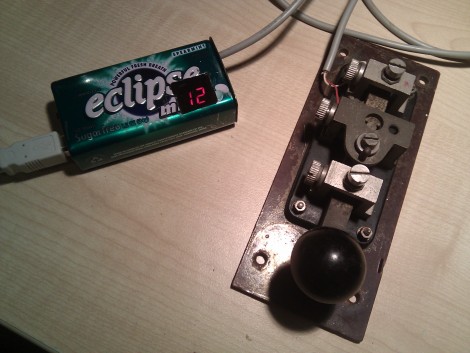
Looking for motivation to practice morse code [BenB] built this morse code keyboard. It uses USB and is recognized as a standard keyboard thanks to the V-USB stack running on the ATmega168. The project is rounded out with a clean look thanks to the chewing gum container that serves as an enclosure.

His design is simple enough that any morse key you have on hand can be used. You could even adapt that glove coder you built a couple of years back.

BAMF2010: DIY Electroluminescent Displays

[youtube=http://www.youtube.com/watch?v=jPclj5lbz48]

In this video from Maker Faire, [Jon Beck] of CLUE — the Columbia Laboratory for Unconventional Electronics — demonstrates the unexpected ease of creating custom electroluminescent (EL) displays using materials from DuPont and common t-shirt screen printing tools. Eagle-eyed reader [ithon] recognized the Hack a Day logo among the custom shapes, which escaped our notice at the time. Sorry, Jon! Very cool project, even if the setup is a bit steep. You’ll find links to materials at the project site.

If the interviewer seems especially sharp, that’s because it’s none other than [Jeri “Circuit Girl” Ellsworth], who makes transistors from scratch and designed the C64 DTV. We’re not worthy!

Unlocking The Crippled Potential Of An Unmanaged Switch

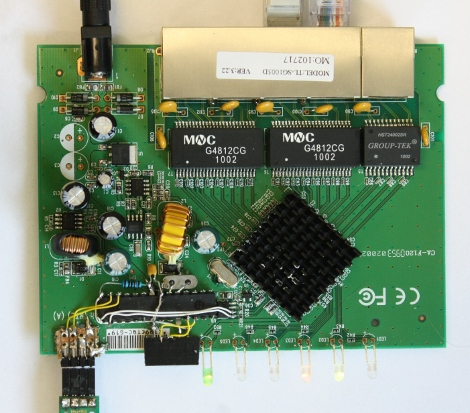
[Sprite_TM] outgrew the features of the cheap unmanaged TL-SG1005D switch he was using on his home network. Instead of buying a new and much more costly switch he cracked the cheap one open and found that the RTL8366SB chip inside possessed the ability to work harder but was crippled for sale as a low-end model. It wasn’t as easy as that oscilloscope firmware upgrade we saw a while back. He had to add an AVR ATmega88 to send I2C commands to the switch. Turns out that the I2C protocol wasn’t standard and after much head scratching he found some Linux drivers for the chipset that gave him enough info to send the configuration commands he needed. Now he’s go the managed switch he needed for his VLAN for the cost of a microcontroller and some wire.

PLCC Replaces Game Boy Cartridge ROM

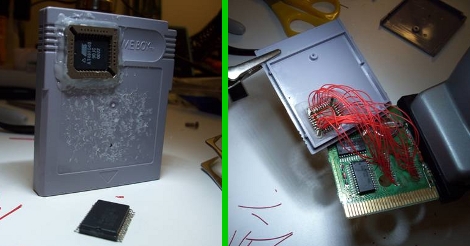
[Gerry] sent us pictures and a few details on replacing the Game Boy cartridge chip with a flash chip. For the prototype he used a PLCC and a little wire porn to interface a flash chip with the cartridge’s PCB while still having access to it for programming. In retrospect he plans to use a 32-pin ZIF socket on the next version to make things easier. It does work and he’s had some success loading his own code and getting it to run. There are other cartridge hacks that let you load code onto a cartridge but if you have the knowhow and the parts this makes for a fun weekend project. We’ve posted the rest of the photos that [Gerry] sent us after the break.

Update: Gerry is working on a video and a pinout. We’ll post info once we get a hold of it.

Continue reading “PLCC Replaces Game Boy Cartridge ROM” →

One-armed Coding Using A Half-qwerty Hack

[Matthew Daughtrey] is going to have one of his paws out of service for a while following some hand surgery. Making a living as a coder seems a bit harder with one hand but he was able to find some solutions online only to balk at price tags reaching $600. He came up with a way have similar functionality on a standard keyboard with creative key mapping and a few auxiliary buttons.

The product he’s trying to mimic is the half-qwerty keyboard produced by Matias Corporation. It sounds crazy, but you can easily use your right hand to type all of the letters the left hand normally would just by mirroring the key locations. That big gray thing you store in your mellon and frequency put at risk handles this automatically. You should give the demo a try. We found that we’re quite good at it and only get confused when switching between the two halves of the keyboard.

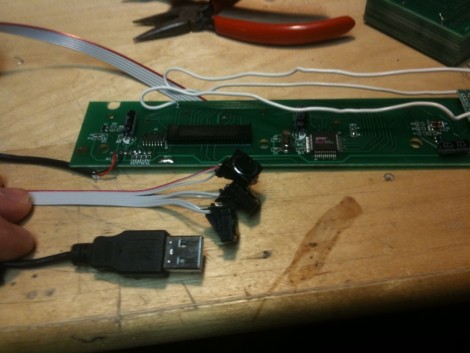
But we digress. [Matthew] wrote a script that will mirror all the key mappings when he holds down the Windows key. He then hacked a second keyboard to extend momentary push sensors as seen above. He plans to use them with a partially mobile thumb after the surgery, or to build a foot pedal (we say build the pedal). An elegant hack that is a pittance compared to the official hardware.


Sound Card Driven Servo Motor

[youtube=http://www.youtube.com/watch?v=1LG2Ecsk13Q]

[Darrell] is using a sound card to drive this servo motor. The motor draws power from a cellphone battery with the control signal coming from one of the audio channels. It’s not too surprising that this works since the motor just needs a PWM signal to operate and that’s what is used to create the different frequencies of sound on electronic speakers. We’re not sure what [Darrell’s] got planned for this system but he mentions that two servos can be used, one on each audio channel. If you’re not using your sound card this would be a way to stop using the Arduino for that mail checker and just use a little flag attached to a servo. When mail comes in the appropriately engineered sound raises the flag.