A Tale Of Two Phases And Tech Inertia

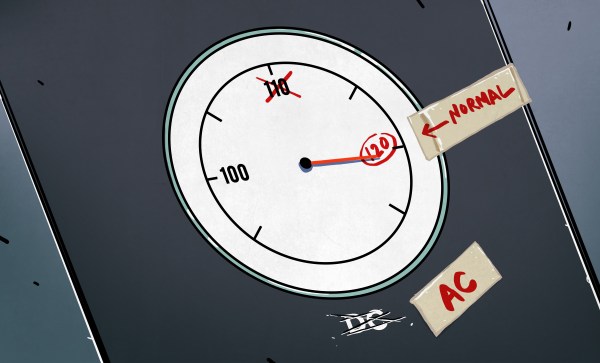
What kind of power service is in the United States? You probably answered 120-volt service. If you thought a little harder, you might remember that you have some 240-volt outlets and that some industrial service is three phase. There used to be DC service, but that was a long time ago. That’s about it, right? Turns out, no. There are a very few parts of the United States that have two-phase power. In addition, DC didn’t die as quickly as you might think. Why? It all boils down to history and technological inertia.

Split Phase Power by Charles Esson CC-BY-SA 3.0

You probably have quite a few 120-volt power jacks in sight. It is pretty hard to find a residence or commercial building these days that doesn’t have these outlets. If you have a heavy duty electric appliance, you may have a 240-volt plug, too. For home service, the power company supplies 240 V from a center tapped transformer. Your 120V outlets go from one side to the center, while your 240V outlets go to both sides. This is split phase service.

Industrial customers, on the other hand, are likely to get three-phase service. With three-phase, there are three wires, each carrying the line voltage but out of phase with each other. This allows smaller conductors to carry more power and simplifies motor designs. So why are there still a few pockets of two-phase?


Continue reading “A Tale Of Two Phases And Tech Inertia”

Friday Hack Chat: Everything Raspberry Pi

The Raspberry Pi is six years old now, and in that time it’s become the most popular single board computer. Over these last few years, the Pi has improved from a relatively anemic board based on a smartphone SoC to a surprisingly fast board that’s loaded up with some of the best software and the best community support we’ve ever seen. There’s an awful lot you can do with a Pi, and the continued support of the Raspberry Pi Foundation has enabled millions of people to get their hands on a cheap computer that runs Linux. It’s great.

Now it’s your turn to ask the engineers behind this tiny little computer what’s going on in the world of Pi. We’re having a Hack Chat this Friday, and you’re invited.

Our guest for this week’s Hack Chat will be [Roger Thornton], principal hardware engineer for the Raspberry Pi, where he oversees design, test, compliance, and production for Raspberry Pi products. Previously, [Roger]’s work for Broadcom included being part of the team that characterized and tested numerous SoCs including the BCM2835/6/7 found in various Pis. He also has experience in the smart home and IoT fields from working in a consultancy where be helped bring chips to market.

[Roger]’s most recent work was announced today; the Raspberry Pi 3 Model B+ is the latest in a long line of Pis, and while it’s not the octocore ARM monster with SATA and PCIe and Gigabit networking and 4G that the power-hungry have been clamoring for, it is more capable than its predecessor and still only costs less than forty bucks.

This is also the second time [Roger] has been a guest on our Hack Chats. You can check out the transcript of the 2017 chat here.

During this chat, we’re going to be discussing the future of Raspberry Pi products, Pi events around the world, and a question on the minds of many: where you can buy Pi Zeros in quantity. You are, of course, encouraged to add your own questions to the Hack Chat. You can do that by leaving the questions as a comment on this Hack Chat’s event page.

join-hack-chat

Our Hack Chats are live community events on the Hackaday.io Hack Chat group messaging. This week it’s going down at the usual time, on noon, Pacific, Friday, March 16th  Want to know what time this is happening in your neck of the woods? Have a countdown timer!

Click that speech bubble to the right, and you’ll be taken directly to the Hack Chat group on Hackaday.io.

You don’t have to wait until Friday; join whenever you want and you can see what the community is talking about.

Stephanie Kwolek: Saving Lives With Kevlar

Like most accidents, it happened in an instant that seemed to last an eternity. I had been felling trees for firewood all afternoon, and in the waning light of a cold November day, I was getting ready to call it quits.

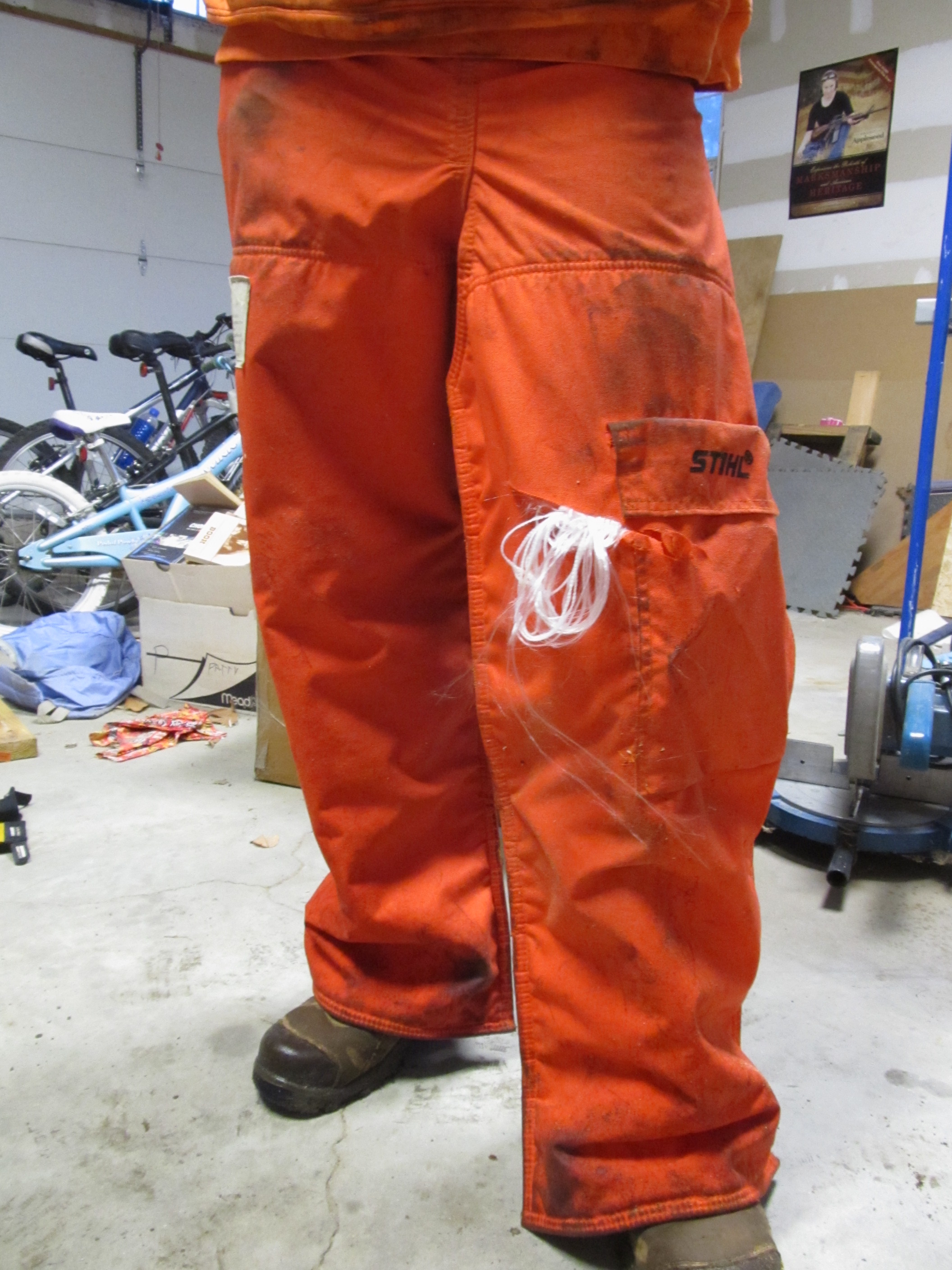
Almost a really bad day in the woods.

There was one tiny little white pine sapling left that I wanted to clear, no thicker than my arm. I walked over with my Stihl MS-290, with a brand new, razor sharp chain. I didn’t take this sapling seriously — my first mistake — and cut right through it rather than notching it. The tree fell safely, and I stood up with both hands on the saw. Somehow I lost my footing, swiveled, and struck my left knee hard with the still-running chainsaw. It kicked my knee back so hard that it knocked me to the ground.

In another world, that would likely have a been a fatal injury. I was alone, far from the house, and I would have had mere minutes to improvise a tourniquet before bleeding out. But as fate would have it, I was protected by my chainsaw chaps, full of long strands of the synthetic fiber Kevlar.

The chain ripped open the chaps, pulled the ultra-strong fibers out, and instantly jammed the saw. I walked away feeling very stupid, very lucky, and with not a scratch on me. Although I didn’t realize it at the time,  I owed my life to Stephanie Kwolek.

Continue reading “Stephanie Kwolek: Saving Lives With Kevlar”

Lost In Space: How Materials Degrade In Space

Hackaday readers are well aware of the problems caused by materials left exposed to the environment over time, whether that be oxidized contact pads on circuit boards or plastics made brittle from long exposure to the sun’s UV rays.

Now consider the perils faced by materials on the International Space Station (ISS), launched beginning in 1998 and planned to be used until 2028. That’s a total of 30 years in an environment of unfiltered sunlight, extreme temperatures, micrometeoroids, and even problems caused by oxygen. What about the exposure faced by the newly launched Tesla Roadster, an entirely non-space hardened vehicle on a million-year orbit around the sun? How are the materials which make up the ISS and the Roadster affected by the harsh space environment?

Fortunately, we’ve been doing experiments since the 1970s in Earth orbit which can give us answers. The missions and experiments themselves are as interesting as the results so let’s look at how we put materials into orbit to be tested against the rigors of space.

Continue reading “Lost In Space: How Materials Degrade In Space”

Hackaday Links Column Banner

Hackaday Links: March 11, 2018

Guess what’ll be wrapping up in just two weeks? The Midwest RepRap Festival, the largest con for open source 3D printing in the world. MRRF is going down in Goshen, Indiana on March 23rd through March 25th. Tickets are free! If you’re looking for a hotel, I can speak from experience that the Best Western is good and close to the con, and I haven’t heard anything bad about the Holiday Inn Express.

Want to go to a convention with even weirder people? Somehow or another, a press release for Contact In The Desert, the largest UFO conference in the world, ended up in my inbox. It’s on the first weekend in June near Cochilla. Why is this significant? Because the greatest people-watching experience you’ll ever see, AlienCon 2018, is happening in Pasadena just two weeks later. The guy with the hair from Ancient Aliens will be at both events. Why are they having a UFO conference where military planes fly all the time? Wouldn’t it be better to rule out false positives?

The entirety of Silicon Valley tech culture is based upon the principle of flouting laws and regulations. We have reached a new high water mark. Swarm Technologies, a ‘stealth startup’ working on ‘Internet of Things’ satellites recently sent up four 0.25U cubesats on an ISRO flight. The satellites were deployed and are currently in orbit. This is somewhat remarkable, because the FCC, the government body responsible for regulating commercial satellites, dismissed Swarm’s application for launch on safety grounds. As reported by IEEE Spectrum, this is the first ever unauthorized launch of commercial satellites.

The TRS-80 Model 100 was one of the first, best examples of a ‘notebook’ computer. It had a QWERTY keyboard, an LCD, and ran off a few AA batteries for 20 hours. It’s the perfect platform for a Raspberry Pi casemod, and now someone has finally done it. [thecodeman] stuffed a Pi into a broken model M100 and replaced the old LCD with a 7.8″ 400×1280 pixel display. The display is the interesting part here, and it comes from EarthLCD, part number earthlcd-7-4001280.

The Flite Test crew is famous for their foam board RC airplanes, but they have historically had some significantly more interesting builds. Can you fly a cinder block? Yep. Can you fly a microwave and have it pop popcorn? Yep. Their latest crazy project is a flying Little Tikes Cozy Coupe, the ubiquitous red and yellow toy car meant to fit a toddler. The wings are made out of cardboard, the motors — both of them — generate thirty pounds of thrust each, and you can weld with the batteries. Does it fly? Yes, until the wings collapsed and the Cozy Coupe plummeted to the ground. Watch the video, it’s a great demonstration of designing a plane to rotate off the ground.

Linux Fu: Regular Expressions

If you consider yourself a good cook, you may or may not know how to make a souffle or baklava. But there are certain things you probably do know how to do that form the basis of many recipes. For example, you can probably boil water, crack an egg, and brown meat. With Linux or Unix systems, you can make the same observation. You might not know how to set up a Wayland server or write a kernel module. But there are certain core skills like file manipulation and editing that will serve you no matter what you do. One of the pervasive skills that often gives people trouble is regular expressions. Many programs use these as a way to specify search patterns, usually in text strings such as files.

If you aren’t comfortable with regular expressions, that’s easy to fix. They aren’t that hard to learn and there are some great tools to help you. Many tools use regular expressions and the core syntax is the same. The source of confusion is that the details beyond core syntax have variations.

Let’s look at the foundation you need to understand regular expression well.

Continue reading “Linux Fu: Regular Expressions”

3D Printering: Print Smoothing Tests With UV Resin

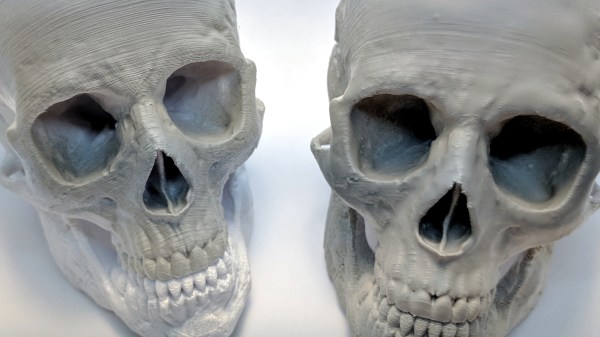
Smoothing the layer lines out of filament-based 3D prints is a common desire, and there are various methods for doing it. Besides good old sanding, another method is to apply a liquid coating of some kind that fills in irregularities and creates a smooth surface. There’s even a product specifically for this purpose: XTC-3D by Smooth-on. However, I happened to have access to the syrup-thick UV resin from an SLA printer and it occurred to me to see whether I could smooth a 3D print by brushing the resin on, then curing it. I didn’t see any reason it shouldn’t work, and it might even bring its own advantages. Filament printers and resin-based printers don’t normally have anything to do with one another, but since I had access to both I decided to cross the streams a little.

The UV-curable resin I tested is Clear Standard resin from a Formlabs printer. Other UV resins should work similarly from what I understand, but I haven’t tested them.

Continue reading “3D Printering: Print Smoothing Tests With UV Resin”