Huge Seven Segment Display Made From Broken Glass

A staple of consumer devices for decades, seven segment displays are arguably one of the most recognizable electronic components out there. So it’s probably no surprise they’re cheap and easy to source for our own projects. But that doesn’t mean there isn’t room for personal interpretation.

[MacCraiger] wanted to build a wall clock with the classic seven segment LED look, only his idea was to make it slightly larger than average. With RGB LED strips standing in for individual LEDs, scaling up the concept isn’t really a problem on a technical level; the tricky part is diffusing that many LEDs and achieving the orderly look of a real seven segment display.

All those segments perfectly cut out of a sheet of plywood come courtesy of a CNC router. Once the rectangles had been cut out, [MacCraiger] had to fill them with something that could soften up the light coming from the LEDs mounted behind them. He decided to break up a bunch of glass bottles into small chunks, lay them inside the segments, and then seal them in with a layer of clear epoxy. The final look is unique, almost as though the segments are blocks of ice.

At first glance the use of a Raspberry Pi Zero to control the LED strips might seem overkill, but as it turns out, [MacCraiger] has actually added in quite a bit of extra functionality. The purists might say it still could have been done with an ESP8266, but being able to toss some Python scripts on the Linux computer inside your clock certainly has its appeal.

The big feature is interoperability with Amazon’s Alexa. Once he tells the digital home assistant to set an alarm, the clock will switch over to a countdown display complete with digits that change color as the timer nears zero. He’s also written some code that slowly shifts the colors of the digits towards red as the month progresses, a great way to visualize at a glance how close you are to blowing past that end of the month deadline.

We’ve seen something of a run on custom multi-segment displays recently. Just last month we saw a clock that used some incredible 25-segment LED displays, complete with their own unique take on the on epoxy-filled diffusers.

Continue reading “Huge Seven Segment Display Made From Broken Glass”

Lightbulb Glows When You Have That Eureka Moment

We’re not entirely sure where the lightbulb-idea concept came from, but it’s a cultural touchstone rapidly becoming outmoded by the prevalence of compact fluorescent and LED lighting. Despite this, [Alex Glow] and [Moheeb Zara] whipped up the Prometheus Lamp to let you experience it for real.

The build starts with a glass lightbulb souvenir from the Neon Museum in Las Vegas. Inside, a TinyLily Mini microcontroller board is tasked with talking to an accelerometer to detect movement. When the lightbulb is picked up and oriented in the vertical axis, it lights up a NeoPixel LED, glowing to indicate that you’ve just had a remarkable idea! It’s all powered off a single CR2032 coin cell, thanks to the low voltage requirements of the modern TinyLily components.

It’s a build that serves as a good way to learn about accelerometers, and it makes a fun desk toy, too. We’ve seen some other projects go by the name “Prometheus”, too — like a wrist mounted flame thrower. How’s that for variety?

Lighting Up Your Spectrespecs

In the ever-popular world of Harry Potter, a pair of Spectrespecs are useful if you’re hunting for wrackspurts and nargles. While we’ve never spotted either of these creatures ourselves, if you’d like to go out on a hunt, [Laveréna]’s build might be for you.

To start with, you’ll need the frames for the Spectrespecs. [Laveréna] elected to source hers commercially, but you can 3D print them or even craft them by hand if you so desire. Then, a TinyLily microcontroller board is installed, with its small size allowing it to be tucked neatly out of sight in the top of the sunglasses. Two NeoPixels are then installed, with the TinyLily programmed to flash the LEDs in the requisite blue and red colors for easy identification of supernatural creatures.

Tools such as cheap microcontrollers designed for wearables and low-cost addressable LEDs are making advanced cosplay designs easier than ever. Whipping up custom blinkables no longer requires knowledge of advanced multiplexing techniques and how to properly drive high-power LEDs. Of course, LED wearables do still get properly advanced – like this skin-based 7-segment display. If you’ve got a glowable project of your own that you’re dying to share, be sure to let us know!

Art Imitates DNA

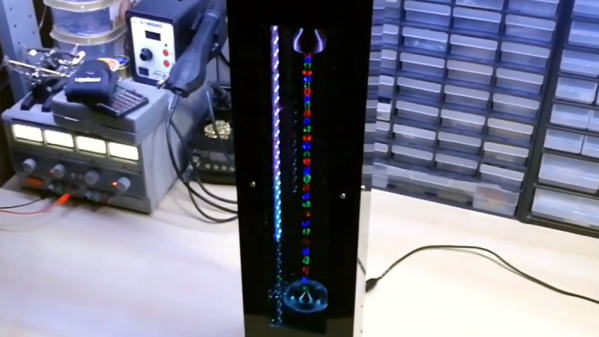
It has recently been possible to pay a service a little bit of money and learn more about your own DNA. You might find out you really aren’t Italian after all or that you are more or less susceptible to some ailments. [Paul Klinger] had his DNA mapped and decided to make a sculpture representing his unique genetic code. The pictures are good, but the video below is even better.

The project requires a DNA sequencing, a 3D printer, and a Raspberry Pi Zero. Oh, you can probably guess you need a lot of RGB LEDs, too. Of course, the display doesn’t show the whole thing at one time — your DNA pattern scrolls across the double helix.

Continue reading “Art Imitates DNA”

Flicker Detector Lets You Hear What You Can’t See

Have you ever looked at modern LED lighting and noticed, perhaps on the very edge of your perception, that they seemed to be flickering? Well, that’s because they probably are. As are the LEDs in your computer monitor, or your phone’s screen. Pulse width modulation (PWM) is used extensively with LEDs to provide brightness control, and if it’s not done well, it can lead to headaches and eyestrain.

Looking to quantify just how much flashing light we’re being exposed to, [Faransky] has created a simple little gadget that essentially converts flashing light into an audio tone the human ear can pick up. Those LEDs might be blinking on and off fast enough to fool our eyes, but your ears can hear frequencies much higher than those used in common PWM solutions. In the video after the break, you can see what various LED light sources sound like when using the device.

The electronics here are exceptionally simple. Just connect a small solar panel to an audio amplifier, in this case the PAM8403, and listen to the output. To make it a bit more convenient to use, there’s an internal battery, charger circuit and USB-C port; but you could just as easily run the thing off of a 9 V alkaline if you wanted to build one from what’s already in the parts bin.

Who knows? If you carry this thing around long enough, you might even hear the far less common binary code modulation in action (but probably not).

Continue reading “Flicker Detector Lets You Hear What You Can’t See”

Clock Uses Custom LED Displays To Keep Myst Time

The Myst fans in the audience will love this project because it displays the 25-hour timekeeping system of the D’ni. The hardware hackers will lean a little closer to their screen because it does so with custom made 25-segment LEDs, and the precision obsessed will start breathing heavily when they hear it maintains an accuracy of 0.001 seconds. As for which of those camps creator [Mike Ando] most identifies with, we can’t say. But we definitely respect his style.

We’ll spare you the in-depth description of the base-25 number system apparently used in the Myst franchise. If you’re interested enough you can click on through to the project’s Hackaday.io page and learn how to actually read the clock. Presumably you’ll then come back here and leave your comment in Klingon.

Let’s instead jump right to the part that really gets us excited, those custom displays. To create them, [Mike] cut the face out of black acrylic with a laser, and filled each void with a mixture of clear resin and very fine gypsum plaster. Getting the mix right can be a little finicky as the plaster can clump up, but the end result diffuses the light nicely. The acrylic front panel and a couple of cardboard “gaskets” to keep the light from leaking onto adjacent segments is then stacked on top of a PCB with corresponding 0603 SMD LEDs.

Beyond the soul-crushing number of wires required to hook everything up internally, the rest of the project is relatively straightforward. It uses a WeMos D1 Mini to connect to the WiFi network and pull the current time down from the geographically closest NTP server every couple of hours. Rather than putting a temperature controlled oscillator on the board, [Mike] has decided to pin his accuracy on a constantly on Internet connection and aggressive synchronizations.

From impressive curved bar graph modules to displays segmented with household items, we’ve seen our fair share of custom indicators. But we have to admit that building 25-segment LED displays for the alphabet of a fictional interstellar species sets the bar pretty high.

Continue reading “Clock Uses Custom LED Displays To Keep Myst Time”

New Part Day: SK6812 Mini-E. A Hand Solderable Neopixel Compatible LED!

Normally when we give you a New Part Day piece, it concerns a component that you will have never seen before. The subject of this find by [Robert Fitzsimons] then is a slight departure from that norm, given that the SK6812 Mini-E is a WS2812 or Neopixel compatible multi-colour LED of a type that has been available for a while now.

What makes this component new though is its packaging. The Mini-E variant of the SK6812 only appeared last year and has now found its way through to smaller order quantities on AliExpress. Its special feature is that it has a set of flat leads rather than the usual pads on the underside of the package. This means that unlike its predecessors it is readily hand solderable, as he demonstrates by attaching a set of leads to one.

The leads emerge halfway up the side of the device, which seems designed to be mounted recessed within a PCB hole. He demonstrates this with a piece of stripboard, and remarks that they would make a good choice for many small projects such as Shitty Add-On boards.

We’ve touched the leadless SK6812s a few times before, along the way remarking that in some respects they are better than the WS2812 they follow.

Continue reading “New Part Day: SK6812 Mini-E. A Hand Solderable Neopixel Compatible LED!”