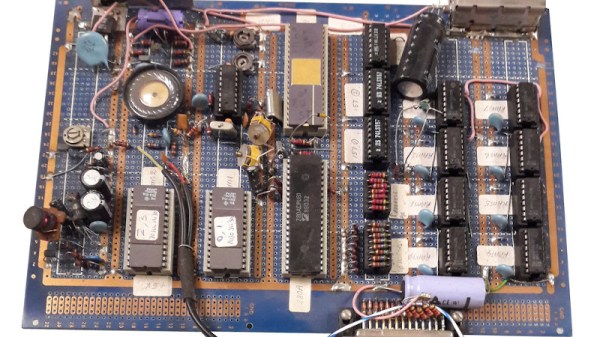
If you are a devotee of the Sinclair series of 8-bit home computers then a piece of news from the Centre For Computing History in Cambridge may be of interest to you, they’ve released a copy of the ROM from their ZX Spectrum prototype. This machine surfaced last year as part of a donation form the company originally contracted to write the Spectrum ROM and has been given pride of place int heir exhibition ever since. They’ve been doing some very careful work on it, and while The Register reports they can’t yet make the board boot, they have extracted the code for study. In the video below the break, we see it running on the Speccy emulator on an older Windows PC.
The ROM comes with an invitation to the ZX Spectrum community to analyze it against the stock version, in the hope of revealing ossified fragments of code such as that for the Microdrive storage peripheral which never made it into the stock Spectrum. But should you simply want to try your favorite games with the earliest possible version of the ROM, you can do that too.
As we enter our second week of official COVID-19-related lockdown where this is being written, it’s evident that there are some resources we will have to conserve to help get us through all this. Instead of just using all of something because we can nip out to the store and buy more, we have to look at what we’ve got and treat it as though it will have to get us through the next three months. It’s not always certain that on our infrequent trips to the supermarket they’ll have stocks of what we want.
This is the very last of the toilet paper in my local supermarket, on the 8th of March.
A particular shortage has been of toilet paper. The news was full of footage showing people fighting for the last twelve-pack, and since early last month there has been none to be had for love nor money. To conserve stocks and save us from the desperate measures of having to cut the Daily Mail into squares and hang them on the wall, a technical solution is required. To this end I’ve created a computerised toilet roll dispenser which carefully controls the quantity of the precious sanitary product, in the hope of curbing its consumption to see us through the crisis.
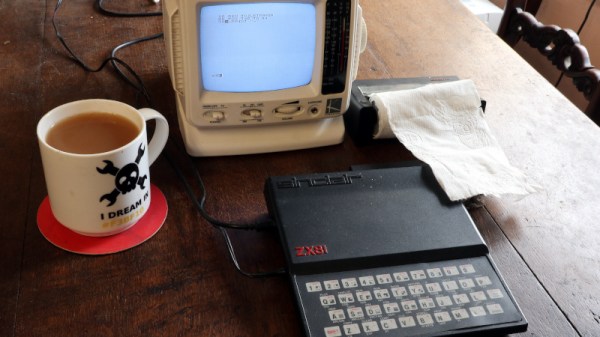
In the midst of a full lockdown it’s difficult to secure immediate delivery of our usual maker essentials, so rather than send off for the controller boards I might have liked it has been necessary to make do with what I had. In the end I selected an older single board computer I had in a box under my bench. The Sinclair ZX81 has a single-core Z80 processor running at 3.25 MHz, dual-channel memory, a Ferranti GPU, and plenty of expansion possibilities from its black plastic case. I chose it because I could repurpose its thermal printer peripheral as a toilet paper printer, and because it has an easily wiped and hygienic membrane keyboard rather than a conventional one that could harbour germs.
Hardware wise I found I was fairly easily able to adapt a standard roll of Cushelle to the ZX printer, and was soon dispensing sheets with the following BASIC code.
10 REM TOILET PAPER PRINTER
20 FOR T=0 TO 44
30 LPRINT ""
40 NEXT T
50 LPRINT "---------- TEAR HERE -----------"
For now it’s working on the bench, but it will soon be mounted with a small portable TV as a monitor on the wall next to the toilet. Dispensing toilet paper will be as simple as typing RUN and hitting the ZX’s NEW LINE key, before watching as a sheet of toilet paper emerges magically from the printer. It’s the little hacks like this one that will be so useful in getting us through the crisis. After all, this Sinclair always has a square to spare.
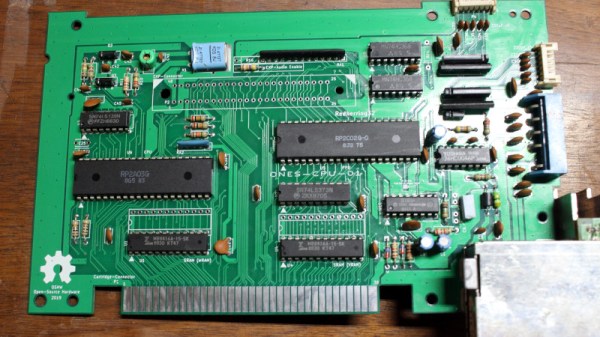
As the original hardware from the golden era of 8-bit computer gaming becomes a bit long in the tooth, keeping it alive has become something of a concern for enthusiasts. There have been a succession of remanufactured parts for many of the major platforms of the day, and now thanks to [Redherring32] it’s the turn of the NES console.
It’s an interesting exercise in reverse engineering as well as a chance to look at the NES at the chip level. Also for Nintendo-heads, it provides all the component footprints and schematic items in KiCAD format. Will many be built? Given that the NES was the best-selling console of its time there should be no shortage of originals to be found, but that in no way invalidates the effort put into this project. There will be NES consoles somewhere running for decades to come because of work such as this, simply remember that you don’t need to blow in the slot to make it work!
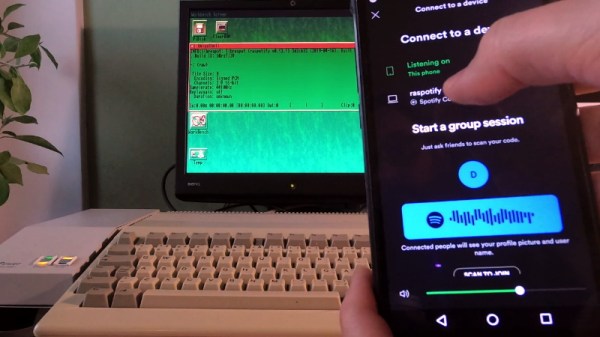
No doubt some purists in the audience will call this one cheating, since this Amiga 500 from 1987 isn’t technically connecting to Spotify and playing the music by itself. But we also suspect those folks might be missing the point of a site called Hackaday. With all the hoops [Daniel Arvidsson] hopped through to make this happen, what else could it be if not a hack?
This one starts, like so many projects these days, with the Raspberry Pi. Don’t worry Amiga aficionados, this classic machine hasn’t been gutted and had its internals replaced with a diminutive Linux board. But thanks to an expansion card known as the A314, you could say it’s received a penguin infusion. This clever board allows an internally mounted Raspberry Pi to communicate with the Amiga 500 through shared memory, making all sorts of trickery possible.
In this case, the Raspberry Pi is actually the one connecting to the Spotify Connect service with raspotify and decoding the stream. But thanks to a few pipes and an ALSA plugin, the audio itself is actually pushed into the Amiga’s sound hardware. In the video after the break, the process is demonstrated with tunes that are befitting a computer of this vintage.
While repairing a real-time clock module for a 1970s HP computer that had been damaged by its leaky internal battery, [CuriousMarc] began to suspect that maybe the replacement clock chips which he had sourced from a seller in China were the reason why the module still wasn’t working after the repairs. This led him down the only obvious path: to decap and inspect both the failed original Ti chip and the replacement chip.
The IC in question is the Texas Instruments AC5948N (along with the AC5954N on other boards), which originally saw use in LED watches in the 1970s. HP used this IC in its RTC module, despite it never having been sold publicly. This makes it even more remarkable that a Chinese seller had the parts in stock. As some comments on the YouTube video mention, back then there wasn’t as much secrecy around designs, and it’s possible someone walked out of the factory with one of the masks for this chip.
Whether true or not, as the video (also included after the break) shows, both the original 1970s chip and the China-sourced one look identical. Are they original stock, or later produced from masks that made their way to Asia? We’ll probably never know for sure, but it does provide an exciting opportunity for folk who try to repair vintage equipment.
If you work on old radios, electronics is only one of the skills you need. The other is wood or metal working to restore the cabinets and chassis. However, more recent electronics have plastic and old plastic tends to turn yellow. [Odd Experiments] shows how to whiten plastic using a UV light source, aluminum foil, and hydrogen peroxide. Generally, ABS is the plastic at fault, especially those mixed with bromine as a fire retardant. You can see the results in the video below.
Note the peroxide in use was 12% — much stronger than what’s probably in your medicine cabinet. That’s usually only 3% solution, although you can get different strengths including some over 30% if you shop. However, if you search you’ll find that people have used 12%, 6%, and even 3% successfully, although we’d imagine it takes more time with 3%.
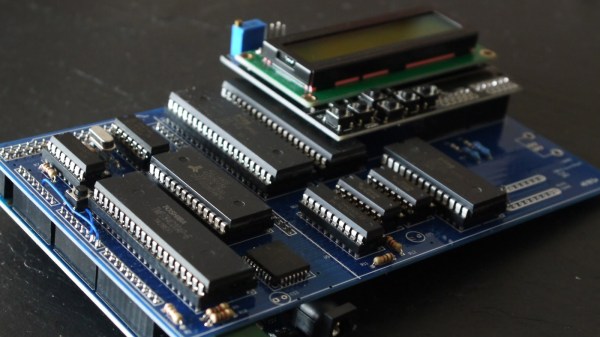
There have been plenty of Z80 computer builds here on Hackaday, but what sets them apart is what you do with them. [Andrew] writes in with his Z80 single-board computer made from scratch, using the Arduino standard headers for its I/O. In turn, since he needed an easy way to program the flash memory which holds the software to run on the Z80, he used an Arduino Mega as a debugger, making the SBC an Arduino shield itself.
Using such a common header pinout for the Z80 computer allows it to be used with a variety of readily-available Arduino shields. This compatibility is achieved with an analog-digital converter and a 3.3 V regulator, mimicking the pins found in an Arduino Uno. The code, available on GitHub, includes an extensive explanation and walkthrough over the process in which the Mega takes over the bus from the Z80 to function as a fully-featured debugger. Programs can be loaded through embedding an assembly listing into the Mega’s sketch, or, once the debugger is up you can also upload a compiled hex file through the serial connection.