Pristine Apple I Sells At Auction For A Jaw-Dropping Price

If you think Apple products are overpriced now, wait until they’re 50 years old.

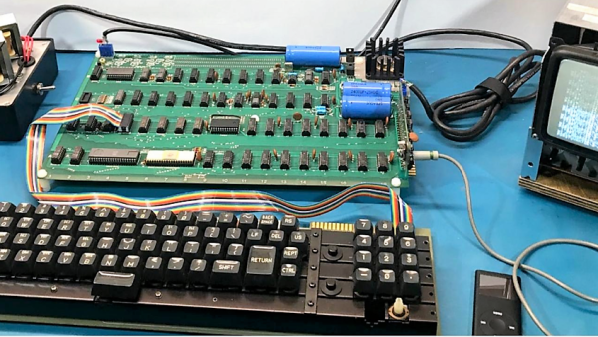
This original Apple I recently sold at auction for $375,000, making it one of the most expensive 6502-based computers in history. Given that only something like 60 or 70 of the machines were ever made are known to exist, most built by hand by [Jobs] and [Wozniak], it’s understandable how collectors fought for the right to run the price up from the minimum starting bid of $50,000. And this one was particularly collectible. According to the prospectus, this machine had few owners, the most recent of whom stated that he attended a meeting of the legendary Homebrew Computer Club to see what all the fuss was. He bought it second-hand from a coworker for $300, fiddled with it a bit, and stashed it in a closet. A few years later, after the Apple ][ became a huge phenomenon, he tried to sell the machine to [Woz] for $10,000. [Woz] didn’t bite, and as a result, the owner realized a 125,000% return on his original investment, before inflation.

The machine was restored before hitting the auction block, although details of what was done were not shared. But it couldn’t have been much since none of the previous owners had even used the prototyping area that was so thoughtfully provided on the top edge of the board. It was sold with period-correct peripherals including a somewhat janky black-and-white security monitor, an original cassette tape interface, and a homebrew power supply. Sadly, there’s no word who bought the machine – it was an anonymous purchase.

Hackers, check your scrap bins. Anything hanging out there that might be worth six figures in a few decades? It’s unlikely, but if you get lucky, hacking just might turn into your retirement plan.

Thanks to [my wife] for the tip on this one.

Microsoft Releases Crown Jewels — From 1982!

If you look back 30 or so years ago, it wasn’t clear what was going to happen with personal computers. One thing most people would have bet on, though, was that CP/M — the operating system from Digital Research — would keep growing and power whatever new machines were available. Except it didn’t. MS-DOS took over the word and led — eventually — to the huge number of Windows computers we know today. Microsoft has released the source code to MS-DOS 1.25 and 2.0 on GitHub.

Microsoft — then another fledgling computer company — had written some BASIC interpreters and wanted in on the operating system space. They paid the princely sum of $75,000 to Seattle Computer Products for something called QDOS written by [Tim Paterson]. Rebranded as MS-DOS, the first version appeared in late 1981 and version 1.25 was out about a year later.

While you might not think having MS-DOS source code is a big deal, there’s still a lot of life left in DOS and it is also interesting from an educational and historical perspective. If you don’t want to read x86 assembly language, there’s also the BASIC source for the samples (paradoxically, in the bin subdirectory) along with compiled COM files for old friends like EDLIN and DEBUG.

Continue reading “Microsoft Releases Crown Jewels — From 1982!”

A Nibble And A Half Of Wooden Bits

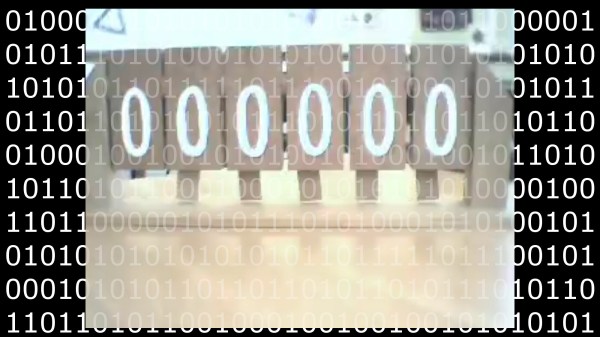
If you are familiar with binary, what would you need to teach someone who only knows decimal? If you do not know how to count in binary, let us know if the video below the break helps you understand how the base-2 number system works. If learning or counting binary is not what you are interested in, maybe you can appreciate the mechanics involved with making a counter that cycles through all the ones and zeros (links to the video shown below). The mechanism is simple enough. A lever at the corner of each “1” panel is attached off-center, so it hangs when it is upside-down, then falls to the side when it is upright, so it can swivel the adjacent panel.

Perhaps this is a desktop bauble to show off your adeptness at carpentry, or skills with a laser cutter, or 3D printer. No matter what it is made out of, it will not help you get any work done unless you are a teacher who wants to demonstrate the discrete nature of binary. If wood and bits are up your alley, we have a gorgeous binary driftwood clock to feast your eyes on. Meanwhile if analog methods of working digital numbers suit you, we have binary math performed with paper models.

Continue reading “A Nibble And A Half Of Wooden Bits”

C64 Keyboard Helps Keep The Memory Alive

To say that the Commodore 64 was an important milestone in the history of personal computing is probably a bit of an understatement. For a decent chunk of the 1980s, it was the home computer, with some estimates putting the total number of them sold as high as 17 million. For hackers of a certain age, there’s a fairly good chance that the C64 holds a special spot in their childhood; perhaps even setting them on a trajectory they followed for the rest of their lives.

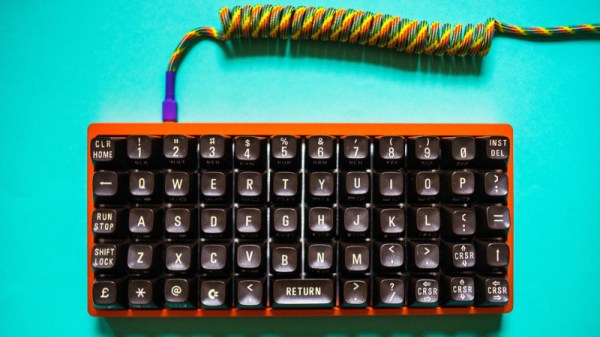
At the risk of showing his age, [Clicky Steve] writes in to tell us about the important role the C64 played in his childhood. He received it as a gift on his fifth birthday from his parents, and fondly remembers the hours he and his grandfather spent with a mail order book learning how to program it. He credits these memories with getting him interested in technology and electronic music. In an effort to keep himself connected to those early memories, he decided to build a modern keyboard with C64 keycaps.

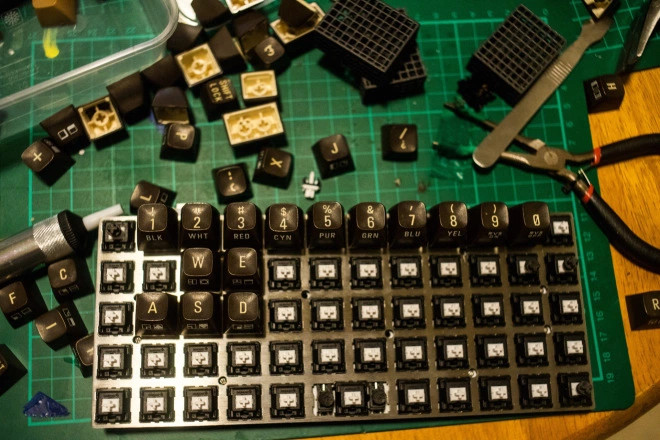
As you might expect, the process started with [Steve] harvesting the caps from a real Commodore, in fact, the very same computer he received as a child. While the purists might shed a tear that the original machine was sacrificed to build this new keyboard, he does note that his C64 had seen better days.

Of course, you can’t just pull the caps off of C64 and stick them on a modern keyboard. [Steve] found the STLs for a 3D printable C64 to Cherry MX adapter on GitHub, and had 80 of them professionally printed as he doesn’t have access to an SLS printer. He reports the design works well, but that non-destructively removing the adapters from the caps once they are pressed into place probably isn’t going to happen; something to keep in mind for others who might be considering sacrificing their personal C64 for the project.

[Steve] installed the caps on a Preonic mechanical keyboard, which worked out fairly well, though he had to get creative with the layout as the C64 caps didn’t really lend themselves to the keyboard’s ortholinear layout. He does mention that switches a bit heavier than the Cherry MX Whites he selected would probably be ideal, but overall he’s extremely happy with his functional tribute to his grandfather.

If you’re more of a purist, you can always adapt the C64 keyboard directly to USB. Or go in the complete opposite direction and put a Raspberry Pi into a C64 carcass.

It’s The Web, Basically

If you are of a certain age, you probably learned to program in Basic. Even if you aren’t, a lot of microcontroller hobbyists got started on the Basic Stamp, and there are plenty of other places where to venerable language still hides out. But if you want to write cool browser applications, you have to write JavaScript, right? Google will now let you code your web pages in Basic. Known as WWWBasic, this is — of course — a Javascript hack that you can load remotely into a web page and then have your page use Basic for customization. You can even import the thing into Node.js and use Basic inside your JavaScript, although it is hard to think of why you’d want to.

According to the project’s documentation — which is pretty sparse so far, we’re afraid — the Basic program is compiled into JavaScript on page load. There are a few examples, so you can generally pick up what’s available to use. There are graphics, the ability to read a keyboard key, and a way to handle the mouse.

Continue reading “It’s The Web, Basically”

Electromagnetic Field: Speczilla!

It is a golden rule of the journalist’s art, that we report the news, we don’t make it. But just occasionally we find ourselves in the odd position of being in the right place such that one of our throwaway comments or actions has the unintended consequence of seeding a story. This is one of those moments, so it’s a rare case of use of the first person in a daily piece as your scribe instead of Hackaday’s usual second person.

At the SHA2017 hacker camp in the Netherlands, [Matt “Gasman” Westcott] gave his presentation on composing a chiptune from an audience suggestion. Afterwards my Tweet about never having seen a Sinclair Spectrum as large as the one on the presentation screen grew a life of its own and became the idea for a project, which in turn at Electromagnetic Field 2018 was exhibited as a giant-sized fully working Sinclair ZX Spectrum.

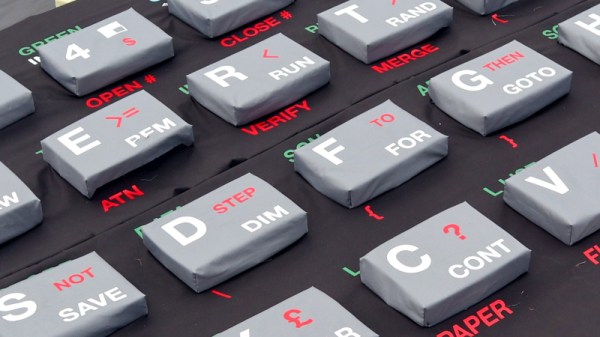
Since much of the work was performed in Oxford Hackspace I saw Matt’s progression, his first experiments with foam rubber keys, then as he refined his two-wire switch mechanism. Early experiments hooking a row of them up to a real Spectrum motherboard weren’t the success he’d hoped for, so he moved to the FUSE emulator on a Raspberry Pi. A huge effort and needlework learning curve plus a lot of help from OxHack’s textile specialists and buying his local furniture store’s entire stock of foam allowed him to perfect a facsimile of the classic Spectrum’s case and blue rubber keys, while its lettering and iconic BASIC keywords were vinyl-cut at rLab in Reading. A Milton Keynes Makerspace member provided transport to the camp where it was united with a huge TV in a gazebo, completing the trio of local spaces.

At the camp, though it suffered a few technical hitches along the way it was rather a success. There were two techniques, kneeling down and pressing keys with the palm of your hand, or dancing on them in socked feet for complex manoeuvres. The trademark single-key-press BASIC keywords took a little while to re-learn though, there was a time when those were instinctive.

We’d normally wrap a piece like this one up with a link or two. To other projects perhaps, or other hacks from the same person. But in this case we have neither another home computer on this scale, nor any hacks from [Matt], as he’s well known in the European arm of our community for something completely different. As [Gasman] he’s a chiptune artist par excellence, as you can see if you watch his set from the 2014 Electromagnetic Field.

Packing 10 Into 1: A Square Inch Dekatron Replacement

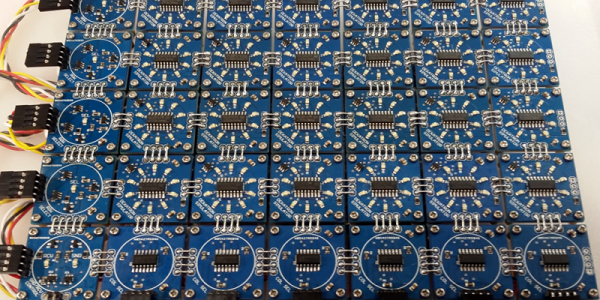
One of the things that always attracts our eye in old movies is how many kinds of displays you see on old gear both real and imaginary. Really old stuff usually had meters or circular recorders. But slightly newer movies often had some kind of exotic digital display with Nixes or Numitron tubes. One of the really exotic display devices was a Dekatron. While these are pretty rare, you can make a stand-in using modern LEDs and [Dave] did just that in an entry into our square inch competition.

These were gas-filled tubes with ten positions. You had to reset the tube and then the tube would visibly count pulses providing a visual indicator from zero to nine. Depending on the tube configuration, you could use them to count or to act as a divider. Those with neon fill looked sort of orange, although there were argon-based ones that had a purple glow. You can see what an older version of the board looks like in the video below or skip to the second video if you want to see the real ones in action.

Continue reading “Packing 10 Into 1: A Square Inch Dekatron Replacement”