The “P Cell” Is Exactly What You Might Suspect

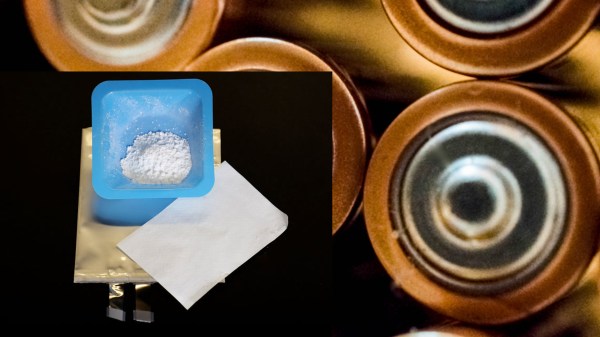
[Josh Starnes] had a dream. A dream of a device that could easily and naturally be activated to generate power in an emergency, or just for the heck of it. That device takes in urea, which is present in urine, and uses it to generate a useful electrical charge. [Josh] has, of course, named this device the P Cell.

An early proof of concept uses urine to create a basic galvanic cell with zinc and copper electrodes, but [Josh] has other ideas for creating a useful amount of electricity with such a readily-available substance. For example, the urea could be used to feed bacteria or micro algae in a more elegantly organized system. Right now the P Cell isn’t much more than a basic design, but the possibilities are more than just high-minded concepts. After all, [Josh] has already prototyped a Hybrid Microbial Fuel Cell which uses a harmonious arrangement of bacteria and phytoplankton to generate power.

[Josh]’s entries were certainly among some of the more intriguing ones we saw in the Power Harvesting Challenge portion of The Hackaday Prize, and we’re delighted that his ideas will be in the running for the Grand Prize of $50,000.

Cheap PSoC Enables Electrochemistry Research

You may think electrochemistry sounds like an esoteric field where lab-coated scientists labor away over sophisticated instruments and publish papers that only other electrochemists could love. And you’d be right, but only partially, because electrochemistry touches almost everything in modern life. For proof of that look no further than your nearest pocket, assuming that’s where you keep your smartphone and the electrochemical cell that powers it.

Electrochemistry is the study of the electrical properties of chemical reactions and does indeed need sophisticated instrumentation. That doesn’t mean the instruments have to break the grant budget, though, as [Kyle Lopin] shows with this dead-simple potentiostat built with one chip and one capacitor. A potentiostat controls the voltage on an electrode in an electrochemical cell. Such cells have three electrodes — a working electrode, a reference electrode, and a counter electrode. The flow of electrons between these electrodes and through the solutions under study reveal important properties about the reduction and oxidation states of the reaction. Rather than connect his cell to an expensive potentiostat, [Kyle] used a Cypress programmable system-on-chip development board to do everything. All that’s needed is to plug the PSoC into a USB port for programming, connect the electrodes to GPIO pins, and optionally add a 100 nF capacitor to improve the onboard DAC’s accuracy. The video below covers the whole process, albeit with a barely audible voiceover.

Still not sure about electrochemistry? Check out this 2018 Hackaday Prize entry that uses the electrochemistry of life to bring cell phones back to life.

Continue reading “Cheap PSoC Enables Electrochemistry Research”

Thermal Actuators: Hydraulic Motors That Feed On Temperature Changes

These Fluid Displacement Thermal Actuators designed by [Andrew Benson] are a delightful and profoundly different approach to the Power Harvesting Challenge portion of The Hackaday Prize. While most projects were focused on electrical power, [Andrew]’s design is essentially a mechanical motor that harnesses the fact that Phase Change Materials (PCMs) change volume when they go from liquid to solid or vice-versa; that property is used to provide a useful hydraulic force. In short, it’s a linear actuator that retracts and expands as the PCM freezes or melts. By choosing a material with melting and freezing temperatures that are convenient for the operating environment, an actuator can be reliably operated virtually for free. A proof of concept is the device shown here; a model of a sun-shade that deploys when a certain temperature is reached and retracts when it has cooled.

Sunshade concept, from deployed (top) to retracted (bottom).

Turning temperature changes into useful physical work is the principle behind things like wax motors and even some self-winding clocks, but what [Andrew] has done is devise a useful method of interfacing directly to the fluids; abstracting away the materials themselves in order to provide mechanical power on the other end. These devices, in general, may not be particularly efficient but they have very few moving parts, are astonishingly reliable, and can operate at virtually any scale. [Andrew] has been thinking big, many of his application ideas are architectural in nature.

[Andrew] was inspired to enter his design for The Hackaday Prize, and we’re glad he did because it was selected as one of the finalists in the Power Harvesting Challenge, and will be in the running for the $50,000 Grand Prize. If you also have an idea waiting for an opportunity to shine, now is the time. The Human-Computer Interface Challenge is up next, followed by the Musical Instrument Challenge. All you really need to enter is a documented concept, so sharpen your pencils and give your idea a shot at reaching the next level.

Micro-Organisms Give Up The Volts In This Biological Battery

Battery cells work by chemical reactions, and the fascinating Hybrid Microbial Fuel Cell design by [Josh Starnes] is no different. True, batteries don’t normally contain life, but the process coughs up useful electrons all the same; 1.7 V per cell in [Josh]’s design, to be precise. His proof of concept consists of eight cells in parallel, enough to give his cell phone a charge via a DC-DC boost converter. He says it’s not known how long this can be expected to last before the voltage drops to an unusable level, but it works!

Eight-cell, 3D printed proof of concept.

There are two complementary sides to each cell in [Josh]’s design. On the cathode side are phytoplankton; green micro algae that absorb carbon dioxide and sunlight. On the anode side are bacteria that break organic material (like food waste) into nitrates, and expel carbon dioxide. Version 2 of the design will incorporate a semi-permeable membrane between the cells that would allow oxygen and carbon dioxide to be exchanged while keeping the populations of micro-organisms separate; this would make the biological processes more complementary.

A battery consisting of 24 cells and a plumbing system to cycle and care for the algae and bacteria is the ultimate goal, and we hope [Josh] can get closer to that now that his project won a $1000 cash prize as one of the twenty finalists in the Power Harvesting Challenge portion of the Hackaday Prize. (Next up is the Human Computer Interface Challenge, just so you know.)

Building a gasometer

Building A Gasometer To Store Wood Gas And Other Bio-Fuels

Old solutions are often so elegant and effective that they keep coming back. The gasometer, or gas holder, is one such example. Now [NightHawkInLight] has built one for storing the wood gas he’s been experimenting with, and it’s pretty neat to watch it rise and fall as he first adds gas and then burns it off. The mechanism couldn’t be simpler.

How a gasometer works

For those who, like us, are hearing about this low tech for the first time, gasometers are a means of safely storing gas stemming from the 1700s when gas was king and electricity was little more than a gentleman scientist’s pursuit. In its simplest form, it consists of a container of water with another container filled with gas sitting upside down in the water. Gas pressure is controlled by the weight of the gas-filled container and the water provides a seal, preventing the gas from escaping. Adding gas simply raises the gas-filled container, and removing or using gas lowers it. Simple, safe, and elegant.

We’ll leave the details of how he made his gasometer to the video below, but suffice it to say that his use of a double-walled gas pipe originally intended as a furnace chimney just adds more elegance to this whole hack.

[NightHawkInLight’s] cool projects have graced the pages of Hackaday before. For example, in the area of gas alone there’s his propane-powered plasma rifle, his transparent hybrid rocket engine, and his thermic lance which was hot enough to melt rocks.

Continue reading “Building A Gasometer To Store Wood Gas And Other Bio-Fuels”

Changing Color Under Pressure

When you saw the picture for this article, did you think of a peacock’s feather? These fibers are not harvested from birds, and in fact, the colors come from transparent rubber. As with peacock feathers, they come from the way light reflects off layers of differing materials, this is known as optical interference, and it is the same effect seen on oil slicks. The benefit to using transparent rubber is that the final product is flexible and when drawn, the interference shifts. In short, they change color when stretched.

Most of the sensors we see and feature are electromechanical, which has the drawback that we cannot read them without some form of interface. Something like a microcontroller, gauge, or a slew of 555 timers. Reading a single strain gauge on a torque wrench is not too tricky, but simultaneously reading a dozen gauges spread across a more complex machine such as a quadcopter will probably require graphing software to generate a heat map. With this innovation it could now be done with an on-board camera in real-time. Couple that with machine learning and perhaps you could launch Skynet. Or build a better copter.

The current proof-of-concept weaves the fibers into next-generation bandages to give an intuitive sense of how tightly a dressing should be applied. For the average first-aid responder, the rule is being able to slide a finger between the fabric and skin. That’s an easy indicator, but it only works after the fact whereas saying that the dressing should be orange while wrapping gives constant feedback.

Silicon Nanowires Create Flexible Photodetectors

Modern display and solar cell technologies are built with a material called Indium Tin Oxide (ITO). ITO has excellent optical transparency and electrical conductivity, and the material properties needed for integration in large-scale manufacturing. However, we’re not content with just merely “good enough” nowadays, and need better materials to build ever better devices. Graphene and carbon nanotubes have been considered as suitable replacements, but new research has identified a different possibility: nanowires.

Researchers from the Indian Association for the Cultivation of Science (IACS) and the Centre for Research on Adaptive Nanostructures and Nanodevices (CRANN) in Ireland have demonstrated a seamless silicon nanowire junction that can be used for photodetector and display technology.

Before you get lost in the jargon, let’s take a step back. A nanowire is just a very narrow length of wire, on the order of 1 nanometer across. When silicon is used at this scale, electrical charges can become stuck (called “charge trapping”), which means that the holes and electrons are separated, allowing for transistors and photovoltaics. By controlling where these holes form in the nanowire, you can create a “seamless” junction without using any dopant materials to create impurities, as is done in modern CMOS transistors

These material properties allow the functionality of a junction, but it still needs to be easily and repeatably manufactured. To solve this problem, the team put the nanowire transistors on a flexible polymer, which should enable flexible nanowire applications, such as a roll-up screen.

The first step towards a display is a simple photodetector, just consisting of a basic P-N junction, but they hope this technology will eventually be useful in “smart windows” due to the junctions’ applicability to photodetectors and cameras. Moving to emitting light for displays or creating a solar cell using this technology will probably take some time.

Do you have any experience with different materials for creating junctions? What would you do with a small, transparent photodetector? We’ve featured homebrew solar cells before, as well as creating DIY semiconductors. We’ve also seen silver nanowires for wearable circuits.

[Via IEEE Spectrum]