Blinking An LED – Extreme Edition

This hacker’s video on blinking LEDs never got the recognition it deserves. At the time of writing clocking in at just 61 views, but it is indeed a work of art. Just trust me, scroll to the bottom of the article and watch it, you wont be disappointed.

Not convinced? OK, let me tell you about it and the world it has opened up in the Japanese maker scene. We’ve all blinked an LED. Maybe it was just to test a microcontroller, like the simplest Arduino example.

blink555

Or we’ve been a tad more old school and used the classic 555 to do it. Or maybe like me, you went through a phase of hacking together Phase Shift and other oscillators because well… it’s fun!

But [Junichi AKITA] has more extreme tastes, deciding that a custom IC layout is the way to go. [Junichi] designed a ring oscillator composed of flip-flops, then hand laid out each MOSFET placing each layer exactly where it should be fabricated.

The resulting design was then fabricated by an academic shuttle service in Japan (a bit like the well known MOSIS service). The result is a tiny circuit in the top right corner of the IC. Which of course [Junichi] then had to wirebond (check the video for a cool 1980s style Westbond machine which are still hugely popular in Japan).

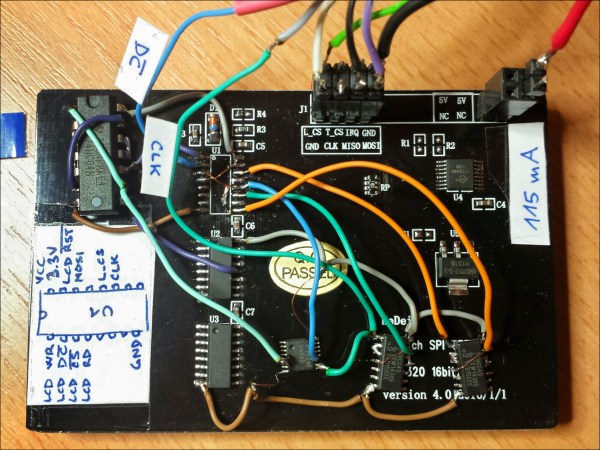
[Junichi] bonded the die directly to a PCB (COB). I assume, purely for irony, a 555, and ATtiny based oscillator were also laid out on the board.

makelsi_icI guess you might have a couple of lingering questions. First you’ll likely bemoan your lack of your own fabrication facility (I’m still eyeing those used 1 micron fab lines that crop up on eBay from time to time). And secondly you might be asking yourself… why?

Both these questions are somewhat answers by the MakeLSI project. This growing project in Japan seems to have opened up semiconductor fabrication to all kinds of projects.

While my Japanese isn’t good enough to fully understand what’s happening it’s clear there are many awesome projects going on. Including joys such as IC layouts designed in vector graphics packages (Inkscape) and die images packed with interesting layouts, anime characters and QR codes.

For more awesome images and information (unfortunately all in Japanese) you can check them out on Facebook or on their homepage.

Continue reading “Blinking An LED – Extreme Edition”

Measuring capacitance with wax dielectric

How To Measure The Dielectric Constant For DIY Capacitors

Every now and then you need to make your own capacitor. That includes choosing a dielectric for it, the insulating material that goes between the plates. One dielectric material that I use a lot is paraffin wax which can be found in art stores and is normally used for making candles. Another is resin, the easiest to find being automotive resin used for automotive body repairs.

The problem is that you sometimes need to do the calculations for the capacitor dimensions ahead of time, rather than just throwing something together. And that means you need to know the dielectric constant of the dielectric material. That’s something that the manufacturer of the paraffin wax that makes it for art stores won’t know, nor will the manufacturers of automotive body repair resin. The intended customers just don’t care.

It’s therefore left up to you to measure the dielectric constant yourself, and here I’ll talk about the method I use for doing that.

Continue reading “How To Measure The Dielectric Constant For DIY Capacitors”

Resurrecting The Retro-futuristic Poly-1

poly1clean

[Tez] has acquired and resurrected a piece of New Zealand computing history, the Poly-1. To anyone who went to school in 1980s Britain, the Poly-1 appears to be a cooler, mirror universe version of Acorn’s BBC Micro. Like the humble Beeb, the Poly-1 was designed primarily for educational use. It also used a related, but superior, microprocessor (the Motorola 6809).

However while the legacy of Acorn lives on in the ARM architecture, only a few thousand Poly-1s were ever sold and it appears to have been largely forgotten.

poly1inards

The Poly-1’s demise was likely in part due to its high price tag — around $5,000 USD — its lack of support within New Zealand, and the difficulty that the small New Zealand company had breaking into international markets: issues which eventually killed off many similar 1980s computer companies in the UK, Japan and elsewhere.

But it’s still fascinating to look back, not just in nostalgia, but in admiration of the intrepid 1980s hackers who created these beautiful machines and the dream of a world that might have been.

[NE555]’s SMD Prototyping Is A Work Of Art

ne555_20yearsold
One of [NE555]’s boards from the 90s.
Over on twitter [NE555] has been posting beautiful SMD prototypes.

Back in the 90s when surface mount components gained widespread adoption, the quick and cheap PCB prototyping services of today were unavailable. This led many to develop their own approaches. In Japan a particularly novel and beautiful approach was, and still is, somewhat popular. [NE555]’s work is a excellent example of this technique using a fine enameled wire (you can find this on eBay as “magnet wire”), wirewrap board, and careful hand soldering. [NE555] has made a great video on the process (which you can watch below).

Continue reading “[NE555]’s SMD Prototyping Is A Work Of Art”

Slide Viewer Upgrade Is A Bright Idea

[cunningfellow] has been putting LEDs in everything lately. That’s understandable. Most recently, he used them to drastically upgrade his father’s super-cool mid-century slide viewer.slide-viewer-comparison

The slide viewer used to use a flashlight bulb, but it didn’t light evenly at all. Not only that, it produced a dim, orange-ish light. [cunningfellow] happened to have an old Nokia N93 lying around and decided to cannibalize that strange, beautiful, swiveling flip phone for its backlight circuitry. Unfortunately, the 4 LEDs aren’t going to run on a pair of C cells like the flashlight bulb did. [cunningfellow] needed some kind of boost converter.

He found one in the form of a Nokia E73 LCD driver board created by [Andy Brown]. The LEDs are way brighter than that old incandescent bulb, and they draw about 10mA less to boot. We think [cunningfellow]’s father will be happy with the result.

If you have an old slide viewer and no slides, try using it as a project case. If this post makes you miss your View-Master (also understandable), you can always turn your phone into a stereopticon.

Arcade Cabinet Build Takes Quarters, Dispenses Fun

Building an arcade cabinet seems to be a rite of passage for many hackers and woodworkers. Not that there is anything wrong with that: as this series of posts from [Alessandro] at boxedcnc shows, there is an art to doing it well.

His final build is impressive, with quality buttons, a genuine-looking banner, and even a coin slot so he can charge people to play. His build log covers both the carpentry and electronic aspects of the build, from cutting the panels to his own code for running the coin acceptor that takes your quarter (or, as he is in Italy, Euro coins) and triggers the game to play.

To extract money from his family, he used the Sparkfun COM-1719 coin acceptor, which can be programmed to send different pulses for different coins, connected to an Arduino which is also connected to the joystick and buttons. The Arduino emulates a USB keyboard and is connected to an old PC running MAME with the Attract Mode front end. It’s a quality build, down to the Bubble Bobble banner, and the coin slot means that it might even make some money back eventually.

The Haunting Last Day Of Hot Metal Typesetting At The New York Times

The short film, Farewell — ETAOIN SHRDLU, produced in 1978 covers the very last day the New York Times was set for printing in the old way, using hot metal typesetting.

We’ve covered the magic of linotype machines before, but to see them used as they were in their prime is something else. They saw nearly a hundred years of complete industry dominance. Linotype machines had entire guilds dedicated to their use. Tradesmen built their lives around them. For some of us we see the rise and fall of technology as an expected thing. Something that happens normally, sometimes within spans that cover only a few short years. Yet it’s still a strange thing to see a technology so widely used shut down so completely and relatively rapidly.

To make it even stranger, the computer that replaced the linotype machines is so alien to the technology used today that even it is an oddity. In the end only the shadow of the ‘new’ technologies — showcased as state of the art in this video — are still in use. Nonetheless it’s important to see where we came from and to understand what it means to innovate. Plus, you never know when you see an old idea that’s ready for a bit of refurbishment. Who knows, maybe part of the linotype’s spirit is ready to be reborn, and all it takes is a clever hacker to see it.

Oh, and that title — ‘etaoin shrdlu‘ — is the linotype equivalent of ‘qwerty’. The first two columns of keys on the linotype machine make up those two words.

Continue reading “The Haunting Last Day Of Hot Metal Typesetting At The New York Times”