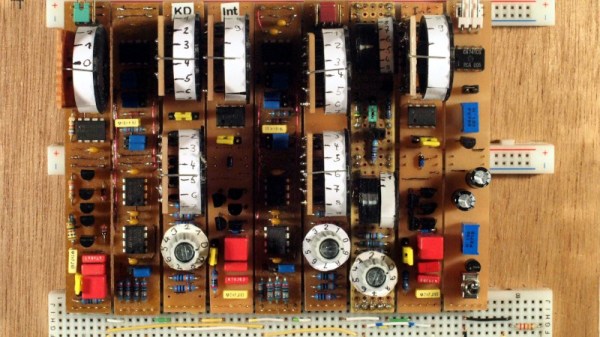
We are all used to modular construction in the analogue synth world, to the extent that there’s an accepted standard for it in EuroRack. But the same techniques are just as useful wherever else analogue circuits need to be configured on the fly, such as in an analogue computer. It’s something [Rainer Glaschick] has pursued, with his Flexible Analog Computer, an analogue computer made from a set of modules mounted on breadboard strips.
Standard modules are an adder and an integrator, with the adder also having inverter, comparator, and precision rectifier functions. The various functions can be easily configured by means of jumpers, and there are digital switches on board to enable or disable outputs and inputs. he’s set up a moon landing example to demonstrate the machine in practice.
We’re not going to pretend to be analogue computer experts here at Hackaday,but we naturally welcome any foray into analogue circuitry lest it become a lost art. If you’d like to experiment with analogue computing there are other projects out there to whet your appetite, and of course they don’t even need to be electronic.



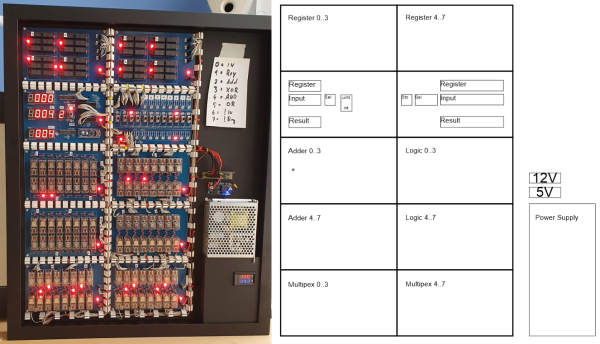
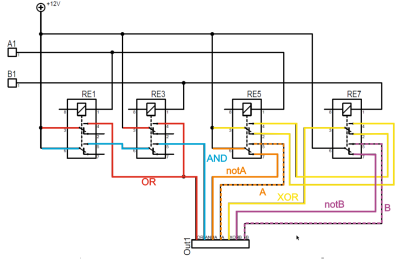 operating on 4-bits. To handle a byte-length word, boards are simply cascaded, making a total of eight. The register, adder, logic function, and multiplex boards are the heart of the build with an additional two custom boards for visualization (using an Arduino for convenience) and IO forming the interface. After all, a basic CPU is just an ALU and some control around it, the magic is really in the ALU.
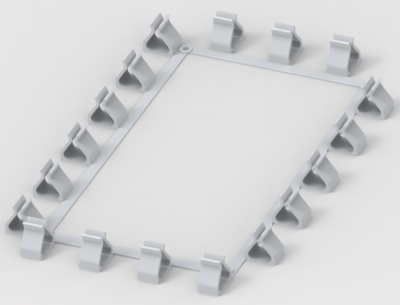 but that’s the job of a separate board. The adder function is the most basic, simply a pair of half-adders and an OR-gate to handle the chaining of the carry inputs and generate the carry chain output.