Fireball-Flinging Figurine Feeds Fiction

If you’re writing a screenplay or novel, there will likely be points along the way at which you can’t get enough encouragement from friends and family. While kind words are kind, acts such as [scubabear]’s can provide a push like no other. By commissioning another 3D designer friend to model a character from the first friend’s screenplay so he could print and animate it, [scubabear] fed two birds with one scone, you might say.
Designer friend [Sean] modeled the mighty Braomar in Maya and Z-brush, and [scubabear] did test prints on a Formlabs Form2 as they went along to keep an eye on things. Eventually, they had a discussion about making space for wires and such, so [Sean] took to Blender to make Braomar hollow enough for wires, but not so empty that he would collapse under the stress of being (we presume) the main character.

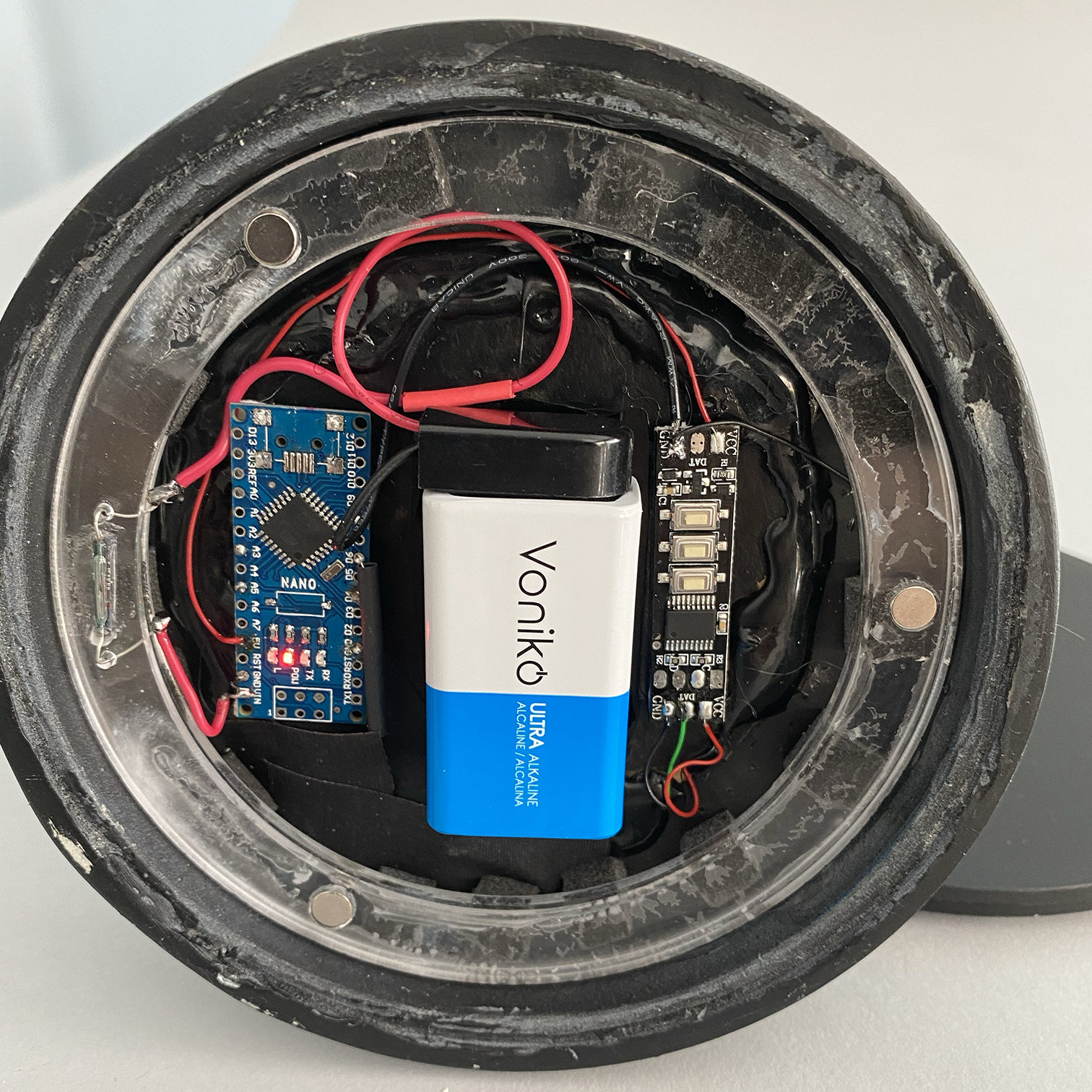
Braomar stands upon a sigil that changes color thanks to an RGB LED ring in the base that’s driven by an Arduino Nano. A single pixel in the fireball is wired through Braomar’s body and flickers with the help of an addressable LED sequencer board.

Our favorite part of this build has to be the power scheme. Not content to have a wire running out from the base or even a remote control for power-draining concerns, [scubabear] used disc magnets in the base to switch on the 9 V battery when Screenplay Friend rotates it.

Of course, if you need inspiration to even thing about beginning to write a screenplay or novel, maybe you should lead with the maquette-building and then construct a story around your creation.


This project was an entry into the 2022 Sci-Fi Contest. Check out all of the winning entries here.
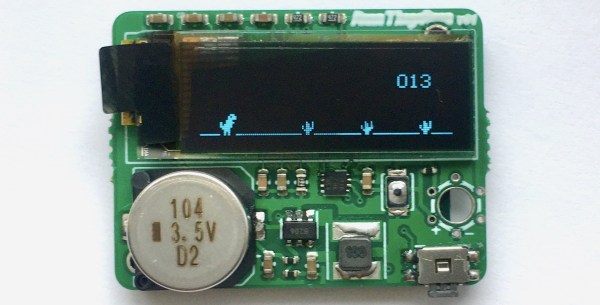
A small PCB with an OLED screen showing a Dinosaur Game

Hackaday Prize 2022: RunTinyRun Is A Fully Solar-Powered, Portable Dinosaur Game

Fully solar-powered handheld gadgets have so far mostly been limited to ultra-low power devices like clocks, thermometers and calculators. Anything more complicated than that will generally have a battery and some means to charge it. An entirely solar-powered video game console is surely out of reach. Or is it? As [ridoluc] shows, such a device is actually possible: the RunTinyRun gets all its power directly from the Sun.

To be fair, it’s not really a full-fledged game console. In fact it doesn’t even come close to the original Game Boy. But RunTinyRun is a portable video game with an OLED display that’s completely powered by a solar panel strapped to its back. It will run indefinitely if you’re playing outside on a sunny day, and if not, letting it charge for a minute or two should enable thirty seconds of play time.

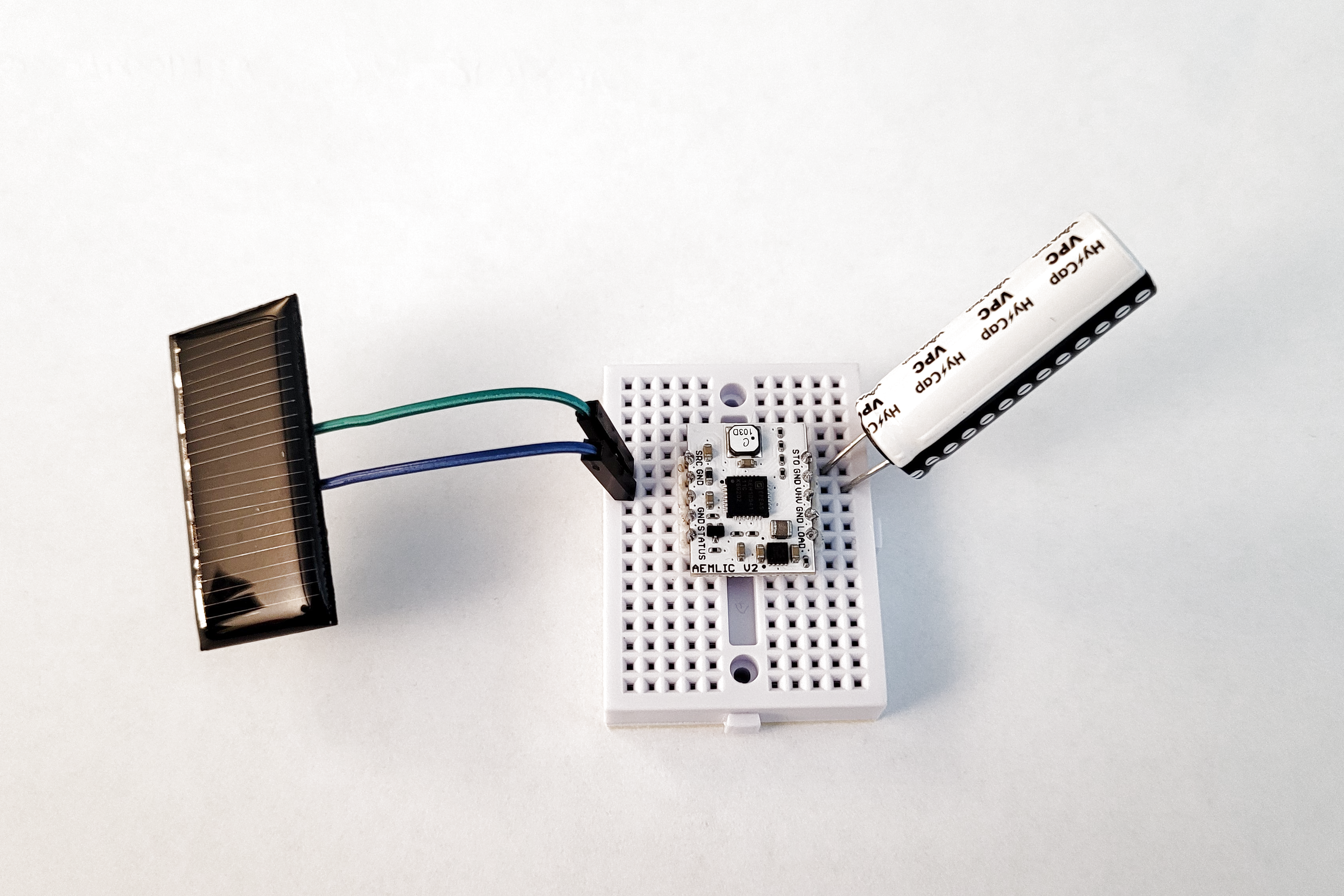
The game it runs is a clone of Google’s Dinosaur Game, where you time your button presses to make a T-Rex jump over cacti. As you might expect, the game runs on an extremely minimalist hardware platform: the main CPU is an ATtiny10 six-pin micro with just 1 kB of flash. The game is entirely written in hand-crafted assembly, and takes up a mere 780 bytes. A 0.1 farad supercap powers the whole system, and is charged by a 25 x 30 mm2 solar cell through a boost converter.

RunTinyRun is a beautiful example of systems design within strict constraints on power, code size and board area. If you’re looking for a more capable, though slightly less elegant portable gaming console, have a look at this solar-powered Game Boy.
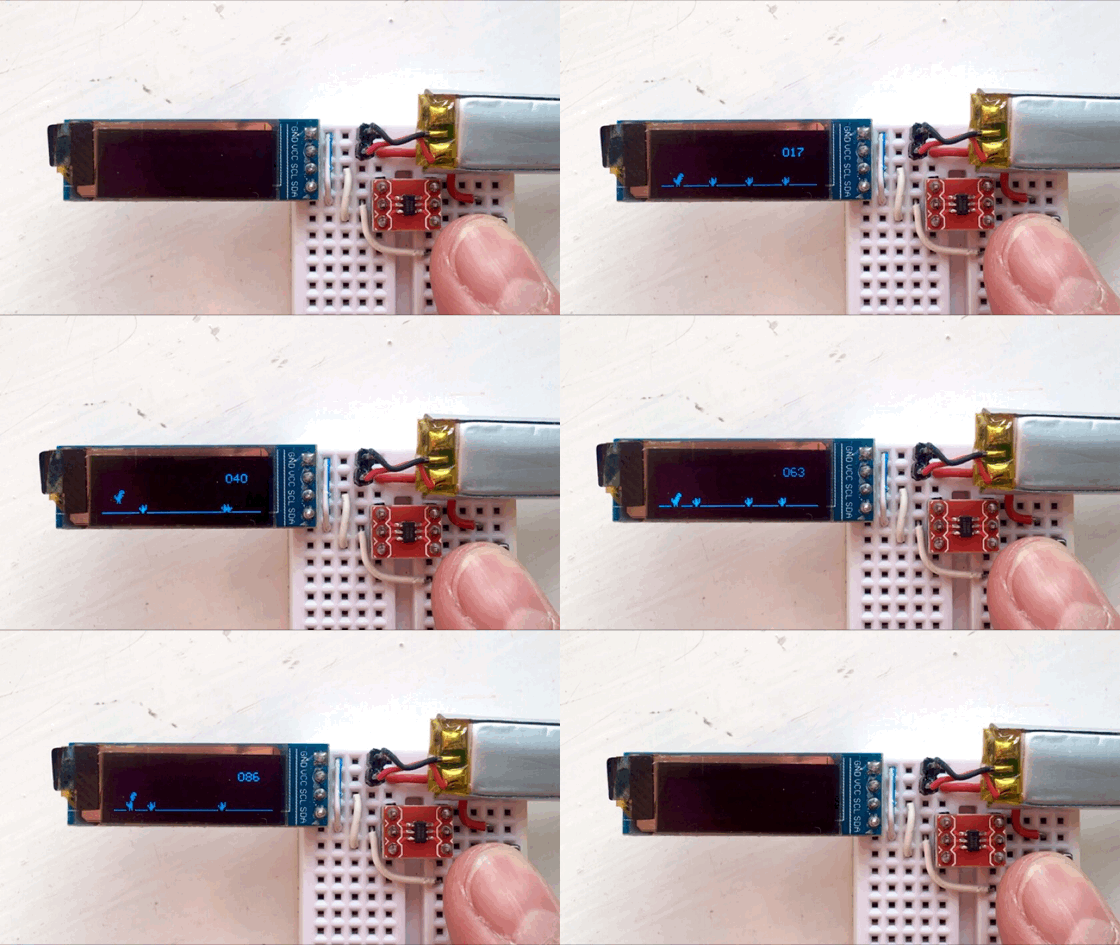
A Dinosaur Game implementation running on a breadboard setup

2022 Sci-Fi Contest: The Winners Are In

The Sci-Fi Contest closed out on Monday, and we put our heads together and picked our favorites. And it was no easy task, because in addition to many of the projects simply looking stellar, many went all-out on the documentation as well, making these stellar examples that we can all learn from, whether you’re into sci-fi or not. But who are we kidding? From the responses we got, you are.

The Winners

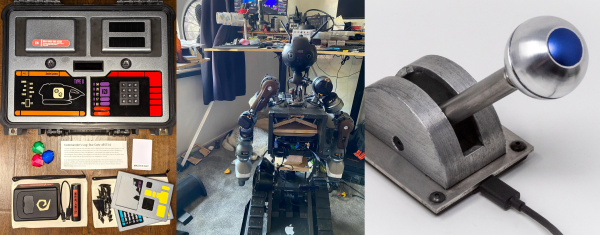
[RubenFixit]’s Star Trek Shuttle Console is a Trek themed escape room in a box. The project’s extraordinary attention to detail and exhaustive project logs absolutely won our judges heart. From the LCARS graphics to the 3D printed isolinear chip bays and mimetic crystals, it’s all there. [Ruben] estimates about 300 hours of work went into this one, and it shows.

We had no shortage of robotic projects in the contest, but [RudyAramayo]’s R.O.B. won our judges over. This one is not a joke, weighing in at over 140 lbs of custom metalwork and righteous treads. It’s also made out of some expensive hardware all around, so maybe this isn’t your weekend-build robot. We love the comment on the Arduino test code suite: “For gods sake man, you must test your code when it becomes an autonomous vehicle.”

Finally, [zapwizard]’s Functional Razor Crest Control Lever is a prop and a video game controller in one. We can totally see Grogu playing with this, and we were wowed by the attention to detail in the physical build — with custom gears and a speed limiter — as well as the attention to prop-making detail. Some parts are custom-cut stainless steel plates. 3D printed parts are covered in aluminum tape and chemically aged. Awesome. Oh yeah, it’s also a working USB joystick.

These three winners will be receiving a $150 shopping spree at Digi-Key.

Continue reading “2022 Sci-Fi Contest: The Winners Are In”

Hackaday Prize 2022: Glass Tube Solar Thermionic Converters

Typically, if you want to convert solar energy into electrical energy, you use either photovoltaic (PV) cells, or you use the sunlight to create steam to turn a turbine. Both of these methods are well-established and used regularly in both small- and grid-scale applications. However, [Nick Poole] wanted to investigate an alternative method, using thermionic converters for solar power generation.

[Nick] has been gearing up to produce various styles of vacuum tubes, and noted that the thermionic effect that makes them work could also be used to generate electricity. They are highly inefficient and produce far less power than a photovoltaic solar cell, meaning they’re not in common use. However, as [Nick] notes, unlike PV cells etched in silicon, a thermionic converter can be built with basic glassworking tools, requiring little more than a torch, a vacuum pump, and a spot welder.

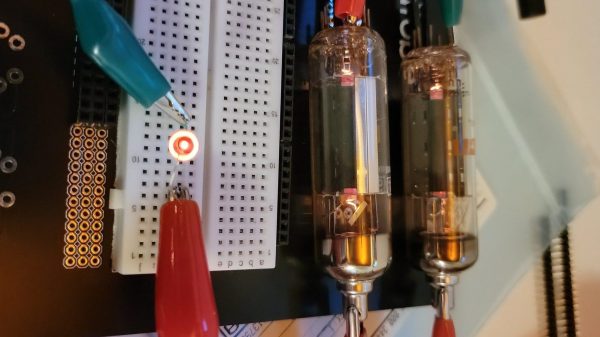
Experiments with a large lens to focus sunlight onto a 6V3A diode tube showed promise. [Nick] was able to generate half a volt, albeit at a tiny current, with the design not being optimized for thermionic conversion. Further experiments involved electrically heating a pair of diode tubes, which was able to just barely light an LED at 1.7 V and a current of 7.5 uA. The conversion efficiency was a lowly 0.00012%, around 5 orders of magnitude worse than a typical PV cell.

[Nick]’s hope is that he can produce a tube designed specifically to maximize thermionic conversion for energy generation purposes. It’s likely there is some low-hanging fruit in terms of gains to be made simply by optimizing the design for this purpose, even if the technique can’t compete with other solar generation methods.

In any case, we’re eager to see what [Nick] comes up with! We love to see makers building tubes in their own home workshops.

Continue reading “Hackaday Prize 2022: Glass Tube Solar Thermionic Converters”

2022 Hackaday Prize: Get Your Planet-Friendly Power On!

Time flies! This weekend marks the end of the first stage of the 2022 Hackaday Prize, and your chance to enter your alternative-energy projects. There are ten $500 prizes up for grabs, and there’s still time to whip up a project page over on Hackaday.io to showcase it.

In this round, we’re looking for projects that harvest their own energy — solar, wind, heat, vibration, you name it — or projects that make it easier to collect, store, or use renewable energy. Whether this is microwatts or megawatts, the scale of the project is up to you! As long as it’s using or making it easier to use clean energy, we want to see it.

So far, we’ve seen some great projects, ranging from a optimizes the tilt angle of a home solar installation to a demonstration of using a new type of lithium-ion capacitor to add solar power to smaller projects. We really love [MartMet]’s simple Bluetooth thermometer hack, which adds a supercapacitor and solar cell to an outdoor thermometer, and then uses hacked firmware to log the charge status over a year of use! We’re suckers for good data.

The sun is not the only game in town, though. There are a surprising number of projects based on human energy production in emergency situations, from cranking to shaking. Thermionic converters were new to us, but we love explorations of fringe tech. Other traditional favorites like wind and water may make more sense for larger applications. And don’t forget how you’re going to store all this juice you’ve collected.

In short, we’ve got a bunch of great entries, but we’re still missing yours! There’s no minute like the last minute: if you’ve done some work in clean or renewable energy, set yourself up a Hackaday.io project page now. You’ll help make all our projects cleaner, and stand a good chance of taking home some real money to boot!

Once we’ve handled power, the next round is “Reuse, Recycle, Revamp” where any tech that uses recycled parts or facilitates reuse, repair, or recycling is fair game!

2022 Sci-Fi Contest: Multi-Sensor Measurement System

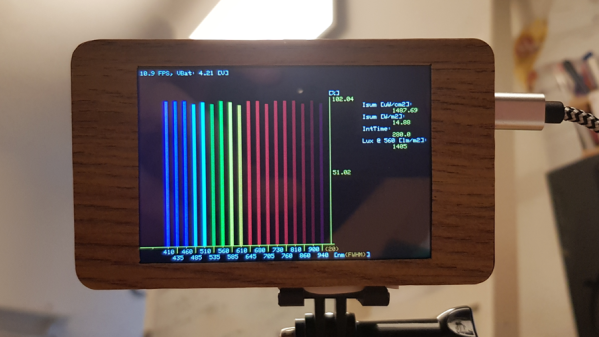
Many sci-fi movies and TV shows feature hand-held devices capable of sensing all manner of wonderful things. The µ Spec Mk II from [j] is built very much in that vein, packing plenty of functionality into a handy palm-sized form factor. 

An ESP32 serves as the brains of the device, hooked up to a 480×320 resolution touchscreen display. On board is a thermal camera, with 32×24 pixel resolution from an MLX90640 sensor. There’s also a 8×8 LIDAR sensor, too, and a spectral sensor that can capture all manner of interesting information about incoming light sources. This can also be used to determine the transmission coefficient or reflection coefficient of materials, if that’s something you desire. A MEMS microphone is also onboard for capturing auditory data. As a bonus, it can draw a Mandelbrot set too, just for the fun of it.

Future plans involve adding an SD card so that data captured can be stored in CSV format, as well as expanding the sensor package onboard. It’s a project that reminds us of some of the tricorder builds we’ve seen over the years. Video after the break.

Continue reading “2022 Sci-Fi Contest: Multi-Sensor Measurement System”

2022 Sci-Fi Contest: A Mac-Based Droid Named R.O.B.

Droids and robot assistants are still not really a part of our daily lives, even if they started showing up in movies many long decades ago. [Rudy Aramaryo] perhaps hopes that will change one day, and is pursuing this goal with their own droid build named R.O.B.

R.O.B. is quite a hefty ‘bot, weighing 140 lbs and sporting a full 80 Ah of lithium-iron-phosphate batteries for a long running time and plenty of power. For brains, R.O.B. packs in an Apple Mac Mini M1 and a Mac Studio, running OS X. It’s an unusual choice for a robot, but one that brings plenty of computing power to bear, nonetheless. Equipped with tracked propulsion, R.O.B. also features a slip-ring setup in the base allowing the droid to rotate endlessly without tangling wires.

By virtue of its size and power, R.O.B. goes a long way to emulating the general feel of the droids of the Star Wars series. It’s all about the roughly-human-scaled design, and the anthropomorphic features. Further helping the cause are a basic chat ability powered by Python, along with arms and actuators to interact with the world.

The name of this droid recalls us of the charming Nintendo console toy from the 1980s. If these aren’t the droids you’re looking for, and you’ve been hacking on ‘bots of your own, be sure to drop us a line.