A month ago General Motors announced plans to wind down production of several under-performers. At the forefront of news coverage on this are the consequences facing factories making those cars, and the people who work there. The human factor associated with the closing of these plants is real. But there is also another milestone marked by the cancellation of the Volt. Here at Hackaday, we choose to memorialize the soon-to-be-departed Chevrolet Volt. An obituary buried in corporate euphemisms is a whimper of an end for what was once their technological flagship car of the future.
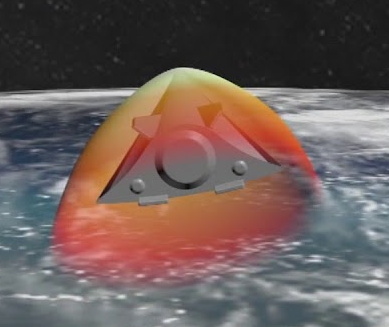
With a highly publicized test firing and pledge by President Vladimir Putin that it will soon be deployed to frontline units, Russia’s Avangard hypersonic weapon has officially gone from a secretive development program to an inevitability. The first weapon of its type to enter into active service, it’s capable of delivering a payload to any spot on the planet at speeds up to Mach 27 while remaining effectively unstoppable by conventional missile defense systems because of its incredible speed and enhanced maneuverability compared to traditional intercontinental ballistic missiles (ICBMs).
Rendering of Avangard reentering Earth’s atmosphere
In a statement made after the successful test of Avangard, which saw it hit a target approximately 6,000 kilometers (3,700 miles) from the launch site, President Putin made it clear that the evasive nature of the weapon was not to be underestimated: “The Avangard is invulnerable to intercept by any existing and prospective missile defense means of the potential adversary.” The former Soviet KGB agent turned head of state has never been one to shy away from boastful claims, but in this case it’s not just an exaggeration. While the United States and China have been working on their own hypersonic weapons which should be able to meet the capabilities of Avangard when they eventually come online, there’s still no clear deterrent for this type of weapon.
Earlier in the year, commander of U.S. Strategic Command General John Hyten testified to the Senate Armed Services Committee that the threat of retaliation was the best and perhaps only method of keeping the risk of hypersonic weapons in check: “We don’t have any defense that could deny the employment of such a weapon against us, so our response would be our deterrent force.” Essentially, the threat of hypersonic weapons may usher in a new era of “mutually assured destruction” (MAD), the Cold War era doctrine that kept either side from firing the first shot knowing they would sustain the same or greater damage from their adversary.
With President Putin claiming Avangard has already entered into serial production and will be deployed as soon as early 2019, the race is on for the United States and China to close the hypersonic gap. But exactly how far away is the rest of the world from developing an operational hypersonic weapon? Perhaps more to the point, what does “hypersonic weapon” really mean?
Insurance is a funny business. Life insurance, for example, is essentially betting someone you will die before your time. With the recent focus on companies getting hacked, it isn’t surprising that cybersecurity insurance is now big business. Get hacked and get paid. Maybe.
The reason I say maybe is because of the recent court battle between Zurich and Mondelez. Never heard of them? Zurich is a big insurance company and Mondelez owns brands like Nabisco, Oreo, and Trident chewing gum, among others.
It all started with the NotPetya ransomware attack in June of 2017. Mondelez is claiming it lost over $100 million dollars because of the incident. But no problem! They have insurance. If they can get the claim paid by Zurich, that is. Let’s dig in and try to see how this will all shake out.
2018 is almost over, and we have another year in the dataset: an improbable number of celebrities died in 2016. The stock market is down, and everyone thinks a crash is coming. Journalists are being killed around the world. Fidget spinners aren’t cool anymore. Fortnite. Trade wars.
But not everything is terrible: Makerbot released a new printer and oddly no one complained. It was just accepted that it was an overpriced pile of suck. Elon Musk is having a great year, press and Joe Rogan notwithstanding, by launching a record number of rockets and shipping a record number of cars, and he built a subway that we’re not calling a subway. FPGA development is getting easier with new platforms and new boards. There is a vast untapped resource in 18650 cells just sitting on sidewalks in the form of scooters, and I’m going to keep mentioning this until someone actually builds a power wall out of scooters.
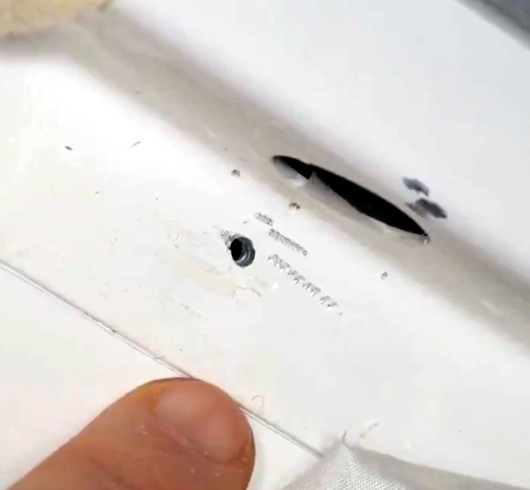
If you happened to tune into NASA TV on December 11th, you’d have been treated to a sight perhaps best described as “unprecedented”: Russian cosmonauts roughly cutting away the thermal insulation of a docked Soyuz spacecraft with a knife and makeshift pair of shears. Working in a cloud of material ripped loose during the highly unusual procedure, cosmonauts Oleg Kononenko and Sergey Prokopyev were effectively carving out their own unique place in space history. Their mission was to investigate the external side of the suspicious hole in the Soyuz MS-09 capsule which caused a loss of air pressure on the International Space Station earlier in the year.
That astronauts don’t generally climb out the hatch and use a knife to hack away at the outside of their spacecraft probably goes without saying. Such an event has never happened before, and while nobody can predict the future, odds are it’s not something we’re likely to see again. Keep in mind that this wasn’t some test capsule or a derelict, but a vehicle slated to return three human occupants to Earth in a matter of days. Cutting open a spacecraft in which human lives will shortly be entrusted is not a risk taken likely, and shows how truly desperate the Russian space agency Roscosmos is to find out just who or what put a hole in the side of one of their spacecraft.
Close inspection from the inside of the spacecraft confirmed the hole wasn’t made by an impact with a micrometeorite or tiny piece of space junk as was originally assumed. It appears to have been made with a drill, which really only allows for two possible scenarios: intentional sabotage or a mistake and subsequent cover-up. In either event, a truly heinous crime has been committed and those responsible must be found. As luck would have it the slow leak of air pressure was detected early and the hole was patched before any damage was done, but what if it hadn’t?
Picture this: it’s late in the evening on a freezing cold, dark, and windy December night in southern England, and an airport worker at Gatwick — London’s second international airport — sees something fly past in the gloom above the floodlights. The weather and darkness makes it difficult to see what the object was, but the report is phoned in to security. What was it? A flock of birds? A piece of plastic litter caught by the wind and blown through the night? In this case, the call is recorded as a drone. Because the magic D-word has been uttered, a security plan swings into action, the airport is put on a high state of readiness, and flights are suspended.
Gatwick by night, on an evening far less inclement than last week. News Oresund [CC BY 2.0].Thousands of people across the site are put on alert, watching for the drone. And of course, the drone reports roll in, and the story takes on a life of its own. People who have no idea what a drone looks like in the air are now expecting to see one, so of course when a flock of birds or a plastic bag caught by the wind crosses their peripheral vision they too are convinced that it is the drone. Night turns into day, there is a lull in the reports so the airport re-opens, only to be closed again following a fresh spate of sightings. Flights are diverted all across the country, and tens of thousands of passengers are stranded in the terminals.
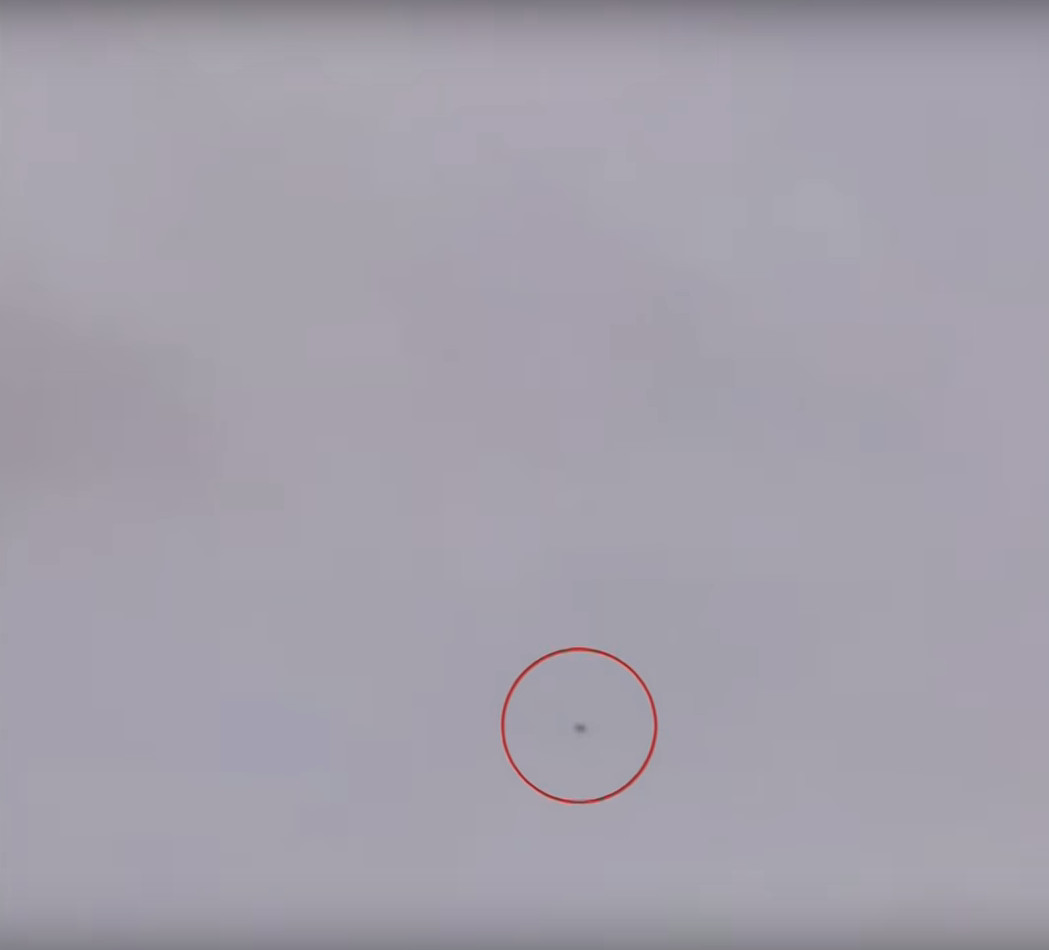
No, it’s not a speck of dirt on your screen, it’s a drone! BBC (Fair use)
There follows three days of airport closure drama. No photos emerge despite almost every one of the many thousands of people on the site having a camera phone from which they are Tweeting about the queues in the terminal. There is a grainy video, but it is indistinct, and crucially it doesn’t have anything in it that is identifiable as Gatwick. Meanwhile the police are frustrated in their search for the drone operators, who like their drone, prove difficult to pinpoint
During the third night a pair of arrests are announced, a local couple. The police have saved the day, the culprits are under lock and key. Everyone breathes a sigh of relief, the airport re-opens, and that’s the end of that. Except of course it isn’t, because inconveniently the pair are found to be blameless and released. When pressed during an interview, a police spokesman then makes the embarrassing admission that there is a possibility that there may never have been a drone at all.
You Couldn’t Make It Up
If these are the drone parts they’ve found, they’re doing it wrong. Francis Wood [CC BY-SA 3.0]You might imagine that this was the fictional plot of a thriller novel, but sadly not. All of the above is a tale of the last few days of events in the British news, save for most of the first paragraph which is our guess at how the first drone sightings may have happened. At the time of writing there remains the possibility that there could have been a drone over Gatwick, but given the current dearth of evidence it is one that seems tenuous. There are reports of drone wreckage, but since readers with long memories will recall UK police once identified RepRap parts as a 3D printed gun we’ll wait until we see it before we call it that.
If there was indeed a drone then of course we would like to see its operators brought to justice forthwith. But what concerns us at Hackaday are the implications the episode could still have for those of our community with an interest in multirotors. The usual clamour was made for Government to do something about it, and we know that would have meant a fresh set of onerous regulations for responsible multirotor owners while doing nothing about the criminals, because of course criminals have little regard for laws.
So if we are to glean anything from this sorry mess, we must examine it from several angles. Why is there a lack of drone detection technology in place? How should drone reports initially be treated and investigated on the ground? How should they be dealt with in official inquiries, and how then should lawmakers see them? This will inevitably have a British flavour to it because of the incident in question, but the points are just as valid worldwide.
When a Drone Report Comes In, We Need a Reliable Way to Evaluate It
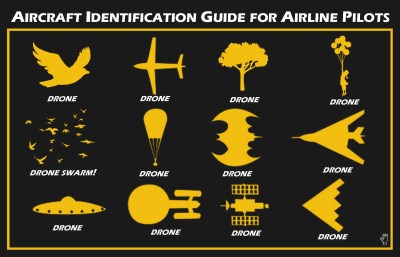
An oft-shared drone identification guide for airline pilots, of uncertain provenance (phantompilots.com).
When we are told something new, it passes a process of evaluation in our minds. We look at the source, and weigh up the story itself. If a guy with crazy hair in the street tells us that the aliens have landed and are controlling the Prime Minister with a ray gun, it will probably be discounted. But if Hackaday tells us that someone has hacked a VGA chipset to work as a software-defined radio we’re guessing most of you would be very interested indeed.
When a fresh drone incident is reported it appears that this evaluation process has historically been defective. We have previously discussed official incident reports that come with no physical evidence of a drone, but contain descriptions of drones with capabilities unmatched even by jet fighter aircraft. It seems like any eyewitness report in which the culprit is named as a drone is automatically taken at face value no matter how unlikely it may be. The fact that a report may have come from a pilot is sometimes mentioned as a boost to its credibility, but that is a false assumption. A pilot who is not familiar with either how drones appear from a distance or what the capabilities of a drone are in the air can only be considered an unreliable witness, because while they may know a lot about aircraft they lack the required expertise for this judgement. So what can be done to help boost the quality of reporting and to immediately highlight credible reports while requiring more for dubious ones?
In the case of a near miss in open airspace there may be little effect on ground-based facilities, but at an airport such as Gatwick there can be no chances taken by the authorities. A drone collision on an aircraft on final approach could cause hundreds of fatalities, so upon receipt of a report they must have had little choice but to close the runways. There appears to have been a lack of drone detection technologies in place at Gatwick which means that the only source available to the airport would have been the eyewitnesses themselves, and since we have amply demonstrated the potential for eyewitness reports being unreliable then the current confusion becomes an inevitability. It is imperative that more reliable detection technologies be fitted or developed if necessary. This is especially true when precautionary shut-downs stretch past minutes or hours into world-news-making delays as happened in this instance.
Competent Police Investigations and Responsible Journalism on Drone Reports
The mass media tech story cycle. Our apologies to Gartner. Curve image: Jeremykemp [ CC BY-SA 3.0 ]Once an incident has started and news of it emerges there is a consequent effect upon members of our community. Legitimate drone fliers away from the airport will find themselves under more scrutiny, and since it is already a common tale to hear of police being called when flying is under way that means they could face harassment and wrongful arrest. Indeed though we do not know all the details of the pair arrested near Gatwick it smacks of their being arrested in a round-up of convenient local drone enthusiasts rather than as a result of meaningful investigation. That the names of the pair were leaked and they became the subject of a media frenzy further shows the danger in which they were placed, as well as the irresponsibility of the reporters who covered their plight.
Perhaps Most Importantly: We Need Accurate Official Incident Reports
Whatever happens in a drone report, whether it be an arrest or an embarrassing debacle, there will inevitably be an official incident report from the Civil Aviation Authority, the regulator of British civilian airspace. This will form the official record of the event, and thus should strive to be as accurate as possible, but here the process falls short for the final time. There appears to be no evaluation step performed on the available evidence and no requirement for physical proof. So if an eyewitness reports behaviors about the drone that no drone ever built could possibly be capable of, it is solemnly recorded as fact. Our previous article on this subject highlights multiple such accounts, and this is an important point because as the official record these reports are what informs legislators. When they make laws pertaining to drones it is imperative that their decisions are based upon accurate evidence, and it is clear that this is not the case. Given that they will no doubt be reviewing drone legislation in the wake of this fiasco it is particularly important that the investigators consult people with specialist knowledge in the field, demand physical proof rather than heresay, and most importantly question accounts that stretch credibility.
It seems obvious that the multirotor hobbyist is caught in a perfect storm of incompetent authorities, deeply flawed investigations, shoddy journalism, and clueless legislators. This incident has laid bare some of the shortcomings, and it is to be hoped that a few lessons might be learned to produce less of a debacle surrounding future drone incidents. It is still a developing story so there may be a breakthrough and the whole narrative will change, and if that turns out to be the case then we hope they find the correct perpetrator this time and send them away at Her Majesty’s pleasure for a very long time. We’re guessing though that every effort will be made to push it as far under the carpet as possible to save red faces among officialdom. As multirotor enthusiasts we must keep the issue of poor investigation alive though, for if we let it be buried once more it will come back to trouble us again.
Despite the fact that the United States and China are currently in the middle of a 90-day “cease fire” in their ongoing trade war, with new tariffs on hold until March 2019 while the two countries try to reach agreement, not everyone is waiting around to see who comes out on top. In a recent press release, action camera manufacturer GoPro has announced their intention to move some production out of China in the face of potential tariff expansions; which many analysts fear will be the result of the current stalemate. That’s right, only some of their production is moving.
“We’re proactively addressing tariff concerns by moving most of our US-bound camera production out of China,” says GoPro CFO Brian McGee. “We believe this diversified approach to production can benefit our business regardless of tariff implications.” Reading his words carefully, the key phrase here is “diversified approach”. GoPro doesn’t intend to move their entire production capability out of China, but only the production of the cameras which are designated for importation into the United States. GoPro models which are to be sold to other parts of the world will still be made in China.
This might seem an extravagant move just to avoid US tariffs, but with better than 40% of GoPro’s revenue for the third quarter of 2018 coming from the Americas, the company stands to be hit hard by the proposed 25% tax. Combined with the fact they shuttered their drone division last year citing “an extremely competitive aerial market”, and the proliferation of “GoPro clones” available for pennies on the dollar, it seems pretty clear that belt-tightening is the name of the game for the company that was once synonymous with action cameras.







![Gatwick by night, on an evening far less inclement than last week. News Oresund [CC BY 2.0].](https://hackaday.com/wp-content/uploads/2018/12/Gatwick_Norwegian_2015mar27_0007_16333812524.jpg)
![If these are the drone parts they've found, they're doing it wrong. Francis Wood [CC BY-SA 3.0]](https://hackaday.com/wp-content/uploads/2018/12/1280px-Dunn_Chanter__Drones_Chantry.jpg?w=400)
![The mass media tech story cycle. Our apologies to Gartner. Curve image: Jeremykemp [ CC BY-SA 3.0 ]](https://hackaday.com/wp-content/uploads/2016/04/media-tech-cycle-800px1.png)