China’s first space station, Tiangong-1, is expected to do an uncontrolled re-entry on April 1st, +/- 4 days, though the error bars vary depending on the source. And no, it’s not the grandest of all April fools jokes. Tiangong means “heavenly palace”, and this portion of the palace is just one step of a larger, permanent installation.
But before detailing just who’ll have to duck when the time comes, as well as how to find it in the night sky while you still can, let’s catch up on China’s space station program and Tiangong-1 in particular.
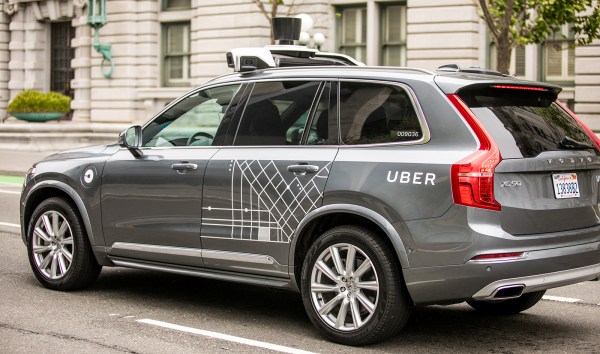
You have doubtlessly heard the news. A robotic Uber car in Arizona struck and killed [Elaine Herzberg] as she crossed the street. Details are sketchy, but preliminary reports indicate that the accident was unavoidable as the woman crossed the street suddenly from the shadows at night.
If and when more technical details emerge, we’ll cover them. But you can bet this is going to spark a lot of conversation about autonomous vehicles. Given that Hackaday readers are at the top of the technical ladder, it is likely that your thoughts on the matter will influence your friends, coworkers, and even your politicians. So what do you think?
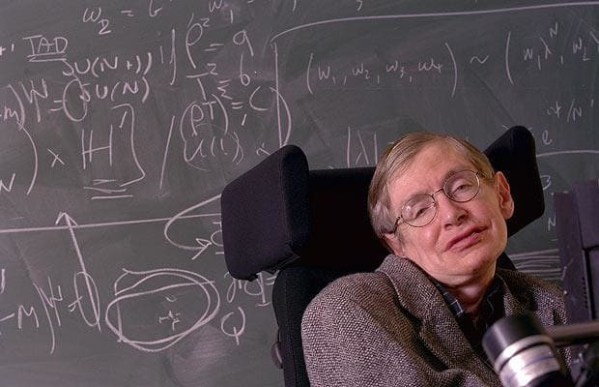
We are saddened by the passing of physicist Stephen Hawking. One of the great minds of our time, Hawking’s work to apply quantum theory to black holes launched his career and led to his best known theoretical discovery that black holes emit radiation, aptly known as Hawking radiation.
Thinking back on Stephen Hawking’s contributions to humanity, it strikes us that one of his most important is his embrace of pop culture. While his scientific discoveries and writings are what will stand the test of time, in our own age it is remarkable that Stephen Hawking is a household name around the world.
Hawking’s first book, A Brief History of Time, has sold more than 10 million copies and for many readers was their introduction into the way physicists view space and time. It was written for general consumption and not reserved for those who were already bathed in the jargon of theoretical physics. It sent the message that contemplating science is something that is fun to do in your spare time. This work continued with his more recent mini-series Into the Universe with Stephen Hawking created for the Discovery Channel.
A fan of the series, Hawking appeared in an episode of Star Trek: The Next Generation in 1993 and made subsequent, often repeat, appearances on The Simpsons, Futurama, and The Big Bang Theory. This was great fun for all science geeks who knew of his work, but it has a far more profound effect of normalizing interaction with a world-class scientist. Appearing on these shows told the story that the pursuit of knowledge is cool.
Having scientists in the public light is crucial to research and advancement. It lets the general public know what kind of frontiers are being pursued, and why that matters. This trickles both up and down, inspiring the next generation of scientists by introducing deep topics at an early age, and ensuring funding and opportunities for this upcoming wave of researchers has widespread support.
Stephen Hawking showed us some incredibly complicated secrets of the cosmos both through his discovery, and through his ambassadorship of scientific knowledge. He will be greatly missed but leaves behind an admirable legacy which we can all strive to live up to.
Today is March 14th, or Pi Day because 3.14 is March 14th rendered in month.day date format. A very slightly better way to celebrate the ratio of a circle’s circumference to its diameter is July 22nd, or 22/7 written in day/month order, a fractional approximation of pi that’s been used for thousands of years and is a better fit than 3.14. Celebrating Pi Day on July 22nd also has the advantage of eschewing middle-endian date formatting.
But Pi Day is completely wrong. We should be celebrating Tau Day, to celebrate the ratio of the circumference to the radius instead of the diameter. That’s June 28th, or 6.283185…. Nonetheless, today is Pi Day and in the absence of something truly new and insightful — we’re still waiting for someone to implement a spigot algorithm in 6502 assembly, by the way — this is a fantastic opportunity to discuss something tangentially related to pi, the history of mathematics, and the idea that human knowledge builds upon itself in an immense genealogy stretching back to the beginning of history.
This is our Pi Day article, but instead of complaining about date formats, or Tau, we’re going to do something different. This is how you approximate pi with the Monte Carlo method, and how anyone who can count to a million can get a better approximation of one the fundamental constants of the Universe than Archimedes.
New York City’s L train carries about 400,000 passengers a day, linking Manhattan and Brooklyn and bringing passengers along 14th Street, under the East River, and through the neighborhoods of Williamsburg, Bushwick, Ridgewood, Brownsville, and Canarsie. About 225,000 of these passengers pass through the Canarsie Tunnel, a two-tube cast iron rail tunnel built below the East River between Manhattan and Brooklyn in 1924. Like many other New York City road and subway tunnels, the Canarsie Tunnel was badly damaged when Hurricane Sandy’s storm surge inundated the tubes with million of gallons of salt water. Six years later, the impending closure of the tunnel is motivating New Yorkers to develop their own ambitious infrastructure ideas.
On February 22nd, a Falcon 9 rocket lifted off from Vandenberg Air Force Base in California and successfully delivered into orbit an Earth-observation satellite operated by the Spanish company Hisdesat. Compared to the media coverage received by the launch of the Tesla-laden Falcon Heavy earlier in the month, this mission got very little attention. But that’s hardly surprising. With respect to Hisdesat, the payload this time around was not terribly exciting, and even the normally dramatic landing of the Falcon 9’s first stage was skipped in favor of simply allowing the booster to crash into the ocean.
As far as SpaceX launches go, this one was about as low-key as they come. It wouldn’t be a surprise if this is the first time some readers are even hearing about it. But while it didn’t invoke the same media circus as the images of a spacesuit-wearing mannequin traveling into deep space, there was still a historic “first” performed during this mission.
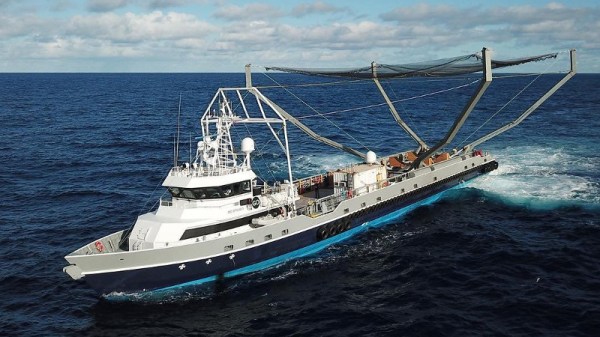
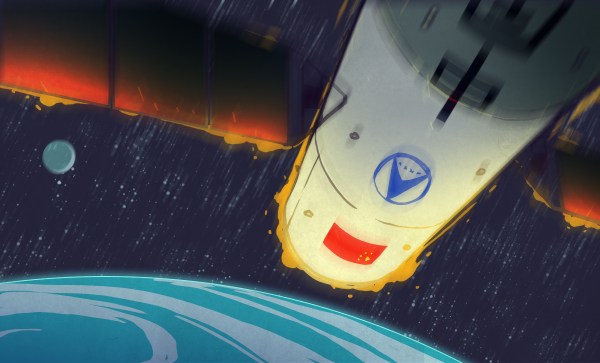
In an effort to increase the re-usability of the Falcon 9 booster, SpaceX attempted to catch the payload fairing (essentially a large protective nose cone) with a huge net as it fell from space. The most interesting thing about this new chapter in the quest for a fully reusable rocket system is that while SpaceX is generally considered to be pioneers in the world of bringing hardware back from space, this particular trick dates all the way back to the 1960’s.
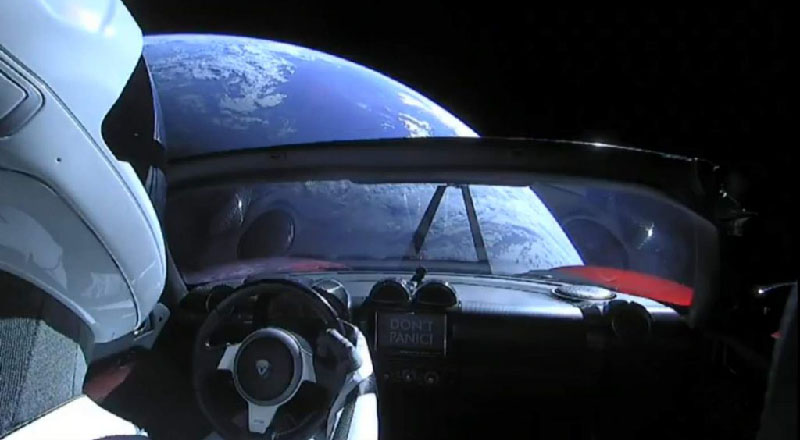
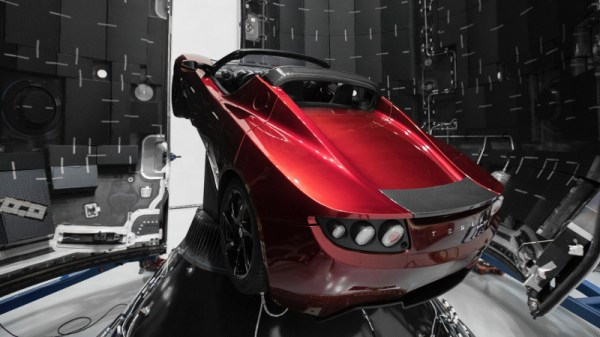
We’ve been having a lively discussion behind the scenes here at Hackaday, about SpaceX’s forthcoming launch of their first Falcon Heavy rocket. It will be carrying [Elon Musk]’s red Tesla Roadster, and should it be a successful launch, it will place the car in an elliptical orbit round the Sun that will take it to the Martian orbit at its furthest point.
On one hand, it seems possible that [Musk]’s sports car will one day be cited by historians as the exemplar of the excesses of the tech industry in the early 21st century. After all, to spend the millions of dollars required to launch the largest reusable space launch platform ever created, and then use it to hurl an electric vehicle into orbit round the Sun seems to be such a gratuitous waste of resources, an act of such complete folly as to be criminal.
Surely even given that there is a reasonable chance of a first launch ending in fiery destruction it must be worth their while canvassing the universities and research institutions of the world with the offer of a free launch, after all there must be a significant amount of science that would benefit from some cost-free launch capacity! It seems a betrayal of the famous “Why explore space” letter from the associate science director of NASA to a nun who questioned the expenditure while so many in the developing world were starving.
Testing
But on the other hand, first launches of rockets are a hazardous endeavour, as the metaphorical blue touchpaper is lit on the world’s largest firework for the first time. Satellites are expensive devices, and it would be a foolhardy owner who entrusted their craft to a launch vehicle with a good chance of a premature splashdown.
Launch of first Arianne 5. Not where you want your pricey satellite.
First launches traditionally carry a ballast rather than a payload, for example NASA have used tanks of water for this purpose in the past. SpaceX has a history of novelty payloads for their test launches; their first Dragon capsule took a wheel of cheese into space and returned it to Earth. We picture Musk looking around a big warehouse and saying, “well, we got a lot of cars!”
There is a fascinating question to be posed by the launch of the car, just what did they have to do to it to ensure that it could be qualified for launch? Satellite manufacture is an extremely exacting branch of engineering, aside from the aspect of ensuring that a payload will work it must both survive the launch intact and not jeopardise it in any way. It’s safe to say that the Roadster will not have to function while in orbit as the roads of California will be far away, but cars are not designed with either the stresses of launch or the transition to zero gravity and the vacuum of space in mind. Will a glass windscreen originally specified for a Lotus Elise on the roads of Norfolk shatter during the process and shower the inside of the craft with glass particles, for example? There must have been an extensive space qualification programme for it to pass, from vibration testing through removal of any hazards such as pressurised gases or corrosive chemicals, if only the folks at SpaceX would share some its details that would make for a fascinating story in itself.
Space Junk
So the Tesla Roadster is a huge publicity stunt on behalf of SpaceX, but it serves a purpose that would otherwise have to have been taken by an unexciting piece of ballast. It will end up as space junk, but in an orbit unlikely to bring it into contact with any other craft. If its space-suited dummy passenger won’t be providing valuable data on the suit’s performance we’d be extremely surprised, and when it is finally retrieved in a few centuries time it will make a fascinating exhibit for the Smithsonian.
Given a huge launch platform and the chance to fill it with a novelty item destined for orbit,the Hackaday team stepped into overdrive with suggestions as to what might be launched were they in charge. They varied from Douglas Adams references such as a heart of gold or a whale and a bowl of petunias should the rocket abort and the payload crash to earth, to a black monolith and a few ossified ape remains to confuse space historians. We briefly evaluated the theory that the Boring Company is in fact a hiding-in-plain-sight construction organisation for a forthcoming Evil Lair beneath the surface of Mars, before concluding that maybe after all the car is a pretty cool thing to use as ballast for a first launch.
It may be reaching towards seven decades since the first space programmes successfully sent rockets beyond the atmosphere with the aim of exploration, but while the general public has become accustomed to them as routine events they remain anything but to the engineers involved. The Falcon Heavy may not have been developed by a government, but it represents every bit as astounding an achievement as any of its predecessors. Flinging an electric vehicle into orbit round the Sun is a colossal act of showmanship and probably a waste of a good car, but it’s also more than that. In hundreds of years time the IoT devices, apps, 3D printers, quadcopters or whatever else we toil over will be long forgotten. But there will be a car orbiting the Sun that remains a memorial to the SpaceX engineers who made its launch possible, assuming it doesn’t blow up before it gets there. What at first seemed frivolous becomes very cool indeed.

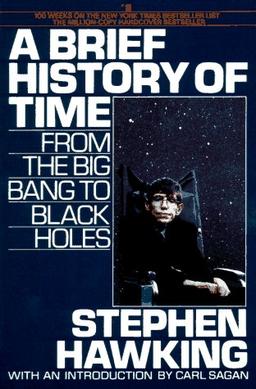 Hawking’s first book, A Brief History of Time, has sold more than 10 million copies and for many readers was their introduction into the way physicists view space and time. It was written for general consumption and not reserved for those who were already bathed in the jargon of theoretical physics. It sent the message that contemplating science is something that is fun to do in your spare time. This work continued with his more recent mini-series Into the Universe with Stephen Hawking created for the Discovery Channel.